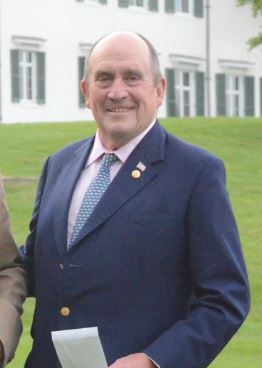
C. Martin Wood, III, MFH / Nancy Kleck photoFoxhounds weren’t the only newsmakers at the Virginia Foxhound Show. A few people were worth noting as well!
Huntsmen’s Room
Three individuals were introduced for induction into the Huntsmen’s Room of the Museum of Hounds and Hunting in ceremonies on Saturday evening. Before dinner under the tent, Jake Carle, ex-MFH, spoke eloquently, reverently, and at the right times humorously about the three men who have hunted hounds with distinction for many years: C. Martin Wood, III, MFH, Live Oak Hounds (FL), G. Marvin Beeman, MFH, Arapaho Hunt (CO), and the late Jim Atkins who hunted hounds for the Piedmont Fox Hounds, Old Dominion Hounds, and the Warrenton Hunt, all in Virginia.
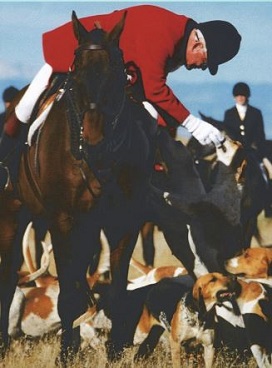
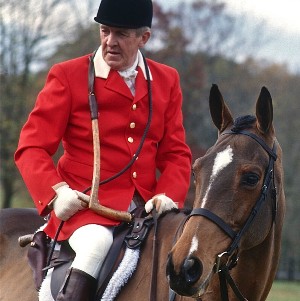
G. Marvin Beeman, MFH Huntsman Jim Atkins
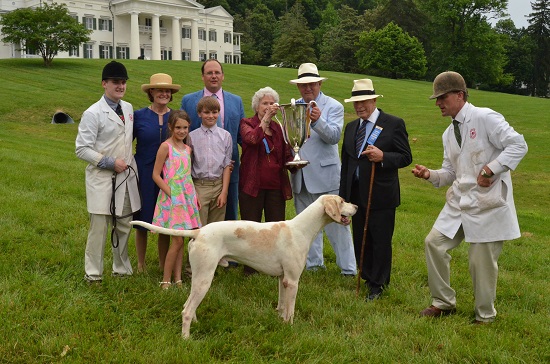
Midland Striker 2015 captures the William W. Brainard, Jr. Perpetual Cup on the lawn in front of the Morven Park mansion. Midland huntsman Ken George holds Striker's attention as three generations of Lamptons and Hardaways gather to accept the trophy from Virginia Foxhound Club President Joan Jones. Dr. John W.D. McDonald, MFH (lapel ribbon) judged this final class of the day. / Nancy Kleck photo
With six hundred foxhounds from thirty-seven hunts showing in five separate rings at the Virginia Foxhound Show at Morven Park on Sunday, May 29, 2016, the hour gets late before the four individual division champions—American, Crossbred, English, and Penn-Marydel foxhounds—finally get their chance to face off for the William W. Brainard Jr. Perpetual Cup designating the Grand Champion of Show.
The hour arrived, somewhere around six p.m., as four handsome champions came together before Dr. John W.D. McDonald, MFH, judge of this prestigious class. It had been a long, hot, and tiring day for everyone—spectators, judges, handlers, and hounds alike. But one foxhound looked like he was still ready and happy to run from one end of the field to the other, which he did when asked to show his movement. With long, powerful, yet graceful strides that looked like a slow-motion camera had been set up just for him, Midland Striker made his statement and would not be denied.
“He is one of the most beautiful movers anyone could expect to see,” said Judge McDonald in admiration. “And he has perfect conformation.”
Martha wrote this story after studying the unpublished manuscript, The Life of an American Sportsman: Being Reminiscences by Harry Worcester Smith, during the course of her 2016 John H. Daniels Fellowship at the National Sporting Library & Museum in Middleburg, Virginia. (Part I was published last month.)
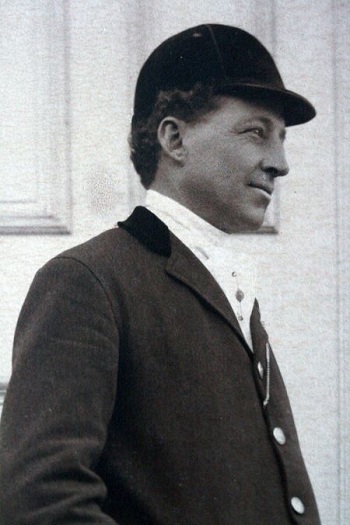
Harry Worcester Smith in hunting attire, circa 1910, from the Harry Worcester Smith Archive (MC0041), National Sporting Library & Museum.Undeterred by his spills the spring and summer of 1900, and against everyone’s advice, Harry entered The Cad in the $10,000, three-and-a-half mile Champion Steeplechase at Morris Park (in what is now The Bronx, NY), Saturday, October 6, 1900. Ollie Ames met him at the clubhouse that Saturday morning.
“You are not going to run The Cad are you?” Harry recalls Ollie saying. “He’ll break your neck!” Next, Mr. B. F. Clyde of Philadelphia admonished him, “Now, look here, Harry Smith, I have seen you ride a great many times around New York, Philadelphia and Saratoga; I have the greatest admiration for you as a sportsman, in fact I am very fond of you. Now, Please don’t take your life in your hands and ride The Cad today against all those professionals.” It seems Mr. Clyde had his money on another horse; Harry thanked the man and walked away. “Then, about noon,” Harry writes, “a Western Union boy came up and handed me a telegram. It was from Mrs. Smith: ‘Don’t ride, get best professional possible. Signed, ‘Mildred.’”
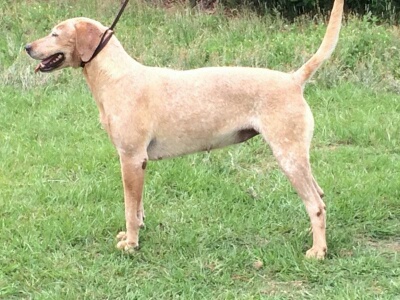
Why Worry Hounds' Heythrop Rachel 2011 is Grand Champion of the 2016 Carolinas Hound Show.
Why Worry’s Heythrop Rachel 2011 was judged Grand Champion at the fortieth annual Carolinas Hound Show held at the Springdale Racecourse in Camden, South Carolina on May 7, 2016. It’s one thing for a visiting MFH to pick up a nice draft to bring back to the home kennels; it’s another thing entirely to know what to do with it. Here’s where George and Jeannie Thomas, MFHs, Why Worry Hounds (SC), showed their breeding acumen.
While visiting friends in England and judging a puppy show at the Heythrop kennels, George mentioned that he needed a bi*ch* to introduce new bloodlines into his breeding program. We have just the hound for you, he was told. So he brought home a nicely-bred entered bi*ch, Heythrop Rachel 2011.
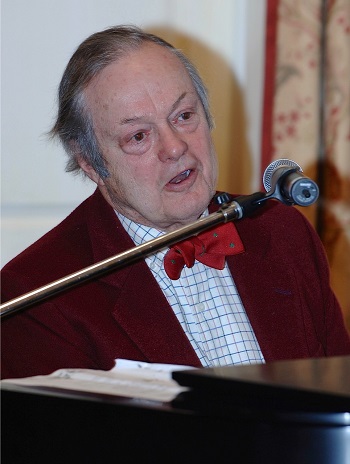
Bill Backer, singing one of his foxhunting ditties while accompanying himself at the keyboard, at the National Sporting Library & Museum. / Douglas Lees photoWilliam M. Backer, a foxhunting man who put phrases and tunes on the lips of people in every corner of the globe, died in Warrenton, Virginia on Friday, May 13, 2016, after a short illness.
A member of the Advertising Hall of Fame, Bill Backer created iconic advertising campaigns such as the 1971 Coca Cola commercial featuring his jingle, "I'd like to Teach the World to Sing." Click for a televised clip of Bill being interviewed for and playing what is arguably the most famous commercial of all time.
Bill added “Miller Time" to the language of those who needed a substitute for “cocktail hour” and created the long-running television argument for Miller Lite: “Tastes Great; Less Filling,” one of the best-liked campaigns in the history of advertising. For Campbell Soup, he persuaded customers that "Soup is good food."
Bill was a longtime member of the Orange County Hunt (VA) and served on the Board of Stewards for fifty years, part of that time as President. At his Smitten Farm in The Plains, Virginia he bred and raised racehorses and was an active member of the Jockey Club and the Virginia Thoroughbred Association.
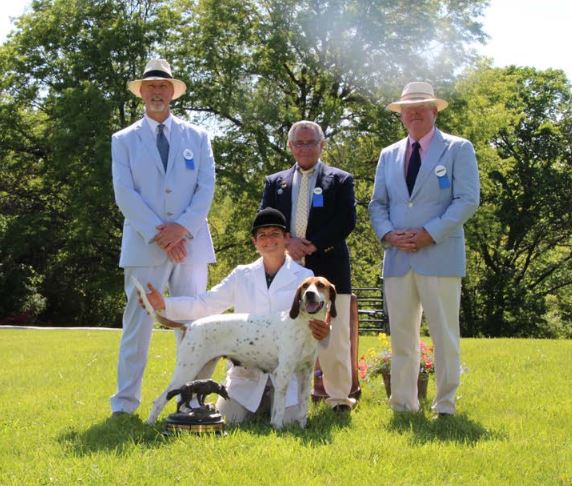
Fort Leavenworth Vixen, Grand Champion of Show, handled by Stephanie Wilcox Carter, MFH and huntsman. Judge Vincent Tartaglia is standing (middle). / Angela Fain photo
Last year was the boys’ year. This year the Crossbred female, Fort Leavenworth Vixen 2013, evened the score with her littermate Valor by winning the Grand Championship at the Central States Hound Show.
Vixen is a speckled, mostly white tricolor by Brazos Valley Baxter ‘08 out of Fort Leavenworth Piper ‘07. American and Crossbred bloodlines are predominantly from Fort Leavenworth Hunt (KS), Brazos Valley Hounds (TX), and the Piedmont Fox Hounds (VA). The most recent contribution of pure English blood to this lovely Crossbred was from the Arapahoe Hunt kennels (CO), three generations back.
Stephanie Wilcox Carter, MFH and huntsman of the Fort Leavenworth pack describes Vixen as conformationally correct, happy, and unflappable.
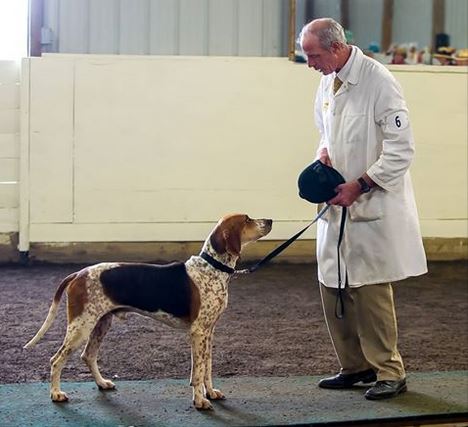
Myopia Gammell '12, a proud son of Potomac Jefferson '05, shown by huntsman Philip Headdon, was judged Grand Champion of the 2016 New England Hound Show. / Photo by Nature of Light Photography
Myopia Gammell 2012 is the second foxhound this season carrying the blood of the inimitable Potomac Jefferson to be named a Grand Champion of Show, this at the New England Hound Show held on Sunday, May 1, 2016.
Gammell was bred by now-retired huntsman Larry Pitts at Potomac, and drafted unentered to huntsman Tony Gammell at the Keswick Hunt (VA) in exchange for another breeding. Tony in turn drafted the still unentered pup to his pal, Brian Kiely, then huntsman at the Myopia Hunt (MA), who named the hound for Tony. Brian, of course, is now huntsman at Potomac, so that completes another circle, entirely!

With the kind permission of the author, here is the first chapter of The Great Hound Match of 1905 by Martha Wolfe. The Library of Virginia has selected Martha’s work as a potential Best Book of 2016 in the Non-Fiction category. Readers may cast their votes by clicking here.
A. Henry Higginson, MFH, Middlesex Hunt, in derby and spats with huntsman Robert Cotesworth and his imported English foxhounds of the period. / Courtesy, National Sporting Library and Museum
Storytellers claim that there is really only one story in the world: “A Stranger Comes to Town.” In this case, two strangers came to two towns in Virginia bringing with them their separate entourages—private train loads of friends and their horses, trunks of tack, boots, formal and informal clothing, food and wine, servants and of course their hound dogs. Neither Middleburg nor Upperville, Virginia, had seen the likes since J. E. B. Stuart established his headquarters at the Beverage House (now the Red Fox Inn) in Middleburg during the Gettysburg Campaign. Alexander Henry Higginson of South Lincoln and Harry Worcester Smith of Grafton, Massachusetts had determined that the Loudoun Valley in Virginia’s pastoral Piedmont was the best place to prove the relative worth of their chosen foxhounds.
It was November of 1905, the peak of foxhunting season across the Midlands of England and up and down the east coast of North America and these folks had come south from already snow-covered New England to the relatively mild winter in Virginia to hunt her plentiful red foxes. There was to be a contest, a Great Hound Match, between two packs of foxhounds, one English and one American. The English hounds carried, on their great stout forearms and deep chests, the monumental weight of centuries of foxhunting in England and were expected to make their hound dog ancestors proud of their New World conquest. The American hounds were expected to show those stodgy old Brits how it was done over here—with spunk and intuition, individuality, drive and nerve. Of course the dogs just wanted to chase a fox or two; it was their Masters who loaded the poor hounds and The Match, this moment in history, with the weighty question of worth.
Back in the late 1950s, Deirdre and her friend Sarah, both just nineteen, came to America. The pair had left Britain, where post-war ration books were still in use. Sarah was to train horses and riders for Jamie Kreuz at Bryn Mawr Farms outside Philadelphia. Deirdre was to work for the Insurance Company of North America in Philadelphia and help Sarah on weekends. What follows is Part III of their adventures, which have included Part I: “How to Bridle a Green Field Hunter,” and Part II: “The Witch With Warts.”
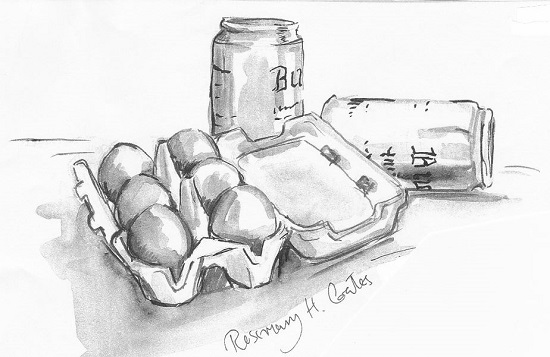
Illustration by Rosemary Coates
We had not been long in the States when Pink Gin arrived at Bryn Mawr Farms. Billy, who mucked out for us, was, as usual, the first to find fault with him.
“He do get drunk, he do. Proper beer-swiller he be. And he eats eggs and molasses with all his feed. Lord, if only I could eat like that!”
Pink Gin (not his real name) was a timber horse with a record of wins. Since most timber racing is in the spring, pre-season training often means blizzards and temperatures averaging ten degrees Fahrenheit. This was one of the reasons for the high-calorie diet that included beer and eggs.
George A. "Frolic" Weymouth, visionary conservationist, philanthropist, artist, and sportsman, died on April 24, 2016. In 1967, Weymouth and two friends purchased two parcels of land in Chadds Ford, Pennsylvania totaling forty-seven acres that were threatened with industrial development. That act of preservation marked the start of the organization that was to become the Brandywine Conservancy. That conservancy, led by Weymouth, and the nearby Mr. Stewart’s Cheshire Foxhounds, led by Mrs. John B. Hannum, MFH, saved the Cheshire hunting country when the King Ranch was sold off. Their success served as a model and inspiration for other conservation-minded foxhunting clubs across North America to preserve their open space and educate their juniors.
Today, the Brandywine Conservancy is one of the leading land trusts in country, with 62,000 acres of land permanently protected in Pennsylvania and Delaware. Weymouth received the MFHA/Chronicle of the Horse Conservation Award in 2013, just one of numerous other awards received for his contributions to land preservation and the arts.