With the kind permission of the author, here is the first chapter of The Great Hound Match of 1905 by Martha Wolfe. The Library of Virginia has selected Martha’s work as a potential Best Book of 2016 in the Non-Fiction category. Readers may cast their votes by clicking here.
 A. Henry Higginson, MFH, Middlesex Hunt, in derby and spats with huntsman Robert Cotesworth and his imported English foxhounds of the period. / Courtesy, National Sporting Library and Museum
Storytellers claim that there is really only one story in the world: “A Stranger Comes to Town.” In this case, two strangers came to two towns in Virginia bringing with them their separate entourages—private train loads of friends and their horses, trunks of tack, boots, formal and informal clothing, food and wine, servants and of course their hound dogs. Neither Middleburg nor Upperville, Virginia, had seen the likes since J. E. B. Stuart established his headquarters at the Beverage House (now the Red Fox Inn) in Middleburg during the Gettysburg Campaign. Alexander Henry Higginson of South Lincoln and Harry Worcester Smith of Grafton, Massachusetts had determined that the Loudoun Valley in Virginia’s pastoral Piedmont was the best place to prove the relative worth of their chosen foxhounds.
It was November of 1905, the peak of foxhunting season across the Midlands of England and up and down the east coast of North America and these folks had come south from already snow-covered New England to the relatively mild winter in Virginia to hunt her plentiful red foxes. There was to be a contest, a Great Hound Match, between two packs of foxhounds, one English and one American. The English hounds carried, on their great stout forearms and deep chests, the monumental weight of centuries of foxhunting in England and were expected to make their hound dog ancestors proud of their New World conquest. The American hounds were expected to show those stodgy old Brits how it was done over here—with spunk and intuition, individuality, drive and nerve. Of course the dogs just wanted to chase a fox or two; it was their Masters who loaded the poor hounds and The Match, this moment in history, with the weighty question of worth.
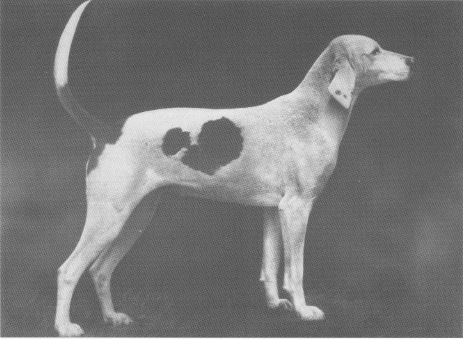 Harry Worcester Smith’s ideal American foxhound, c. 1909 / Courtesy, National Sporting Library and Museum
The proverbial spark that struck The Match came in the form of a letter to the editors of Rider and Driver dated January 21st, 1905 from Harry Worcester Smith, a self-made millionaire, owner and operator of a cotton manufacturing plant in booming Worcester, Massachusetts, who liked to say that he did everything, he lived, “For the Sake of Sport in America.” Smith’s letter stated his dual intentions: first to ask his venerable old hunting club, the “Brunswick Fur Club” base in Brunswick, Maine, to change its name to the “Brunswick Foxhound Club;” and second to have the club adopt a new standard for the American foxhound. The significance of the first, was to change the public’s perception of the club from one of trapping and shooting defenseless animals to that of a prestigious club of foxhunters, specifically those who did so from the back of a horse with a pack of hounds. If the Brunswick Foxhound Club were to adopt a new standard and press the American Kennel Club to do so, the impact of the second rule change would be to officially recognize the American foxhound, distinct from pure and half-bred imported hounds from England, making it possible for hounds bred and raised in America to compete against one another in field and bench trials rather than against their very different cousins from across the way.
In his letter to Rider and Driver Harry Worcester Smith advocated “a new standard for the American foxhound.” He believed that the smaller boned, leaner, tougher Southern hound bred for running the Appalachian foothills was better than the larger, bigger-boned English hound at finding and killing American foxes, “which is the crowning point of all.” Smith never imagined small things; his efforts were usually universal, practically biblical. His goal, beginning in 1904, was to establish an American foxhound that could chase the Brits from American soil once and for all.
The editors printed (coincidentally?) in that same issue a letter from Alexander Henry Higginson telling the sporting world at large that he had recently received a draft of hounds from England and claiming that they would clearly benefit not only his own hunting, but that of all of North America, due to their excellent lineage. A friend of Higginson’s, Julian Ingersoll Chamberlain using the nom de plume “Lincoln,” also wrote a letter reiterating Higginson’s confidence, saying that Middlesex Hunt’s new stallion hound “Visitor”(1899) by the Milton “Redcar” (1890) out of Belvoir “Vigilance”(1895) had all the qualities “essential to prevent the tendency of thoroughbred English hounds to deteriorate in bone after a few generations in America.” “Lincoln” went on to label the “so-called American hound…weedy and chance-bred.”
Here were A. Henry Higginson, and his friend “Lincoln,” deriding the very thing that Harry Worcester Smith believed was the key to great sport in America. Smith had many friends in Fauquier and Loudoun Counties in Virginia where he had been invited to hunt, beginning in 1889, with the Dulany family in Upperville. With the help of Burrell Frank Bywaters, a hound breeder in Warrenton, Virginia, Smith had begun to assemble a pack of American-bred hounds that he believed would be able to run down and kill the red fox that had so-far, in his opinion, eluded the British imports. When he read Higginson’s and Lincoln’s opinion of his championed hound, he must have spit his soup.
What better way to sell a newspaper? The editors of Rider and Driver essentially acted as seconds in the duel of words that ensued the winter of 1904 and through the spring of 1905 between Smith and Higginson:
Higginson: “The truth of the matter is, there is no American foxhound to-day.”
Smith: “That those who have only in the past twenty-four months graduated from hunting foot beagles, still believe in the English hounds, I am not surprised.”
Lincoln: “Surely if we cherish fond hopes of a future standard for the foxhound in America, we shall not, as sensible men breed to this type.”
Smith: “As he is a member of the Middlesex Hunt Club, I refuse to converse with ‘Lincoln’ further.”
Higginson: “What Mr. Smith wants, what we all want, is a hound that will kill foxes in America. How to get it? Mr. Smith suggests turning to a lighter hound. Why not take the English standard?”
Smith: “The English breeders are the best in the world, and they have produced a type which is without a doubt absolutely satisfactory for use in their own country, but when they cannot show sport here, as Graham [Joseph A., author of The Sporting Dog] puts it, “they drop into the discard.”
Within weeks—two weeks of bickering, chest pounding, false modesty and outright bragging from both camps—Higginson writes, “Finally I am ready to make an offer:”
“Let Mr. Smith choose a judge, let me choose a judge, let the two name a third.
Then let Mr. Smith go to any fair fox-hunting country in America with such hounds as he chooses—and I will bring such clean-bred hounds as I choose and my huntsman and whippers-in—and we’ll hunt on alternate days for love, money, or marbles. Then if his hounds kill more foxes than mine or show better sport, I’ll admit I’m wrong—but not until then.”
Throughout the summer, north and south and back and forth across “the puddle,” debate raged and the respective camps swelled. The Washington Post, The New York Herald, The New York Post, The Boston Herald, The Boston Evening Transcript, The Baltimore Sun, The Richmond Times Dispatch, and The London Times kept a running commentary. Basil Nightingale of Leamington, England, wrote to the New York Post:
“American hounds were hunted in this neighborhood with the Blackmore Vale. At a check their curious deep note could be heard in the distance coming nearer and nearer. They had enormous ears, as long as bloodhounds’, short coupled, compact bodies, were very light of bone, shocking legs and feet, and were quite incapable as regards pace and power of crossing a country with English hounds. They were tailed off directly. It’s nice to think of them when one gets low.”
By August the Piedmont Valley of Virginia was chosen as the site and each competitor agreed to put down $1000—winner take all. Rider and Driver’s editors agreed to hold the cash prize for the winner, but a hitch stalled their giddy-up when in July Higginson neglected to send his first installment of $250. Smith, ever the testy little fellow, withdrew his money, writing to Higginson via Rider and Driver, “I regret exceedingly that you have not taken this matter more seriously.” Higginson complied forthwith.
The hounds that Mr. Higginson so adamantly championed were bred in the heart of England’s Midlands. Smith had bred his own hounds from stock he had purchased in Virginia and Kentucky. Where Smith’s hounds were prized for their unmistakable musical cry, individuality and hard-driving attitude, with or without their pack mates, English hounds were known for their pliability, their obedience and their willingness to stay together and hunt as a pack. For Higginson, the rub was Smith’s lack of respect for Tradition and the foxhound’s English heritage. “The usual Virginia pack,” he writes much later in his 1931 autobiography Try Back, “consisted in those days of six or seven couples of scrawny, ill-kept hounds, coupled together (scandalous) and looking for all the world as if they’d never had a square meal.” He’s referring here to the custom of using a double collar to literally tie two hounds together, usually an older hound with a younger one, to keep them from taking off on their own, a habit that the American hound breeders were actually proud of. Higginson respected, above all, the English hound’s proclivity to be led in their every movement by their huntsman.
The differences between Smith’s and Higginson’s personalities were as distinct—and one could even say mirrored—that of their hounds. If Higginson was a prig, Smith was a scalawag; if Higginson was a Brahman, Smith was of the working class; if Higginson was a pure bred, Smith was a mutt. Higginson’s roots were deeply puritanical; Smith’s were Catholic in religion and catholic in taste.
While Higginson had made the challenge and appeared serious about it, Smith managed to turn the coming Match into a moral quest for America’s absolution from Britain’s tyranny (again). At times the real question, which hounds could hunt best, got mixed up in a patriotic brouhaha. F. S. Peer, author and hound man, wrote to Rider and Driver to remind their readers of the “absurdity of making the question one of pseudo-patriotism.”[2] Others pointed out that the differences in foxhunting in America and England, the terrain, the climate and relative-humidity and thus the scientific aspects of scent, the very nature of the fox—some said England’s foxes were basically domesticated—made the very question, somewhat ridiculous. But once the challenge was made, nobody was willing to back down, least of all Smith or Higginson.
In January of 1905 Teddy Roosevelt took the Oval Office in his first elected term and “The Scarlet Pimpernel” opened in London. That March Mata Hari (her name means “eye of the day”) was introduced in Paris. In May a hundred and ten acres in the middle of the Nevada desert were auctioned and Los Vegas was founded. Early in June the first motor lorry ran between London and Brighton and later that month The Automobile Association was inaugurated in England. In September the Russo-Japanese War, the twentieth century’s first Great War ended. That October the HMS Dreadnaught was laid down (to be launched the following February) and the Wright Flyer III stayed aloft for a full thirty minutes. Mark Twain’s characters Huckleberry Finn and Tom Sawyer were banned at the Brooklyn Public Library for their “coarseness, deceitful and mischievousness” behavior.[3] On October 31st six men met at The Piedmont Inn in Upperville, Virginia to formalize the beginning of The Great Hound Match of 1905.
[1] J. Blan Van Urk, The Story of American Foxhunting: from challenge to full cry, Vol. I, (New York: Derrydale Press c. 1940-41), 7.
[2] Alexander Henry Higginson, Try Back; a huntsman’s reminiscences, (New York: Huntington Press, 1931), 15.
[3] Barbara Schmidt, “Mark Twain Quotations, Newspaper Collections and Related Resources,” accessed 10/31/14,
The Great Hound Match of 1905 is available at Amazon and other booksellers.