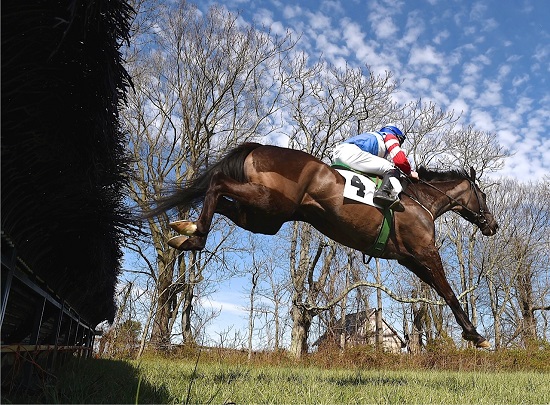
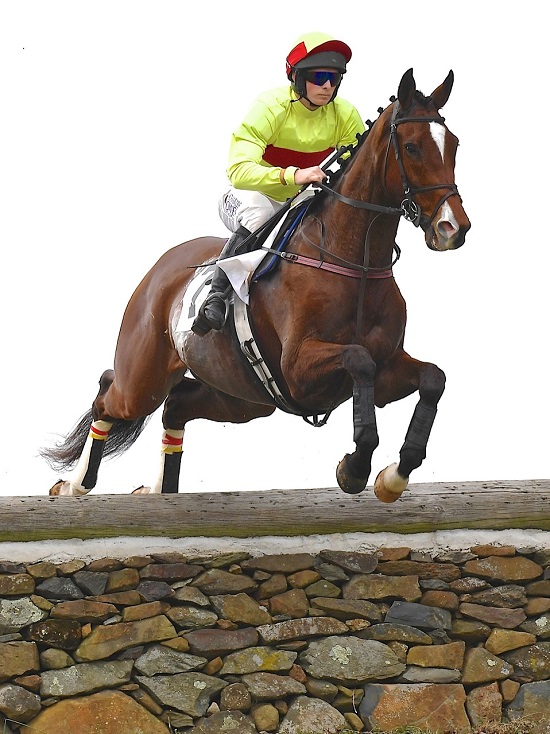
Hishi Soar, owned and trained by Randy Rouse wins the Locust Hill Open Hurdle Race with Gerard Galligan in the irons. / Douglas Lees photo
In May, last year, at age ninety-nine, Randy Rouse, MFH of the Loudoun Fairfax Hunt (VA), saddled his Hishi Soar, put Gerard Galligan up, and won the featured race at Foxfield in Charlottesville—the sanctioned $25,000 Daniel Van Clief Memorial optional allowance hurdle. That feat made Rouse the oldest American ever to train a Thoroughbred winner.
Last Saturday, April 2, 2017, Rouse, brought Hishi Soar to the Orange County Point-to-Point Races at Locust Hill Farm, put Galligan up again, and won the Open Hurdle Race in a five-horse field. That feat, by our reckoning, makes Mr. Rouse the first one-hundred-year-old American ever to train a Thoroughbred winner.
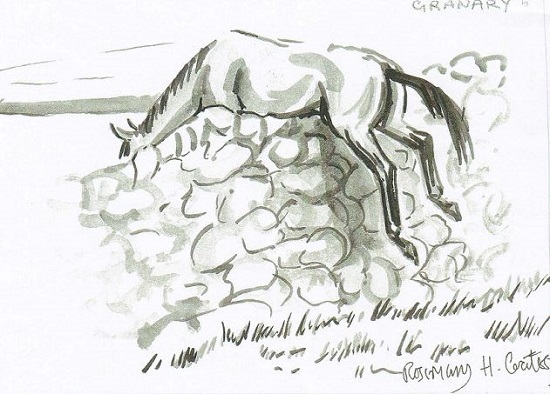
Back in the 1950s, Deirdre and her friend Sarah, both just nineteen, came to America. The pair had left Britain, where post-war ration books were still in use for food, petrol, and clothing. Sarah was to train horses and riders for Jamie Kreuz at Bryn Mawr Farms outside Philadelphia. Deirdre was to work for the Insurance Company of North America in Philadelphia and help Sarah on weekends. What follows is Part II of their adventures with Perfec’ Granary. Click for Part I, or type the author’s name in the Search box for more of her stories.
Illustration by Rosemary Coates
Because I loved Granary, Sarah let me exercise her daily. At this time we were experiencing some freezing autumn days, so just going out at all required a gritty determination. One thing with Granary—she had the ability to actually run away whilst merely walking along the road. She would walk faster and faster and a tug on the reins would only slow things momentarily. To make matters worse, her 'walk-ability’ made it difficult to go out exercising with another horse, the sheer pace of keeping up with her exhausting the others. This 'power-walking' classed her as 'unstoppable' a lot of the time.
Featuring the Photos of Douglas Lees
Jeff Murphy on Secret Soul. "If at first...try, try, again." / Douglas Lees photo
Race-goers at Piedmont enjoyed a warm, sunny day at the Salem Racecourse in Upperville, Virginia on Saturday, March 25, 2017. Entries were strong for the seven-race card consisting of four timber races and two flat races. So much so that one timber race and two flat races were split into two divisions each.
Jeff Murphy scored a hat trick in the first race, Maiden Timber, winning as rider, owner, and trainer. His horse, Secret Soul, delighted his syndicate, but it was a multi-stage struggle to get to the winner’s circle. Secret Soul opened a comfortable lead on the eight-horse field, but lost a lot of ground midway through as the result of a loose horse. Secret Soul got his rhythm back and regained the lead, but turning for home he was passed by Going For It and Hill Tie. Both those horses went off course by jumping the fence at the finish line and were disqualified. So it was Secret Soul, saved again!
As we approach the 2017/2018 season, Foxhunting Life makes its annual report on the recent moves of eight huntsmen across the North American hunting countries.
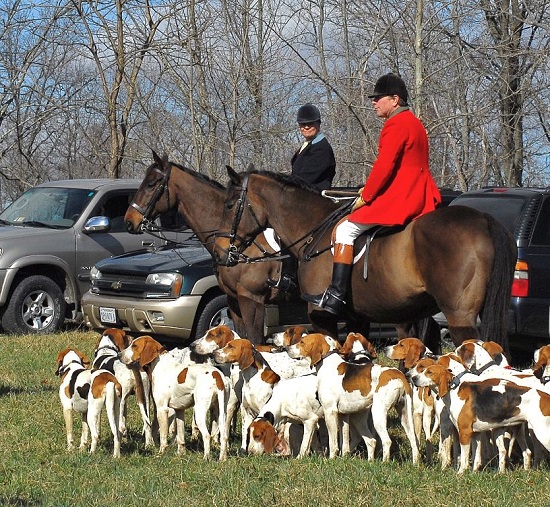
Retiring huntsman Hugh Robards, wife and first whipper-in Julie, and the foxhounds of the Middleburg Hunt / Chris Cancelli photo
Round I:
Hugh Robards’ decision to hang up his hunting horn after fifty-five seasons in hunt service got Round One underway. Fully half of those seasons, and certainly the most visible, Robards spent in Ireland’s challenging ditch-and-bank country as huntsman for the County Limerick Foxhounds. There, he provided world-class sport for Master Lord Daresbury (whom he succeeded as huntsman), the hard riding members, and a constant stream of hunting visitors from around the globe.
For the last three seasons, Robards has carried the horn for the Middleburg Hunt (VA). As difficult as his personal retirement decision must have been, the Middleburg Masters and members paid Robards such a stirring tribute at their Hunt Ball that he had to have felt the sincere respect and affection in which he was held, notwithstanding his short tenure there. The members made certain that the ball revolved about him with mounted photographs of his career, the showing of a specially produced video, and speeches—sincere and well-earned, to recognize an illustrious career.
Featuring the photos of Douglas Lees
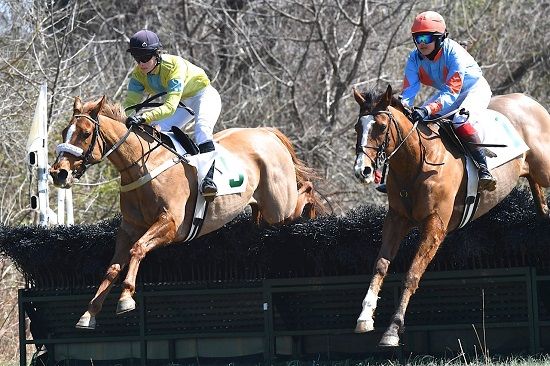
Fall Colors (Amber Hodyka up) and Slaney Rock (Erin Swope up) neck and neck in the Amateur/Novice Rider Hurdle Race.
Point-to-Point Racing in Virginia finally got its start on Saturday, March 18, 2017 at Airlie Racecourse with the Warrenton Hunt Point-to-Point. (The Blue Ridge Races, scheduled for the previous Saturday, were postponed because of weather until Sunday, April 23.)
Of the ten races carded, nine went into the books, entries being on the light side. The trainer/rider team of Neil Morris and Kieran Norris—last season’s leading trainer and rider respectively in Virginia—were certainly consistent. No appearances in the winners circle, but placing second three times: Open Hurdle, Maiden Hurdle, and Virginia Bred/Sired Flat Race.
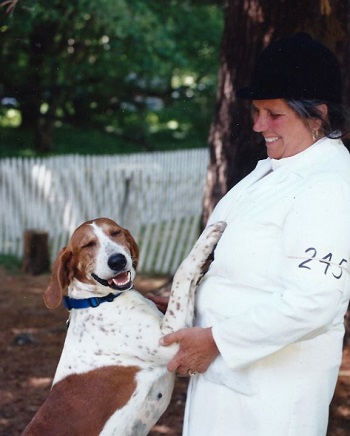
Marion Lee Crosson Scullin with one of her many favorite hounds, Howard County-Iron Bridge Opal.Marion Lee Crosson Scullin passed away peacefully at her Damascus, Maryland home after a brief struggle with brain cancer on March 5, 2017.
Born March 3, 1943 in Bryn Mawr, Pennsylvania, to a family of huntsmen (father, grandfather, uncles, and cousins), Marion’s future could be said to have been predetermined. At the time she was born, Marion’s father, Albert “Pud” Crosson, was the huntsman for Rose Tree Foxhunting Club, moving to Huntingdon Valley Hounds, then Whitelands Hunt, and concluding his career with Pickering Hunt where, in 1976, he “died in the hunting field of a heart attack after his hounds completed a splendid run, marking their fox to ground.” Inducted into the Huntsman’s Room of the Museum of Hounds and Hunting, Marion’s father was known for breeding a hard-running pack of deep-throated Penn-Marydels.
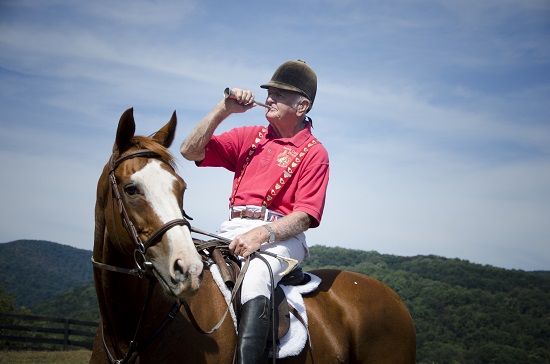
The late Melvin Poe remains a legendary American huntsman, and undoubtedly will for all time. From his earliest days, Melvin absorbed the ways of the forest and the habits of every wild creature.
From a new book, Foxhunters Speak (The Derrydale Press, 2017), here is one of fifty interviews conducted by an accomplished author highly experienced in the art of the interview. Mary Kalergis has traveled the country to learn how foxhunters acquired their passion. For books inscribed by the author, purchase directly.
Mary Kalergis photo
I was born in 1920, five miles down the road from where I live now in Hume, Virginia. There were ten of us in the family—five girls and five boys. My dad worked for a dollar a day. He had hounds when I was a little boy, and as soon as I got big enough to hunt, that was all I wanted to do. I loved to hunt skunks and possum at night when I was a schoolboy. We had no coons in those days. No beavers either. Those skins would have been worth a lot more than skunk or possum.
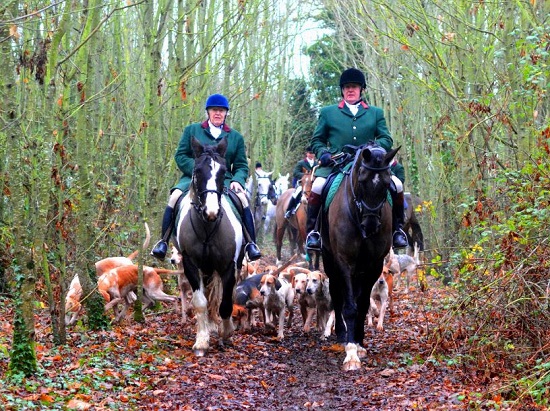
Stella Smith celebrates her ninetieth birthday hunting with the Tara Harriers (IRE). Her son, Henry Smith (shown right) is Master and huntsman. / Noel Mulliins photo
What does one do to celebrate a ninetieth birthday? Well some people probably go on a cruise, while a few may go on a religious pilgrimage, then others are just happy to be upright. But not Stella Smith. To her, age is just another number. So she went for a day’s hunting with the Tara Harriers, hunted by her son Henry. This was not just impulse, as Stella rides out most mornings on her family farm at Corballis, Donabate, in North County Dublin, Ireland, on her coloured hunter out of a mare that happened to be in foal without them knowing. Hence the name, Surprise.
Michael Dempsey, longtime Master and former huntsman of the Galway Blazers, describes Stella as the most natural horsewomen ever to cross Galway stone walls, getting the most from any horse she rode. Stella (Briscoe) who her mother described as a lovely mistake, there being such an age gap between her brother George and her sister Constance, was born into a hunting and racing family.
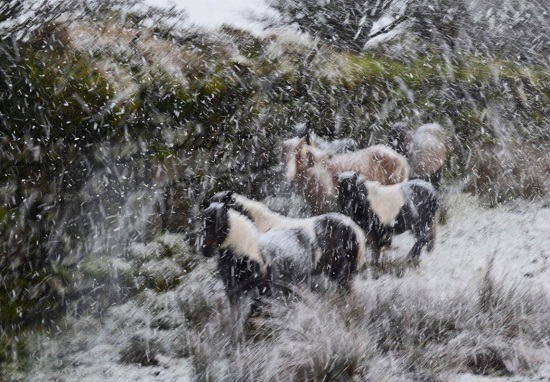
From Foxhunting Life archives, now that we all have more reading time on our hands, here is this issue’s Bonus Article to fatten the content for our subscribers and to open more articles, previously restricted, to our non-paying registrants. We were reminded of Sir Arthure Conan Doyle's poem since we've been talking about Dartmoor in recent issues.
Janet Ladner photo
Photographer Janet Ladner was out following the Mid-Devon Foxhounds when she came across these wild ponies taking shelter from the snow. I have hunted on Dartmoor, in England’s West Country, and found it to be a fascinating landscape of bleakness and beauty, with visible reminders of cultures that serially take one back in time all the way to prehistory. While hunting, one comes across ditches left by tin mining activity that began in pre-Roman times and continued to the twentieth century, evidence of farm tillage going back to the Bronze age in the parallel rows running across the slopes, and standing stones erected in prehistoric times. During quiet moments when hounds check, one can allow the imagination to soar.
For me, Dartmoor also conjures memories of cold winter boyhood days at home, reading the spooky mystery, Hound of the Baskervilles by Arthur Conan Doyle. It was the third of his Sherlock Holmes novels to be published, and this Dartmoor mystery filled my young head with delicious terror.
By coincidence, Janet Ladner’s photos of the ponies on Dartmoor arrived just as writer/editor Steve Price sent me this foxhunting poem, written by Arthur Conan Doyle. A confluence of Dartmoor and Doyle. Who knew he wrote foxhunting poetry?