The late Melvin Poe remains a legendary American huntsman, and undoubtedly will for all time. From his earliest days, Melvin absorbed the ways of the forest and the habits of every wild creature.
From a new book, Foxhunters Speak (The Derrydale Press, 2017), here is one of fifty interviews conducted by an accomplished author highly experienced in the art of the interview. Mary Kalergis has traveled the country to learn how foxhunters acquired their passion. For books inscribed by the author, purchase directly.
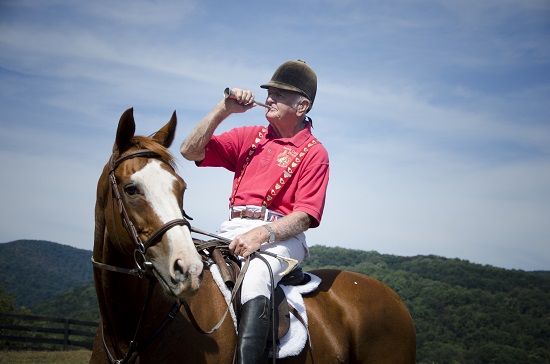 Mary Kalergis photo
I was born in 1920, five miles down the road from where I live now in Hume, Virginia. There were ten of us in the family—five girls and five boys. My dad worked for a dollar a day. He had hounds when I was a little boy, and as soon as I got big enough to hunt, that was all I wanted to do. I loved to hunt skunks and possum at night when I was a schoolboy. We had no coons in those days. No beavers either. Those skins would have been worth a lot more than skunk or possum.
As poor as we were, with so many kids to feed, we took our hounds out every day to catch game. If we carried a gun on foot, dogs would chase rabbit, squirrel, or my favorite, possum, and we’d have it for dinner. Muskrat is one of the best things you can eat. I was a good shot. I got fifteen squirrels in one day with a rifle. You shoot ’em in the head so you don’t hurt the meat. If you got on a horse, those same hounds would run a fox and not pay any attention to other game. They were smart and knew what was expected of them. Back in those days, a lot of farmers had their own pack of hounds, and oftentimes on Sundays, they’d join the packs together, and we’d have a big go of foxhunting. On the way to church, the whole community would stop to see this turnout. We called it a turnout because we’d have a fox that we dug out from the last hunt and have the kids hold the hounds while the Sunday school superintendent released the fox. The kids let the dogs go after the fox had a chance to put a good distance between himself and the hounds. Folks showed up on whatever they had to ride, and if they didn’t have a horse, they went on foot.
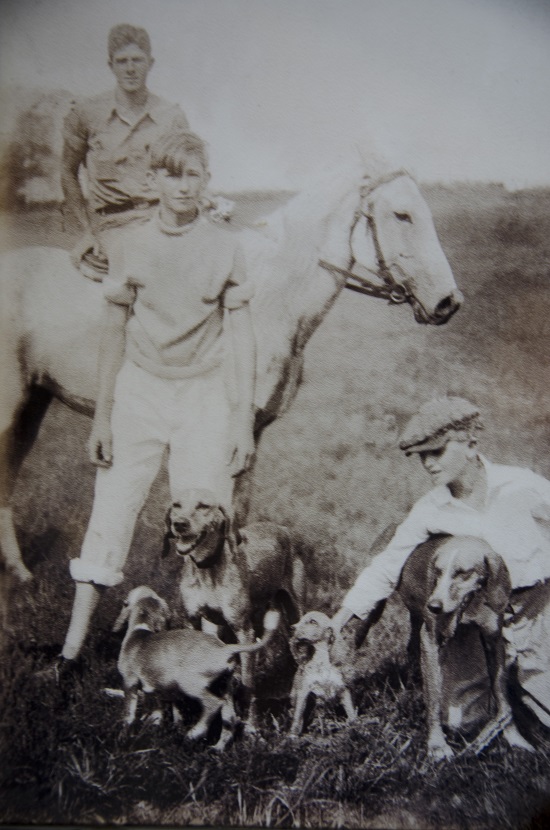 (R–L) Melvin kneeling with family foxhounds, brother Jim, neighbor on horseback. Circa early 1940s.
We were fortunate enough in this area to have ponies available to anyone willing to ride. Over at Belle Meade, there were a couple of hundred brood mares, and any kid could take the unbroken babies home for a while. They’d never been handled. They’d herd ’em up in the corral, and we’d catch ’em and put a bridle on. By the time we rode that pony bareback eight or ten miles to the house, he was pretty broke. The next year, we’d return that pony and get another green one. We were ole country boys that came up the hard way and weren’t scared of nothing. There were no school buses in those days, and we rode those ponies to school. The families (that were mostly my relatives) got together and built a run-in shed at the school so the kids would have someplace to keep their ponies while they were in class. The teachers drove a buggy, and so did my family.
When I come out of the army in October 1945, I was hired by Old Dominion to be huntsman that November, and there I stayed until I was fired in May of sixty-two. A huntsman never quits because he doesn’t want to leave his hounds. Orange County immediately offered me a position, so what at first seemed like a comedown was in fact a step up.
I was huntsman there for thirty years. The land is a lot less open nowadays, but it’s still a good place to hunt. Like everything else, the rules have changed over the years, and things are different than when I started. Used to be grooms had to ride in the back. Now you’ll see five or six professionals right behind the Field Master, and they’ll help themselves to the hunt breakfast afterwards. You wouldn’t see that back when I got started as huntsman. Ms. Mars does a great job, though. She cracks a big whip and gets things done right.
When I was seventy-seven years old, Jimmy Young told me I had to retire at the end of the season. My wife Peggy and I were in shock. We didn’t even know what to think. I stayed on for three more years after that, but they were the worst three years of my life because I was supposed to show the new huntsman the ropes. But two huntsmen is one too many for any hunt club! They wanted to put riders on our jumps when I knew a seven-board coop is always better than a rider, but I was on the way out, so Jimmy Young prevailed, and those riders just rotted up top there with no one ever bothering to take them down. The gate is always a lot quicker than dropping a rail, but if they’d just added a board on top of the jump, we could have still jumped it without having to go through the gate. During that terrible time, Mr. Ohrstrom came to me with an offer to start a little hunt in Bath County, with me as huntsman. I took some hounds that Orange County wasn’t hunting on down there. As we drove up that valley, damn if there wasn’t a fox just planted on the hillside, like it was waiting for us. I just picked up hounds from other hunts and carried ’em on down there, and we had ourselves a lot of fun hunting in Bath County for twelve or thirteen years. I’d haul the pack back and forth from my place in Hume to Bath County. George Ohrstrom built me a kennel at home as well as enlarging the one in Bath County. I no longer hunt there, but at ninety-three, I still hunt my hounds on Fridays and Sundays from my backyard kennel. I call my pack OPs—other people’s. All of my dogs have some little something wrong with ’em—they might be getting old and falling behind, or they follow the horses instead of the pack. My best huntin’ hound is a good lookin’ son of a bi*ch—good enough to show. The only fault I can find with him is he’s mean, so that’s probably the reason I got him. I had a great bi*ch from Warrenton because she had a crooked tail. I got another one that jumped up and licked everyone in the face. Both of them died this past year. They were wonderful hunting dogs despite their faults. When other hunts are dissatisfied with a hound, they’d pass him on to me and most of ’em make it too. I’ve got a good group that I can rely on.
I wouldn’t have an English foxhound. They’re not my type of dog. I’ve always liked an American foxhound because they are so keen to hunt. Sometimes too much so. You never want to excite an American foxhound. You need to hunt them as quietly as you can to keep their minds focused. If you rile ’em up, they’ll run crazy. If you kill a fox, you don’t make a big to-do over it because it’s bad for their minds. It’s hard for the English huntsman to understand that because they are used to the English breed, which are much less excitable than the American hounds. If you run a fox to ground, I don’t believe in messing with the den. They’re scarce, and the huntsman shouldn’t let the hounds dig and dig there. If forty hounds are moving all that dirt around, it’s too much for a fox to repair. A lot of times, the young fox can get trapped inside. I pick the pack up and move ’em elsewhere. No good can come from letting them scratch up a den. For hundreds of years, we’ve been breeding dogs that want to chase fox. The breeding is what counts more than praise or punishment.
When I hunt hounds I don’t want my whips to call a fox as soon as it jumps covert because a fox will either get killed or go to ground right away if the hounds are close behind. An animal can’t run wide open but for so long. If he has enough space between him and the hounds, he’ll run all day and have a better chance of surviving to run another day too! As huntsman, we’re hired to promote good sport for the field, who pays the bills. You need to give the fox a chance to have enough space so he can sit down and listen and catch his breath. That saves the fox and gives the field a good chase. To me that’s a win-win situation. I say you never count your hounds ’til the dealing’s done. It’s boring for the field to have to wait while you pick up hounds after a run. Just keep hunting another covert, and the strays will catch up. I learned from night hunting that hounds are pretty good at packing themselves up.
I love all types of hunting, not just foxhunting. Foxhunting was the only sport that paid me to do what I’d do anyway! Many a day, I’d go deer hunting at dawn, then take the foxhounds out hunting in the morning before I’d take the bird dogs out quail hunting in the afternoon. After supper, I’d put my coon dogs in the truck and go coon hunting. I like to hear hounds run, no matter the quarry, and I can’t imagine that changing for me. If you love to hunt like I do, it’s just who you are, and I’m too old to change!
Posted March 17, 2017