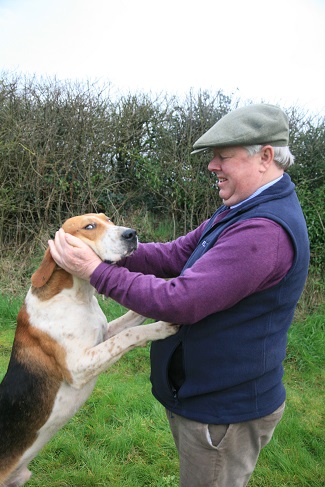
Author and friend / Catherine Power photoWith the season winding down, we decided to keep the best wine ’til last...or very nearly so. Monday saw us with the “Dashing” Duhallow at their meet at Monymusk Stud in Kanturk. The Duhallow is the oldest hunting establishment in Ireland with foxhounds, and has hunted the country continuously since 1745. The market town of Kanturk is looked on as the capital of the ancient barony of Duhallow, so it seemed a suitable venue on which to end their season.
Monymusk, now the property of Duhallow Senior Master Kate Jarvey, was bound to be a gala occasion, and so it proved. Kate holds the unique distinction of being Master of two of Ireland’s leading packs simultaneously—the Duhallow and neighbouring Scarteen. Her great-grandfather was Ely Lily of pharmaceutical fame, and she was brought up during Cape Cod summers near the Kennedy family. Kate is also a former chairman of the Irish Masters of Foxhounds Association. Sadly she was not riding as she is recovering from a broken hip, the result of an unfortunate schooling fall just after Christmas.
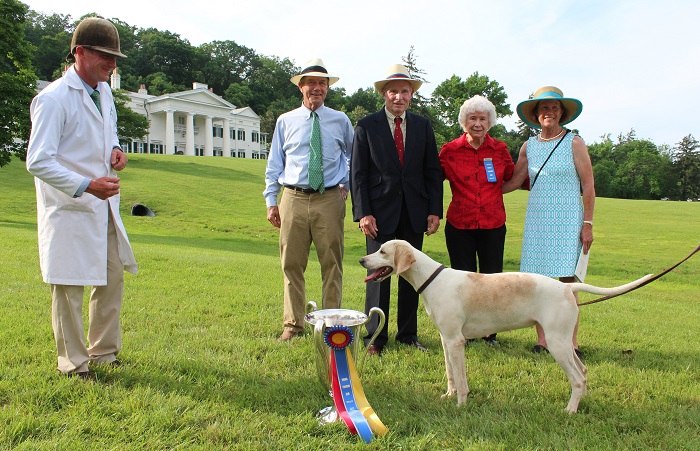
Grand Champion Green Spring Valley Sapphire with (l-r) huntsman Ashley Hubbard; Franklin Whit Foster, MFH; J.W.Y. Martin, MFH; Virginia Foxhound Club president Joan Jones, ex-MFH; and Sheila Jackson Brown, MFH. / Karen Kandra photo
More than six hundred foxhounds from thirty-seven hunts were exhibited at the Virginia Foxhound Show at Morven Park on Sunday, May 26, 2019, over the Labor Day Weekend. Hunts from thirteen states up and down the Eastern Seaboard and from as far away as Texas brought foxhounds to stand up against the finest examples of their breeds in North America. It is the largest foxhound show in the world.
In the always exciting final class of the show, four foxhound Champions—American, English, Crossbred, and Penn-Marydel—presented themselves to be judged for this year’s Grand Championship Class. It’s always a difficult class to judge because each entry has already been winnowed down throughout the day’s classes and has been chosen as the best specimen of its type by the judges in each ring. Each hound is deserving, and the attention and hopes of all spectators, though friendly, are ratcheted to a new level.
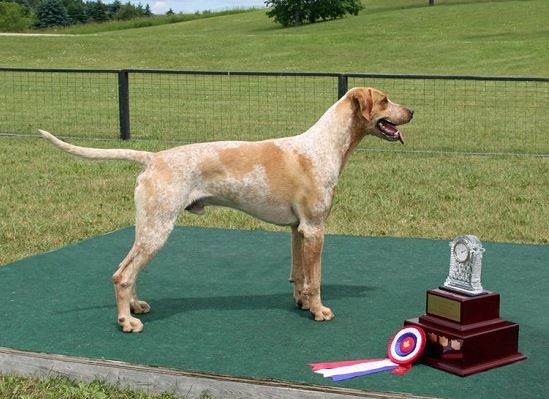
The conformation of Toronto and North York's Blue Ridge Wentworth 2015, Grand Champion Foxhound at the 2017 Canadian Foxhound Show, is clearly seen in this well-posed photograph. / Denya Massey photo
Foxhounds to be entered in a virtual hound show should be photographed so their conformation is clearly visible to the judges in the photos. Anything less will reduce or negate the judge's ability to accurately assess the qualities of your hound. Masters and huntsmen entering hounds in a virtual hound show might want to remind their photographers of the responsibility of their mission. A classical portrait of the hound is Job-1.
While the photographer will be photographing the hound from five angles for virtual judging, the side views profiles convey the most information about structure and conformation and are discussed in detail here. That discussion will be somewhat applicable to the other three views as appropriate. What follows are six-steps to achieve the profile images the judges will need to see.
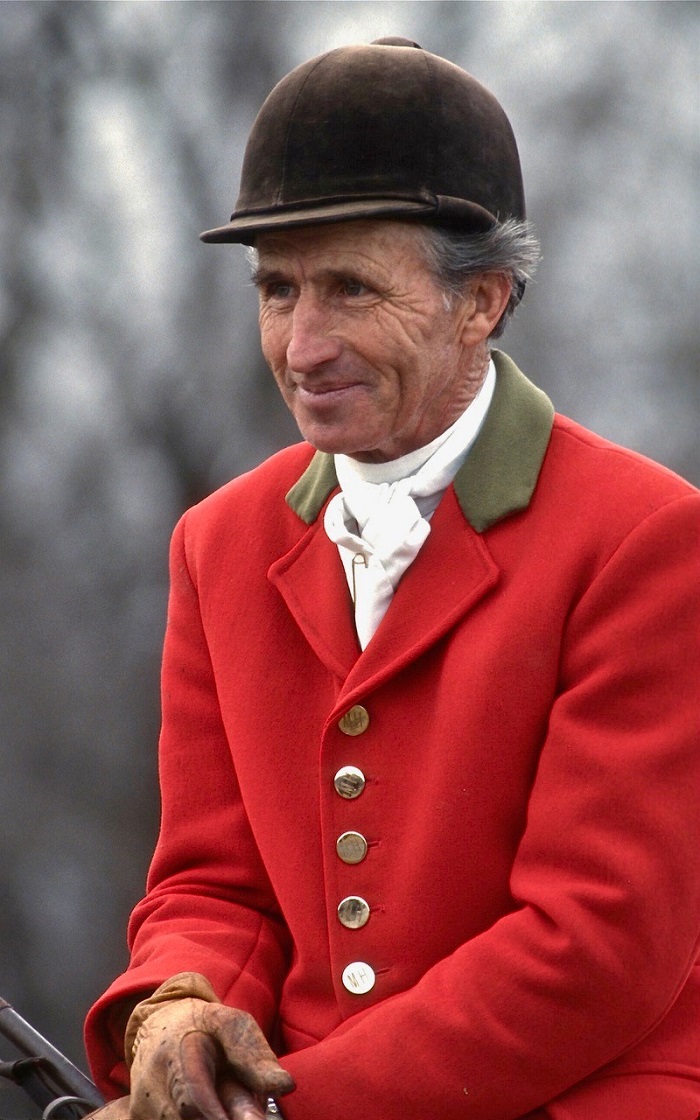
Albert Poe was huntsman of the Middleburg Hunt (VA) for 15 years before retiring from an illustrious career breeding and hunting old Virgnia Bywaters type foxhounds. / Douglas Lees photo
Albert Poe died on Saturday night, May 18, 2019. He was arguably the finest American-born professional breeder of foxhounds of our time. Along with his brother, Melvin, the pair have to be considered the two most storied American-born professional huntsmen that any foxhunter living today could have followed across the country.
Melvin might have been considered the more gregarious personality, but Albert, in his quiet way, was extremely articulate. He could put into words the hunting wisdom which developed perhaps instinctively.
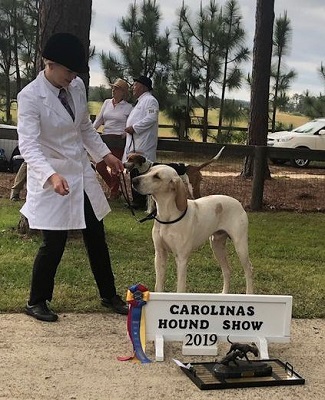
Grand Champion of Show, Bedford County Detroit 2017 with handler Laura Pitts.The 2019 Carolinas Hound Show was hosted by the Moore County Hounds on May 11th at Lyell’s Meadow in the Walthour Moss Foundation, a paradise for horsemen and naturalists in the sand hills of Southern Pines, NC. The Foundation was formed in 1974 by Pappy and Ginny Moss, MFHs of the Moore County Hounds (NC), as a charitable trust of 1,700 acres preserved in perpetuity. With additional gifts through the succeeding years from Ginny Moss and others, the Foundation now totals more than 4,000 acres and represents Moore County’s principal hunting country.
Hounds competed in three rings, Crossbred in Ring 1, Penn-Marydel in Ring 2, and English, American, and Foot packs in Ring 3. That one ring is dedicated entirely to Penn-Marydel hounds, and English and American foxhounds are combined in one ring with foot hounds, strikes this reporter as a noteworthy indication of the growing affinity for Penn-Marydel foxhounds amongst North American hunts well outside of the breed’s native region of Pennsylvania, Maryland, and Delaware. Concomitantly, the consequence must be a reduction in the numbers of Pure English and American types now being hunted in these southern Atlantic states.
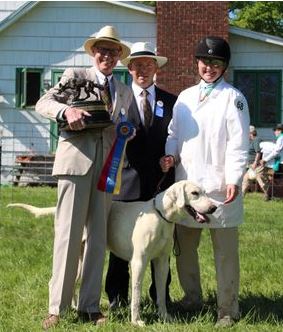
Standing with Grand Champion Harvard Goneaway 2018 are (l-r): J. Nick Badgerow, Steward and Show Chair; Judge Graham Buston, huntsman, Blue Ridge Hunt; and Harvard Fox Hounds member Angela Heinz. / Angela Fain photoThe Central States hound Show was held on May 4, 2019 in Stilwell, Kansas, hosted by the Leavenworth Hunt. Hounds from six hunts were shown: Brazos Valley Hounds (TX), Bridlespur Hunt (MO), Fort Leavenworth Hunt (KS), Harvard Fox Hounds (OK), Mission Valley Hunt (KS), and North Hills Hunt (NE). Hounds were judged by Graham Buston, huntsman, Blue Ridge Hunt (VA).
Brazos Valley was the high scoring hunt for the day and was gunning for its third consecutive Grand Championship at Central States, but it was not to be. Grand Champion of Show was Harvard Goneaway 2018, drafted unentered by Hillsboro Hounds (TN) to Harvard and entered last season. Goneaway’s male line is highly prepotent, as we will see, and Goneaway’s story serves as a fine example of how the system is supposed to work: top breeding kennels generously drafting well-bred hounds to bolster other packs around the country.
Photos by Douglas Lees
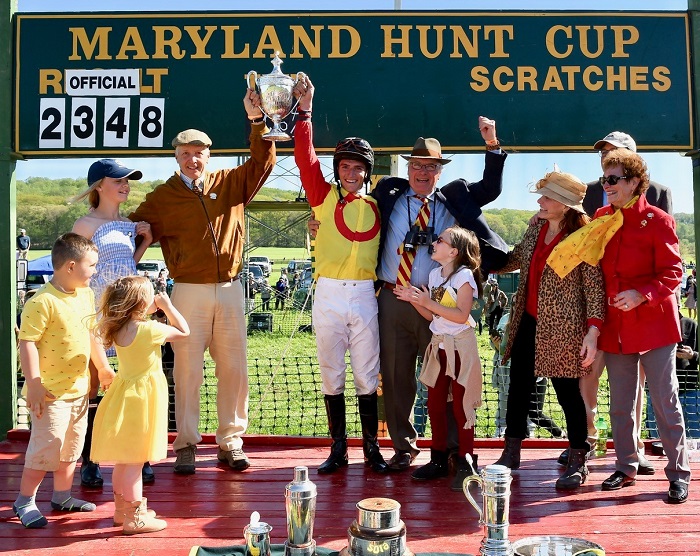
Trainer Joe Davies and jockey Eric Poretz hoist the Maryland Hunt Cup in jubilation as owner Skip Crawford, MFH, fist-pumps Senior Senator's 3rd victory in the 125th running of the Maryland Hunt Cup to retire the trophy. Potomac Hunt Joint-Master Vicki Crawford is at far right.
In a heroic come-from-behind effort exacerbated by a momentary heart-stopping mishap, Senior Senator battled back and claimed the fruit of a four-year quest. Owner Skip Crawford, MFH, Potomac Hunt (MD) now takes permanent possession of the Maryland Hunt Cup—arguably the world’s crown jewel of timber racing—which he can place alongside the Grand National Challenge Cup which Senior Senator also retired just last week in Butler, Maryland.
Photos by Joanne Maisano
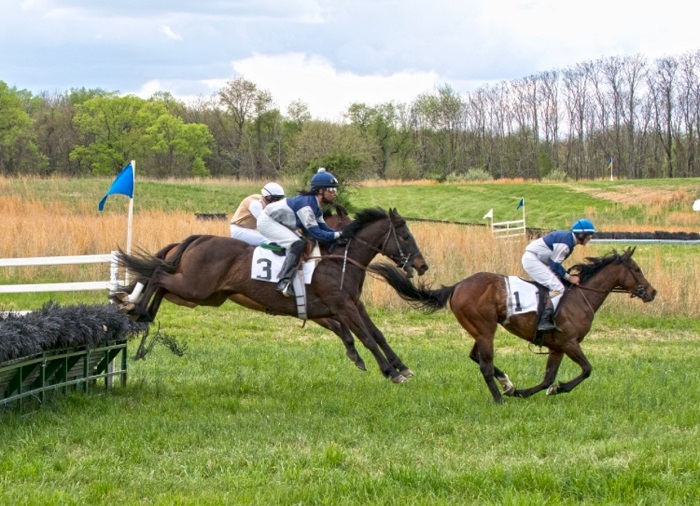
Maiden Hurdle (r-l): Number 1, Keoni (Woods Winants up) wins on a DQ; Number 3, Scrappy Warrior (Mike Woodson up) loses rider at the last fence.
Blue Ridge’s warm spring race day on Saturday, April 21, 2019 was a welcome change for those who hark back to those cold, blustery days on the Woodley hillside in early March when the races were formerly held.
In the first race of the day, Maiden Hurdle, trainer Michael Pearson saddled two strong horses, Keoni and Scrappy Warrior. With seasoned amateur jockey Woods Winants on Keoni and Mike Woodson on Scrappy Warrior, the Pearson team shared the pacesetting until the last fence when Scrappy Warrior stumbled and lost its rider. Racing to the stretch, Shannon Hill Farm’s All Out of Aces with 2018 leading jockey Barry Foley aboard grabbed the lead. Keoni battled back but All Out of Aces was first at the wire, then disqualified for cutting a pole and being off course. Keoni was declared the winner. Big E, ridden by Kieran Norris and trained by Julie Gomena placed second.
Photos by Douglas Lees
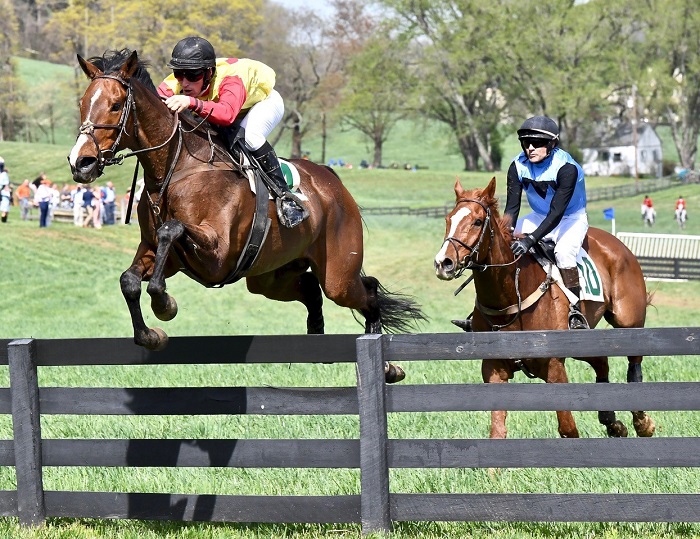
Senior Senator (Eric Poretz up) and challenger Monstaleur (Forrest Kelley up) at the last fence.Potomac MFH Skip Crawford’s Senior Senator won his third straight Grand National Point-to-Point—a three-and-a-quarter mile race over timber in Butler, Maryland—in a dominant finish to retire the challenge cup. The horse also has two legs up on the Maryland Hunt Cup and will be gunning to retire that trophy next Saturday in Glyndon.
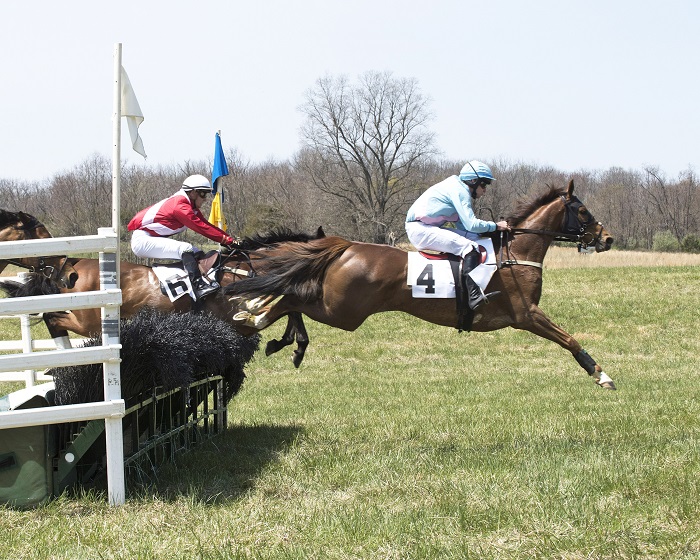
Steeplechase horses swish through the man-made national fences routinely at most hurdle races around the country today. Brush fences were once expensive and time-consuming to set up, and racetracks were dropping steeplechase races from their cards. / Joanne Maisano photoIt was autumn of 1973, and the world was in turmoil. U.S. forces were pulling out of Vietnam, the Watergate scandal was rocking the nation, and a looming energy crisis was getting global traction.
The steeplechase circuit, too, was in a state of flux. The year before, the bottom had fallen out of the industry. New York basically kicked out the jumpers and went from eighty-three jump races at Belmont, Aqueduct, and Saratoga in 1970 to fifteen in 1973. And those were at Saratoga only.