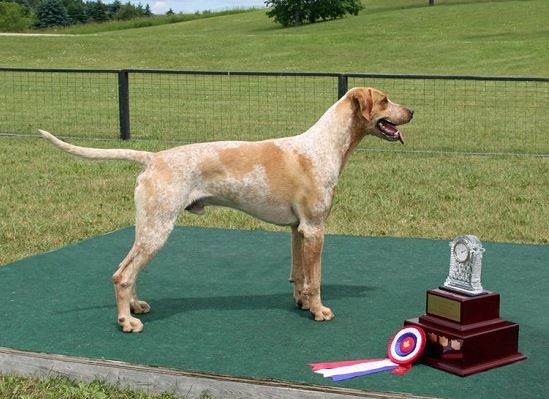
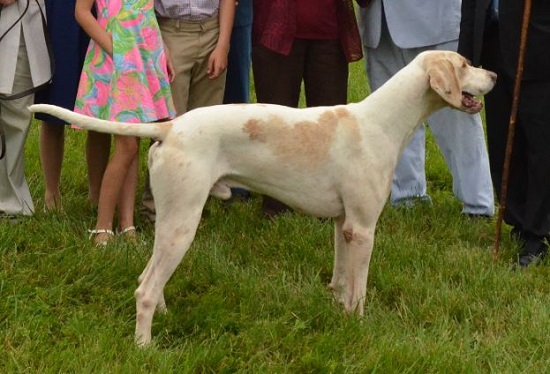
 The conformation of Toronto and North York’s Blue Ridge Wentworth 2015, Grand Champion Foxhound at the 2017 Canadian Foxhound Show, is clearly seen in this well-posed photograph. / Denya Massey photo
Foxhounds to be entered in a virtual hound show should be photographed so their conformation is clearly visible to the judges in the photos. Anything less will reduce or negate the judge’s ability to accurately assess the qualities of your hound. Masters and huntsmen entering hounds in a virtual hound show might want to remind their photographers of the responsibility of their mission. A classical portrait of the hound is Job-1.
While the photographer will be photographing the hound from five angles for virtual judging, the side views profiles convey the most information about structure and conformation and are discussed in detail here. That discussion will be somewhat applicable to the other three views as appropriate. What follows are six-steps to achieve the profile images the judges will need to see.
Of course, there are those experienced photographers who are expert at photographing four-legged animals, both hounds and horses. The basics are pretty similar for each animal. Editors of sporting magazines—those who cover dogs, hounds, horses—love those photographers. They make us proud by providing images for publication comparable to our unforgettable prose. So, here are some basic guidelines for shooting foxhounde with the camera.
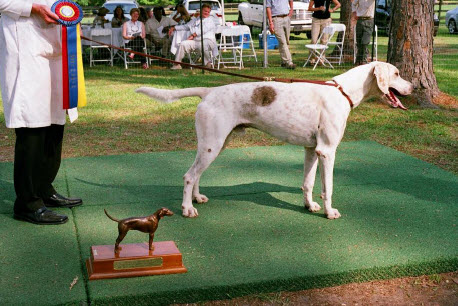 The incomparable Jim Meads captured this portrait of Fox River Valley Nightcap 2009 when she was judged Grand Champion at the Southern Hound Show in 2011.
To the photographer, then. Since you are carrying a camera, I will assume you know all about light, shadow, composition, ugly backgrounds, shutter speed, apertures, and such. Here is only what you need to know about shooting a hound portrait for the benefit of houndsmen.
And, yes, it is the duty of the handler to present the hound properly to the photographer. But since live animals tend to move around, the photographer needs to know when to shoot, and when not to shoot the image.
1. Face the hound squarely broadside (or as close to broadside as you can get). Ideally, you and your camera want to be perpendicular to the axis of the hound. If the photo is taken from too much of a forward angle or too much from a rear angle, perspective may distort the hound’s conformation.
2. Crouch down closer to hound level so perspective doesn’t foreshorten the legs.
3. The foreleg closest to the camera should be vertical to show the hound’s front end angles (shoulder to point of chest to elbow) best. If the pose isn’t ideal, at least one of the front legs should be vertical. The other foreleg may be either vertical or slightly behind.
4. The hind leg closest to the camera should be vertical from the hock down (to show off the shape of the gaskin and a well let-down hock).
5. Head and neck should be in profile, extended naturally.
6. Otherwise, don’t shoot! Instead, make a courteous suggestion to the handler. As in, “Could you please stand your dog up for me?” Or kind words of your own choosing, if you want to remain friends.
This is the ideal pose for the hound. The shot available to you will not always be ideal, but a study of the photos accompanying this article should give you a standard to strive for. There is even some leeway in less than ideal poses that still result in useful shots.
Foxhunting Life will be happy to furnish copies of this article to photographers, Masters, and huntsmen for their guidance. These tips should benefit any new foxhound photographer, especially.
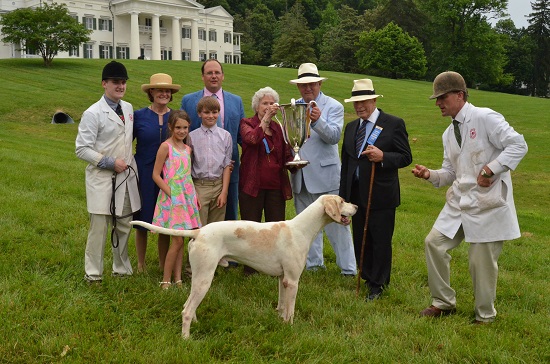 Nancy Kleck captured this excellent portrait of Midland Striker when he was judged Grand Champion at Virginia in 2016.
 Detail from photo above. Midland huntsman Ken George makes certain his hound is standing properly for the photo. / Nancy Kleck photo
Posted June 8, 2020