A Sporting Tour Through Merry Old….Part 2
Join James Barclay—an ex-Master of five English foxhunts—for Part 2 of his personal and revealing tour of elite hunting establishments through Middle and Eastern England. Barclay went out with twenty-one packs in just two months during the informal season, the last of which on the morning before the first of six Opening Meets. Click for Part 1.
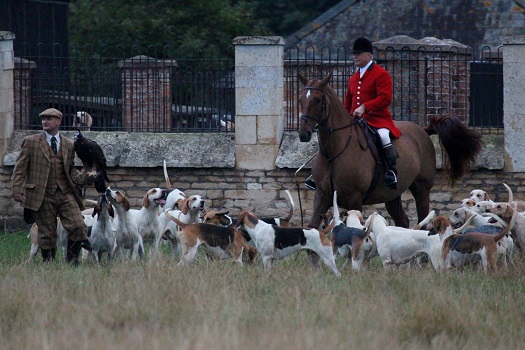
Fitzwilliam huntsman George Adams and hounds with birdman John Mees at the kennel meet, Milton Park / James Barclay photo
Fitzwilliam
Hunting with the Fitzwilliam is always a treat, especially as my family and I spent twelve very happy seasons there. Although Peterborough is on the doorstep, the Park is beautifully laid out for hunting and many good days are enjoyed there. The kennels are situated on the eastern side of the Park and have a history going well back into the 1700s.
The combination of these hounds hunting with an eagle—[The Hunting Act allows a pack of hounds to flush a fox to a bird of prey]—in close proximity to the action is something we are seeing in all but a few places now and is very much a sign of the times. George Adams has hunted these hounds for over thirty years and is certainly one of the most popular men in his profession. This particular morning was when one realises just how lucky we are. On our side of the Park wall was a great gathering of like-minded people enjoying something that has taken place here for generations. On the other side is four miles plus of new houses, factories, roads and the roar of urban noise. Is it therefore, not up to us—those who love our countryside and its activities—to encourage and involve those who may never have come across us before? Our worlds may be far apart in one sense, but they are not in another. There may be just a wall between us in this case, but it should never be looked upon us as a barrier.
A New Hunting Experience in the Lowcountry
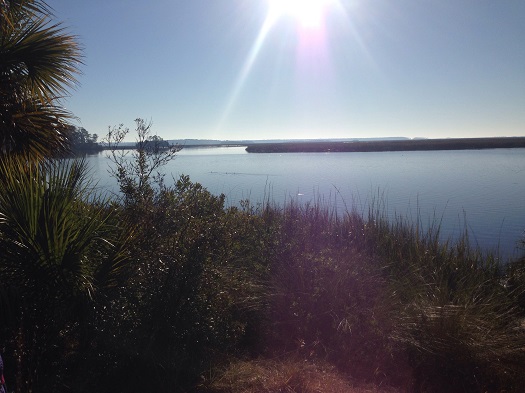
South Carolina’s Lowcountry / Caroline Leake photo
I have been hunting for fourteen years now—since age six—and recently experienced a completely different way of hunting! I visited the Lowcountry Hunt in South Carolina to visit old friends—Lowcountry huntsman Martyn Blackmore and his lovely wife Sue. My mom Caroline and I drove down on Friday, December 12, to be ready to go hunting on Saturday. My first observation was everything is flat! Absolutely no hills. And the footing is sand—much different than what I am used to here in the Blue Ridge of Virginia.
Martyn was up by 4:30 in the morning and getting hounds ready since we had a two-hour drive ahead of us. The pack is mostly Crossbred, but when Martyn came to the Lowcountry he brought with him some puppies bred from his favorite Old English lines.
Sue was up getting the horses ready to go. The meet was at a place called Palmetto Bluff. I thought we had arrived because we pulled off the road into a smaller driveway. Wow, was I wrong! The driveway started as pavement and then went to gravel and then to sand and then we were not particularly on a road at all, just more of a path in the woods. We kept driving and driving, and fourteen miles later we ended up at the meet.
A Sporting Tour Through Merry Old…Part 1
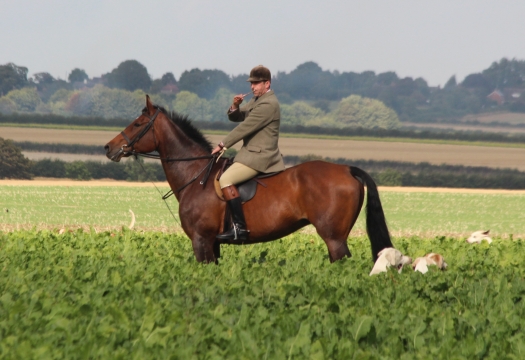
Master and huntsman Adam Esom and the South Wold Foxhounds midst the sugar beets in Lincolnshire. / James Barclay photo
Join James Barclay—an ex-Master of five English foxhunts—for a personal and revealing tour of elite hunting establishments through Middle and Eastern England. Part 2 to follow.
This last summer has been one of the busiest for a while with a fair share of weekends spent judging various Puppy Shows, which is always a pleasurable thing to do, but sadly does nothing beneficial for the waistline! It is always nice to look at hounds during their restful period, and we can soon start to gauge what there is coming on from behind the scenes and start to assess the breed’s general standard.
On that note, it is a great relief to see a lot of nice hounds about, as there was a time after that dreaded day in February 2005 when the Hunting Act became law that many packs cut right back to a minimum. However, to see that confidence returning is most reassuring to all of us who take the breeding of the Foxhound seriously.
Now the time had come to dust off the camera and get out there and firstly to take some early morning pictures of hounds on exercise. This is a wonderful time of year as, given the blessing of some good weather, harvest starts to move, and with those dewy late summer mornings and a hint of mist in the air, our countryside comes to life in a way any true hunting man knows. So visits to Badminton, Belvoir and the Bicester were a particular pleasure this year, as last summer, I had decided to cover most packs in the Eastern Counties as well as the Midlands.
The Galway Blazers at Craughwell
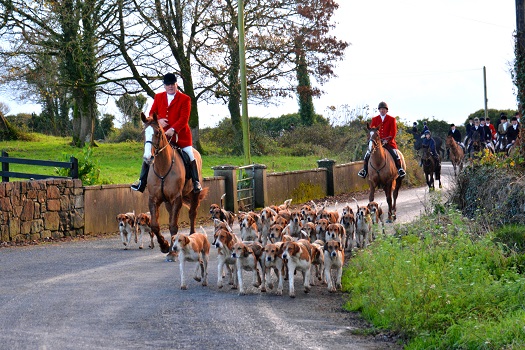
Galway Blazers huntsman Tom Dempsey and whipper-in Anthony Costello hack home after a cracking day’s hunting in Craughwell. / Noel Mullins photo
The County Galway Foxhounds (the Blazers), hunted by Tom Dempsey, had a brilliant day’s hunting at Craughwell, finding five foxes and running each one to ground.
The hunt was formed in the early nineteenth century and hunts about thirty square miles of unique limestone wall country. The first Master and huntsman was John Denis, an ancestor of the late Lady Molly Cusack-Smith, MFH, who, neé Molly O’Rourke, hunted the Blazers during World War II. There were many other well known Masters, including Isaac (Ikey) Bell, father of the modern English foxhound; American film director John Huston; and Captain Brian Fanshawe, one of England’s illustrious Masters (Warwickshire, North Cotswold, and Cottesmore) and renowned breeder of foxhounds. Two Field Masters that held office for long periods were Lady Anne Hemphill and Willie Leahy.
The Galway Blazers have some of the very best hunting country in the world. To say it is unique is an understatement, with miles of small enclosures, resulting in often fifty stone walls to the mile and uninterrupted views of hounds hunting. To hunt even once with the Galway Blazers is on most hunt followers’ bucket list.
My First Opening Meet
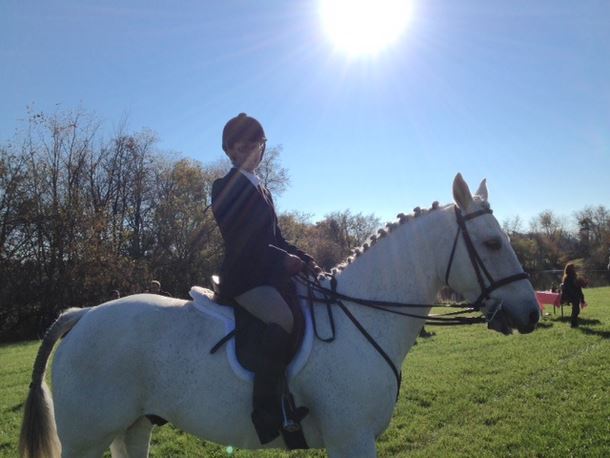
One of the quiet moments in Carla Lake’s first Opening Meet
My first Opening Meet has been about a year in the making, and I can hardly believe I’m here. By here, I mean standing on top of a log, cursing my horse, who, instead of standing quietly for me to remount, has decided to leap over the log while I try to stay calm and not burst into tears.
It’s been a trying weekend so far.
My borrowed horse, Seven Up, is completely sick of me after I spent a total of six hours Friday night and Saturday morning grooming the living bejezus out of him. Up to this point, I never had to braid for any kind of equestrian event, so on Friday night I arrive at the barn around 6:30, brush and bathe him, and separate his mane into little sections.
Old Chatham Rising
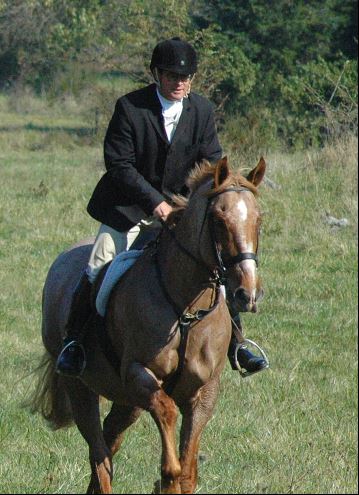
Newly appointed Old Chatham MFH Jef Murdock tells how it feels to hunt hounds for the very first time. / Nancy Kleck photoOn a recent Saturday the Old Chatham Hunt (NY) had a rare hunting day. Hounds ran their first coyote hard for an hour before huntsman and staff had to stop them from going into country where it was difficult to follow. Hounds then found another coyote and ran it through their wooded country in fine voice for another forty-five minutes to finish an excellent day of hunting. What’s remarkable about that? one might ask. Nothing, except that the huntsman had never hunted a pack of hounds before in his life until that day.
At the end of last season, Old Chatham members made some difficult and controversial organizational changes in an effort to improve their sport. A new huntsman—Tommy Hopkins—was named, and a new Master—Jef Murdock—was appointed. Hopkins had been whipping-in for years and was familiar with the hounds, but Murdock, though he’d been following hounds as a field member for years, was better known for his skiing acumen—he owns the popular Butternut ski area in the Berkshire Mountains of Massachusetts—than for his prowess with foxhounds.
Consensus at Green Creek: A Barnburner!
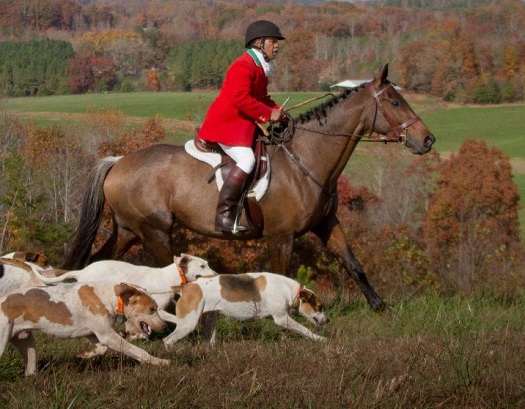
Huntsman Tot Goodwin and the Green Creek Hounds / Erik Olsen photo
It’s always fun to hear a day’s hunting described by different members of the hunt. Years ago I would ask Mrs. A how the day had been, and she would assure me, “They ran and screamed all day.” When Mr. B was queried, he said, “They had a bit of a flurry.” When Mr. C was asked the same question, “They didn’t do a thing.” This past Thursday, however, everyone at Green Creek Hounds (Carolinas) agreed it was a barnburner!
Hounds met at Coxe Road where a few of the young entry thought the deer they saw were worth a go. Puppies were reprimanded, and they hacked obediently through the woods to East Green Creek Road. It was a cool, misty morning with great scenting conditions. This is known as coyote country. Tot sent the pack into covert and allowed them to trail for ten or fifteen minutes, and then they opened. All hounds were on (thirty couple), and the cry was ear-splitting.
See You at Second Horses
This hunt report—a short but informative excerpt from Chapter 3 of Barclay Rive’s new book, See You at Second Horses—harks back fifteen years to when Barclay accompanied Rosie and Grosvenor Merle-Smith to England. The book recounts their hunting adventures during that trip and is available from Horse Country Saddlery, Warrenton, Virginia.
At the time, Grosvenor was Master and huntsman of the Bull Run Hunt (VA), and Barclay whipped-in to him. Barclay also whipped-in to the Keswick Hunt (VA)—sometimes to both hunts on the same day when Keswick met in the morning and Bull Run in the afternoon!
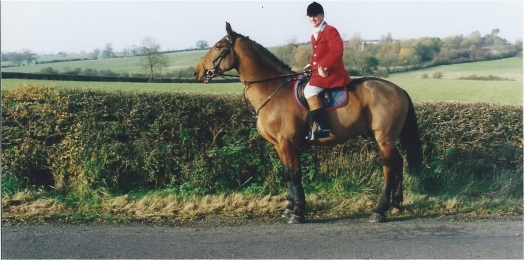
The author on Bruno at the Fernie meet at Billesdon / Rosie Merle-Smith photo
Julie and Colin brought our horses down the ramp out of the box. We had our first experience of what became a familiar routine: stepping up the ramp and using it as a mounting block for the horse led up beside it. I usually had to shorten my stirrups. Colin had to hold on to the horse’s head until I was done, because they were ready to go as soon as they felt weight in the saddle. Julie gave me instructions as I mounted a big bay.
“This is Bruno. He prefers a longer rein to a shorter one. He hunts with the Fernie every Saturday, so he knows his job.” This was her diplomatic way of telling me to stay off of the horse’s mouth and let him take care of me. I thought Bruno looked like he should be pulling a cart, but I was ignorant. He was a brilliant field hunter. An excellent teacher, Bruno was what American horse dealers call a packer, meaning he could pack me around as if I were a sack of grain. He was calm at checks, but ready to run and jump when the need arose. Sporting author Michael Clayton in Endangered Species reports that English foxhunters say the ideal hunting horse should have “the head of a duchess and the arse of a cook.” Bruno had plenty of muscle behind, and while his head was hardly elegant, he possessed beautiful brains.
Grosvenor, Rosie and I headed down the road where hounds had gone. Julie called to us, “See you at Second Horses.”
Cubhunting at Old Dominion
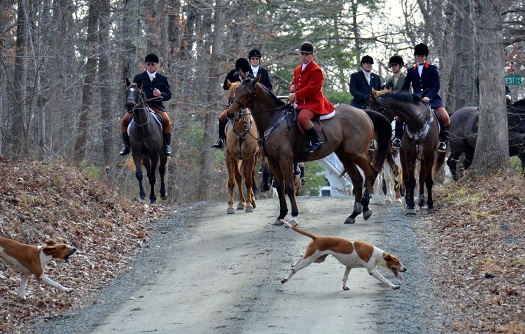
Cubhunting is in full swing and it’s time to be publishing hunt reports once again. Here’s one from an honorary whipper-in to the Old Dominion Hounds (VA) about a good hunt on a clever fox. How are your hounds doing? Click to send us your story and photos. John Stuart (left), huntsman Ross Salter (center), […]
The Drag Hunt that Brightened My Season

James Tonery on Starlight, 17-h Irish Sport Horse
The Grallagh Harrier hounds that I follow in County Galway, Ireland had more than enough sport last season, but for us riders, hunting was hampered with the deluge of rain that fell from the heavens. No God would send such volumes of rain on any huntsman; there must be other forces at work here.
Because of the rain, I was able to hunt on open ground only three times. The rest of the hunting was done in forestry, where the hounds could have plenty of sport. To say I was frustrated is an understatement, but to be fair you could not expect to enter a farmer’s land when it was under all that water.
Regardless, I have a lot to be joyous about. My hunt nominated me for being the best subscriber, having brought many newcomers to the sport from the U.S. and other parts. And, with all the water in the ground, I learned that the drag hunt has advantages to offer!