
Robert Brooke: America’s First MFH
This essay is adapted from J. Blan van Urk’s The Story of American Foxhunting as published in The Derrydale Press Treasury of Foxhunting edited by Norman Fine. At the time of van Urk’s writing (1940), the Brooke family had maintained the breeding of their hounds for nearly three hundred years. Today, while it may be doubtful that a purebred Brooke hound could still be found, the genes live on in various old American foxhound strains.
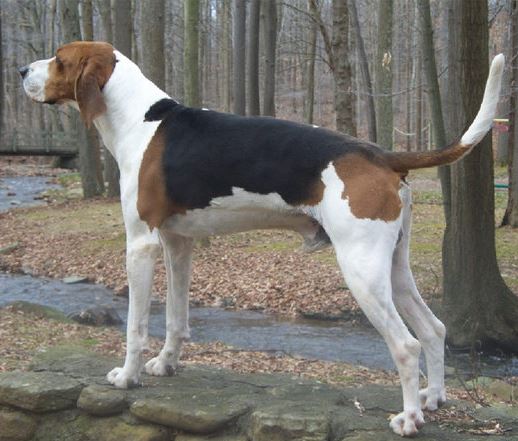
Walker foxhound. Foundation bloodlines were contributed by the Brooke hound.
Robert Brooke, Esq., came to Maryland from England in 1650 with a pack of hounds. He’d been appointed a member of the Privy Council of State for the Province of Maryland by Lord Baltimore, who wished to increase Maryland’s population.
Arriving with Mr. Brooke and his hounds aboard his private ship were a wife, ten children, (eight of whom were boys), twenty-one man-servants, and seven maid-servants—forty persons in all and a meaningful contribution to the fulfillment of Lord Baltimore’s wishes. Brooke’s hounds more than satisfied another of Lord Baltimore’s foremost requirements—that each colonizing family bring at least one dog.
What Is a Penn-Marydel?
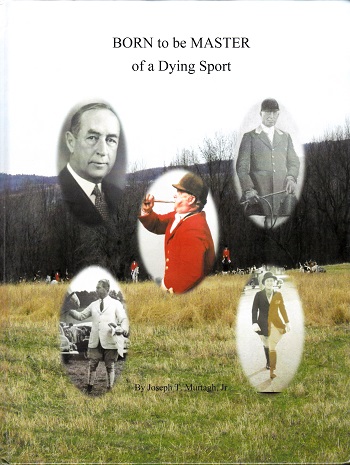
Born to Be Master of a Dying Sport by Joseph T. Murtagh, Jr., ex-MFH, 2016, 287 pages, illustrated, $45.00 plus $5.00 shipping. Purchase direct from author by clicking on this email address: [email protected]. Inscribed, signed copies may be requested.What follows is an excerpt from Jody Murtagh’s new memoir, Born to Be Master of a Dying Sport. The book tells the unvarnished story of the ups and downs of a man trying gallantly to keep his hunt and his heritage going in a changing world and his love for the Penn-Marydel foxhound, a breed formally established by his maternal grandparents.
A Penn-Marydel is a true American hound that was a derivative of hounds that came to America from England and France in the early 1600s with the settlers of the time. These settlers came to what we now call the Eastern Shore regions. One such family with which I am very familiar—the Jackson Family—settled around 1682 in the Maryland family seat, Jackson’s Choice, a three hundred-acre tract on the Eastern Bay shore opposite Lower Kent Island, patented to Richard Jackson by Lord Baltimore in 1664.
Bagpipe Is Hound of the Year at Tennessee Valley
Johnsey’s tribute to Bagpipe was first published in the 2016 Yearbook of the Tennessee Valley Hunt. The hunt, founded in 1989, is unique in that most of the founding members had never foxhunted prior to forming the hunt. Fortunately, they found their way to Dr. Todd “Doc” Addis who, along with his wife Happy, brought his hounds to Tennessee and taught the fledgling foxhunters all about hunting. Before leaving, Doc made a gift of twenty couple of Penn-Marydels to the Tennessee Valley Hunt.
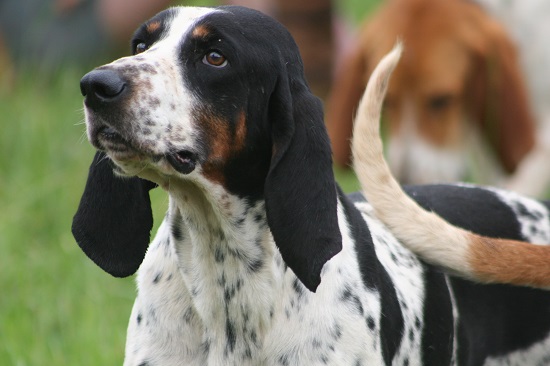
Kimberton’s Bagpipe 2010 / Gretchen Pelham photo
I’ve chosen Kimberton’s Bagpipe 2010 as this year’s Hound of the Year. Prior to last hunt season, Bagpipe was nothing more than your everyday, stubborn, old filler hound. Terrified of his own shadow and extremely anti-social when it came to humans, Bagpipe did everything on his own terms. By the end of the 2014/2015 season he would pack in, walk out, and was only decent in the hunt field.
In All Fairness to Horse and Hound

Epp Wilson, MFH wrote this piece for members of the Belle Meade Hunt (GA). Foxhunting Life subscriber Howard Benson suggested that Epp’s recommendations deserve wider distribution. We agree. What follows is a sympathetic, timely, and heartfelt message as only Epp can deliver it!
Master and huntsman Epp Wilson and the Belle Meade hounds / Lauren Giannini photo
The hound-roading or exercise season is a good time to bring out green horses—or horses otherwise not used to hunting and hounds bolting out of the bushes and dashing at them from behind.
It is a lot easier for green horses to process surprises now, while we are just exercising hounds than it is when we are hunting, and their minds are already overwhelmed with the mental challenges of a coyote chase. Frequently the inexperienced horse is already at wit’s end during a coyote run, so, of course, he is more likely to kick a hound.
Fabled American Foxhound, Potomac Jefferson, Dies
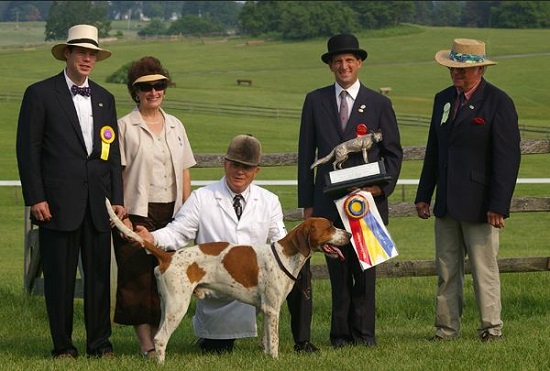
Potomac Jefferson 2005, the toast of North American Foxhounds, winning the Grand Championship at the 2007 Bryn Mawr Hound Show one week after capturing the same honor at Virginia. (L-R): George Hundt; Vicki Crawford, MFH; Larry Pitts, huntsman; Lance Taylor; Jake Carle, judge. / Karen Kandra Wenzel photo
The fabled American foxhound who, along with his get, cornered the silver market in North America has passed on. Potomac Jefferson 2005 was the MFHA Centennial Grand Champion Foxhound at both the 2007 Virginia Foxhound Show and the Bryn Mawr Hound Show one week later.
That year, 2007, marked the one hundredth anniversary of the founding of the Masters of Foxhounds Association. The entire year was filled with special exhibits, competitions, and events all across the country, attracting large and enthusiastic crowds of foxhunters, horses, and hounds. The classes of all the hound shows were swelled with the best examples of foxhounds that could be mustered, along with their supporters. The year 2007 was a big deal.
Old English Hounds Thriving at Irish National Hound Show
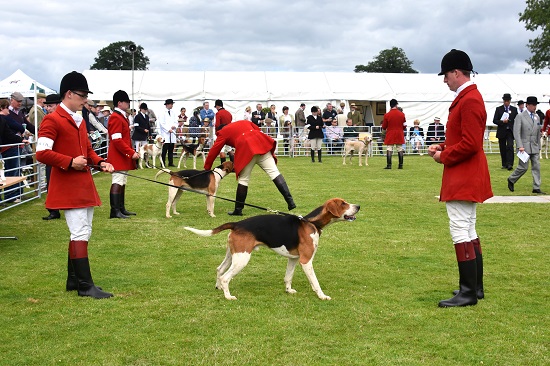
Pair of Old English hounds. County Louth hound (foreground) shown by huntsman Alan Reilly / Noel Mullins photo
The Irish National Hound Show at Stradbally Hall, County Laois, Ireland keeps growing in both entries and spectators. This year the weather also played a positive role as hound enthusiasts were often three deep along the ringside, and a large number lingered and socialised long after the show was over.
Competition was keen in the foxhound ring where judge Nigel Peel, a well-known hunting correspondent himself (and a member of Foxhunting Life’s Panel of Experts), commented that the Old English hounds were some of the finest he has judged either in Ireland or in the UK, and the Modern English Hounds had real quality as well.
The Old English (or Traditionally-Bred) hounds and the Modern English hounds are judged separately in their own classes, but the winners of those classes come up against each other in the final championship classes for dogs and bi*ches.* On occasion the Old English hounds being bred today will prevail.
My Hound Training Program:Well-Intentioned But Misguided

Marj Botsford would winter the hunt’s puppies again, but do it differently!A few years ago, the Ottawa Valley Hunt (ON) huntsman at the time, Mr. Adrian Quick, made a request for volunteer families interested in being sponsors for hound puppies over the winter. My husband and I volunteered to take on two puppies. We are animal lovers and were between canines at the time.
In late November, the puppies arrived—Hamish and Hawkesbury. They were about six months old. Being familiar with family dogs and not hounds, we asked Adrian if there was anything in particular that we should know about foxhounds. His advice was to feed them lots of proteins. We knew that hounds are working animals and not family pets so we prepared a stall in the barn for them. Feeding proteins was not a problem as my brother has a dairy farm and a side business selling beef; therefore we had access to all the organ meat the hounds needed.
Toronto and North York Farquhar Is Grand Champion at Canada
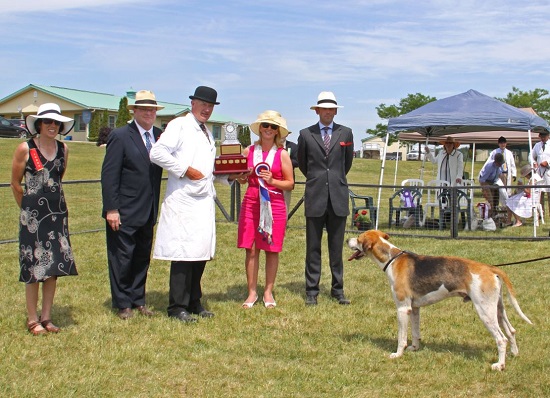
Canadian Grand Champion Farquhar with (l–r) Apprentice Judge Katherine Selby, huntsman, Green Mountain Hounds (VT); Judge Dr. Jon Moody, MFH, Mooreland Hunt (AL); Toronto and North York huntsman John Harrison; Mrs. Alice Tyacke; and Judge Richard Tyacke, MFH and huntsman, Sir Watkin Williams-Wynn’s (UK). / Denya Massey photo
Toronto and North York Farquhar 2014 was judged Grand Champion of Show at the Canadian Foxhound Show on Saturday, June 18, 2016. This was the third Grand Championship for the hunt in the last three years.
It has to be exceptionally gratifying to John Harrison, who returned as huntsman just two years ago, as all three grand champions go back to bloodlines he introduced to the pack during his earlier term as huntsman twenty years ago. Common to the pedigrees of all three, going back three generations, is Toronto and North York Crafty 1995 by their Freedom 1992.
In 1995, while Harrison was hunting the Toronto and North York pack in his first stint (1991 to 1996), he received a draft from the Berkeley (UK). One was Ballad 1987, who arrived in whelp to Berkeley Freshman 1984. Freshman was by Captain Ronnie Wallace’s Exmoor Freestone 1981. “Freestone is the key,” Harrison said.
Blue Ridge Wentworth 2015 Is Grand Champion Foxhound at Bryn Mawr
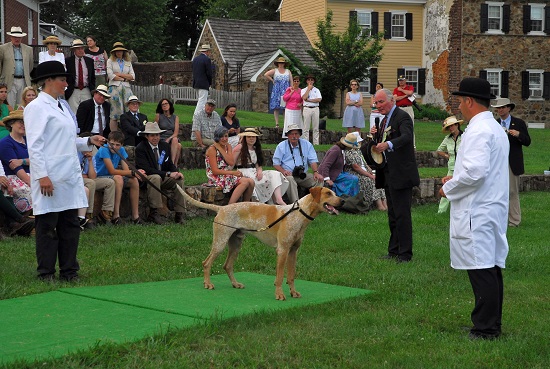
Bryn Mawr 2016 Champion Foxhound of Show is Blue Ridge Wentworth 2015. Huntsman Graham Buston (right) shows Wentworth; Cheri Buston holds the lead. Judge Ian Farquahar, MFH, Duke of Beaufort’s (UK) explains to the spectators the points of conformation upon which he bases his decision. / Chris Cancelli photo
Displaying activity, purpose, and movement while chasing the biscuit, Blue Ridge Wentworth 2015 staked his claim to the Midland Foxhound Trophy for Champion Foxhound of Show at the Bryn Mawr Hound Show on Saturday, June 4, 2016. It was no walk-away for the first-year English hound from Blue Ridge. He faced stiff competition from the other division champions, one of which was the Crossbred, Midland Striker, who came to Bryn Mawr having already been judged Grand Champion in two of this season’s sanctioned hound shows. Striker was Reserve Champion this day.
The class was judged by Ian Farquhar, MFH and huntsman of the Duke of Beaufort’s Foxhounds (UK). Farquhar was careful to explain to the spectators, using the hounds as examples, how he evaluated conformation and came to his decision.
Midland Striker Is Grand Champion at Virginia
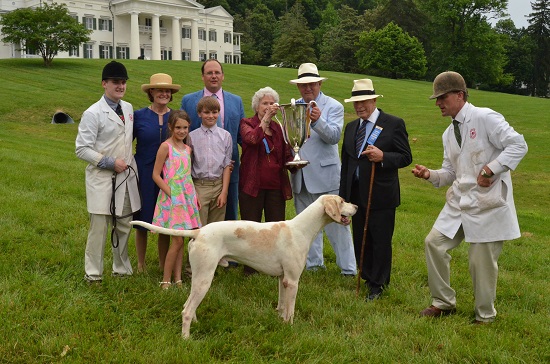
Midland Striker 2015 captures the William W. Brainard, Jr. Perpetual Cup on the lawn in front of the Morven Park mansion. Midland huntsman Ken George holds Striker’s attention as three generations of Lamptons and Hardaways gather to accept the trophy from Virginia Foxhound Club President Joan Jones. Dr. John W.D. McDonald, MFH (lapel ribbon) judged this final class of the day. / Nancy Kleck photo
With six hundred foxhounds from thirty-seven hunts showing in five separate rings at the Virginia Foxhound Show at Morven Park on Sunday, May 29, 2016, the hour gets late before the four individual division champions—American, Crossbred, English, and Penn-Marydel foxhounds—finally get their chance to face off for the William W. Brainard Jr. Perpetual Cup designating the Grand Champion of Show.
The hour arrived, somewhere around six p.m., as four handsome champions came together before Dr. John W.D. McDonald, MFH, judge of this prestigious class. It had been a long, hot, and tiring day for everyone—spectators, judges, handlers, and hounds alike. But one foxhound looked like he was still ready and happy to run from one end of the field to the other, which he did when asked to show his movement. With long, powerful, yet graceful strides that looked like a slow-motion camera had been set up just for him, Midland Striker made his statement and would not be denied.
“He is one of the most beautiful movers anyone could expect to see,” said Judge McDonald in admiration. “And he has perfect conformation.”