
This essay is adapted from J. Blan van Urk’s The Story of American Foxhunting as published in The Derrydale Press Treasury of Foxhunting edited by Norman Fine. At the time of van Urk’s writing (1940), the Brooke family had maintained the breeding of their hounds for nearly three hundred years. Today, while it may be doubtful that a purebred Brooke hound could still be found, the genes live on in various old American foxhound strains.
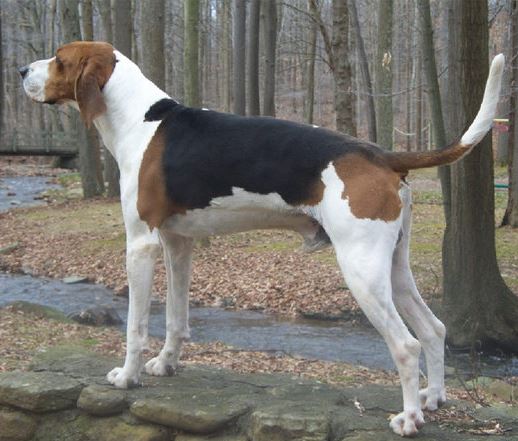 Walker foxhound. Foundation bloodlines were contributed by the Brooke hound.
Robert Brooke, Esq., came to Maryland from England in 1650 with a pack of hounds. He’d been appointed a member of the Privy Council of State for the Province of Maryland by Lord Baltimore, who wished to increase Maryland’s population.
Arriving with Mr. Brooke and his hounds aboard his private ship were a wife, ten children, (eight of whom were boys), twenty-one man-servants, and seven maid-servants—forty persons in all and a meaningful contribution to the fulfillment of Lord Baltimore’s wishes. Brooke’s hounds more than satisfied another of Lord Baltimore’s foremost requirements—that each colonizing family bring at least one dog.
The plantation named De La Brooke (the namesake of the contemporary Maryland Hunt recognized by the MFHA in 1976) consisted of only two thousand acres, but there were some in those days who considered this an enviable hunting ground. Because of Mr. Brooke’s prominence in Colonial affairs, records of his activities have survived. For this reason, he is the first known Master of a pack of hounds in America, and the year 1650 must be the first date in any chronological history of American foxhunting. Of course it is extremely unlikely that his pack should have been kenneled for foxhunting alone upon arrival in this country.
Mr. Brooke’s contribution to American sport should not be minimized, however, both for his interest in the chase and for the basic hound blood-strain he introduced, later so important in developing American hounds. His death only five years after coming to the Colonies ended what might well have been a long and merry acquaintance with the fox—and exclusively; but although his life in Maryland was brief, “he left a lasting impression upon the history of his day.”
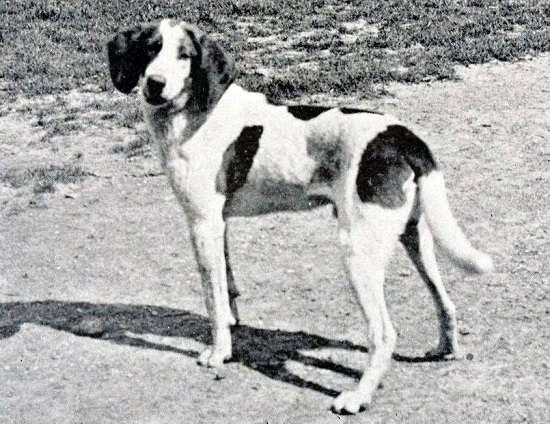 An early Trigg hound. Foundation bloodlines were contributed by the Brooke hound.
What is more remarkable than any influence Mr. Brooke’s five years may have had on early Maryland is the fact that his hounds have lived and been bred by the Brooke descendants right down to the present—290 years of American breeding by one family. To be sure there have been many crosses, and other hound breed reputations have grown to high prominence; but the Brooke hound has been throughout the years, and remains today, a distinct entity. As Roger Williams—a great hound breeder, student, and authority—expressed it in 1905, “Allowing for the many outcrosses during all these years, there is still resemblance enough to justify these claims…and the owners of them [Brooke hounds] point with pride to the long, unbroken line of ancestry.”
The original Brooke family moved from Prince George’s County (Maryland) to Montgomery County, where they established themselves at Sandy Spring, Brooke Grove, and Willow Grove. The eight boys and their sons, and the sons following, all kept and bred hounds—and hunted fox (among other things), some mounted, some afoot, some by day, some by night. Records show that the Brooke hound formed basic stock for such famous strains as the Trigg and Walker.
Posted February 20, 2017