Bull Run Hunt On a Spree at Belle Meade
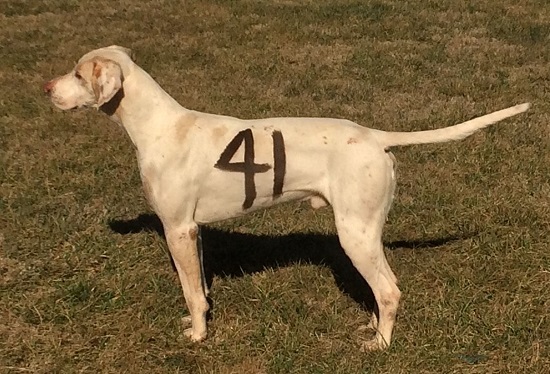
Bull Run’s Spree was the top scoring foxhound in the Belle Meade Hunt Foxhound Performance Trials held in Thomson, Georgia on January 20 and 21, 2017. Of thirty-six hounds competing, Spree won three of the four scoring categories: Hunting, Trailing, and Endurance. In the Full Cry category, he was second.* His combined score led the field in points.
Six foxhounds from each of six hunts competed—Belle Meade Hunt (GA), Bridlespur Hunt (MO), Bull Run Hunt (VA), Farmington Hunt (VA), Fox River Valley Hunt (IL), and Mill Creek Hunt (IL). The three top scoring hunts, based on the combined scores of their hounds from first to third, were: Bull Run, Fox River Valley, and Belle Meade.
Trial Huntsman Sam Clifton was called upon during the award ceremonies to announce his choice—the hound he’d most like to take back to his own kennels. Huntsman’s Choice is an honorary award and receives no official prize, but, as in past trials, Sam’s reasoning for his personal choice was worth hearing.
Any Reasonable Horse
This is the first story (and the shortest) of thirty-two short stories from Foxhunting Adventures: Chasing the Story by Norman Fine, The Derrydale Press.
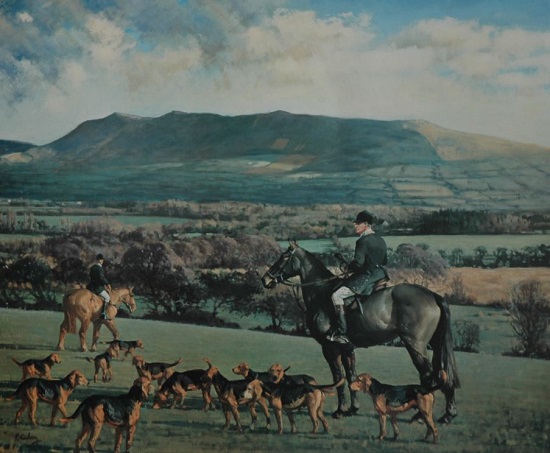
Master and huntsman Thady Ryan, whipper-in Tommy O’Dwyer, and the Scarteen hounds at Knocktoran Bog (1982) from a print of the oil painting by Peter Curling
When the nights turn crisp and the dinner talk turns to tales of foxhunting, I like to share a bit of philosophy imparted to me by that special animal—part horse, part cat, and all heart—the Irish hunter. That remarkable creature understands something of the flavor of life. He never allows natural caution, reticence, or conservatism to limit his perception of what’s possible.
The Scarteen hounds were hunting a most unusual piece of country in Kilcommon, County Limerick this day. A wild and forbidding landscape, far from the well-traveled roads, high into the hills, it was unknown country even to Master Thady Ryan. To complete the scene, a dense fog obliterated every feature of the landscape.
Irish Horses Treasured in New Zealand Hunt Field (2)
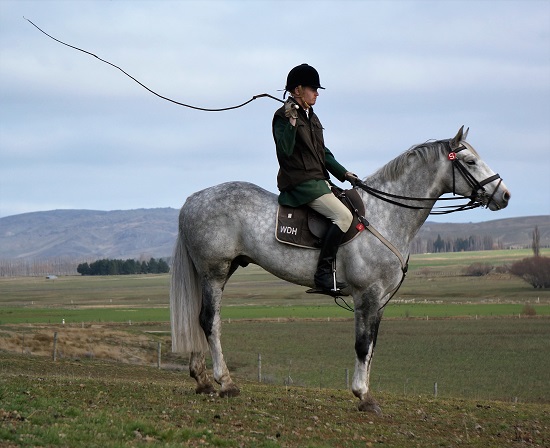
Ben Lott hunts Gavin and Tracy Crossan’s Brian (aka Ballineen Blue Mountain by Bealagh Blue ex Ballineen Glen Abbess), a 16.2-hand Irish grey stallion imported from England in 2011.
In the beginning there was Thady Ryan. Master and huntsman of the three-hundred-year-old family-owned Scarteen hounds of County Limerick, Ireland, Thady retired in 1986 to Temuka, South Island, New Zealand with his New Zealand-born wife Anne. The following summer, Thady and Anne imported Kingsway Diamond (King of Diamonds x Bawnlahan Beauty), a chestnut 17-hand Registered Irish Draft (RID) stallion from Ireland.
To their surprise, another RID stallion arrived, consigned to Glyn and Edwina Morris of Wynyard Lodge Stud in Christchurch, also South Island, New Zealand.
“Laughton’s Legend (Lahinch x Starlight), a 16.2-hand chestnut, was on the same flight to Christchurch as Kingsway Diamond,” said Lesley Spence of Christchurch, secretary of the Irish Draft Horse Society of New Zealand (IDHSNZ). “On that flight was also a King of Diamonds mare, Kilmarna Queen. Suddenly, there was a competition: both men thought they would revolutionize the New Zealand sporthorse breeding industry.”
Venerable Quorn Embraces Latest Technology
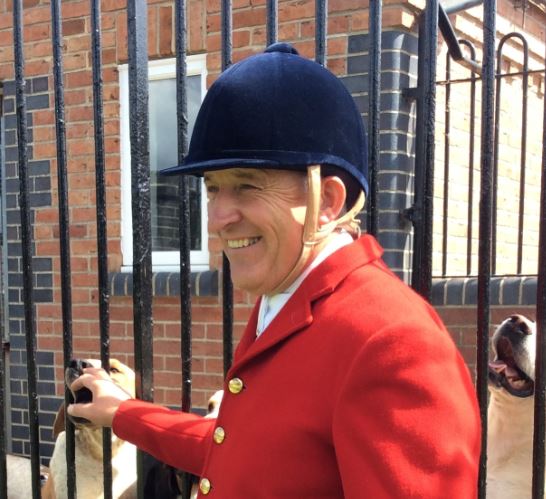
Quorn huntsman Peter Collins rides a motorbike in the summer and wouldn’t dream of getting on without a proper safety helmet. He decided it was time to make a stand for mounted hunt staff, so he worked with Charles Owen to design the QH Hunter. The cap is available directly from the Quorn at £250.
Would you hunt in a safety helmet if it more nearly resembled the classic and traditional hunt cap? If so, maybe the new QH Hunter model will satisfy you. It satisfies Quorn huntsman Peter Collins, one of England’s premier huntsmen. And it satisfies the Quorn Hunt, founded in 1698 and renowned for their uncompromising standard of sport, style, and turnout.
Years of technological development have been invested in safety helmets, and the benefits are well-proven. Yet, many professional huntsmen (and Masters as well) continue to shy away from replacing their traditional headwear. It’s understandable. Most manufacturers have given the foxhunting community—a small segment of their market—short shrift in choices of traditional-appearing hunt helmets. Charles Owen is one helmet manufacturer, however, that has worked with the Quorn at making safety headwear for foxhunters that looks as much as possible like the classic hunt cap.*
A Horse Called Guitar
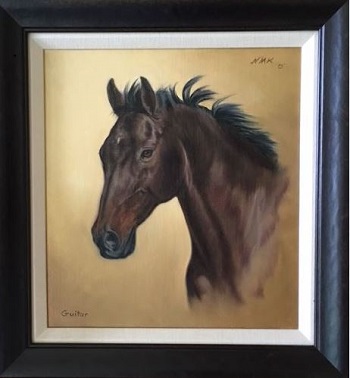
Guitar, oil on canvas, by Nancy KleckI want to talk about a horse. After nearly fifty years of hunting—around North America, Canada, Ireland, and England—on my own horses and on countless strange horses for the first time, I speak from some experience. Most of the horses have been darn good, even many of the strangers. A memorable few of the strangers have been especially good! Very few, thankfully, have been rank or dangerous. But I have to talk about one horse in particular—one of my own.
His name is Guitar. Yes, that simple. He’s registered with the Jockey Club just that way. Plain dark brown, sixteen-hand high, he was bred by the late Bill Backer of Smitten Farm in The Plains, Virginia. He’s by Our Native out of Royal Pastime by Tudor Grey. Sixty-four percent of Our Native foals were winners, and fifty-three percent of Tudor Grey grand-foals were winners. Guitar was bred to race, but he was never even put in training—no tattoo. My good luck.*
Accusations Against UK Hunt Devastating
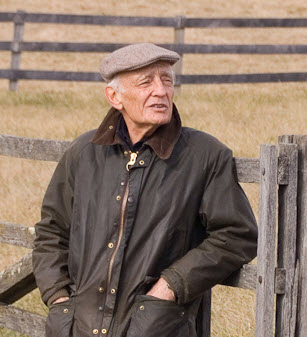
Karen L. Meyers photoIf the accusations are proven in court, the South Herefordshire Foxhounds, established in 1869, could be forced to dissolve—their hunting country redistributed to neighboring hunts. If the accusations are proven, a few misguided outlaws may have killed any chance of reversing Britain’s Hunting Act, certainly for the near future. If the accusations are proven, all foxhunting is tarnished.
Video footage taken secretly by anti-hunting activists purports to show two live fox cubs placed into the kennels with foxhounds, later removed lifeless, the carcasses placed in a dumpster from which they were later recovered and photographed by the activists.
If true, this wouldn’t even contravene the Hunting Act of 2004. It would be a breach of Britain’s Animal Welfare Act. It would also breach accepted hunting practices for the past century or more. All as a new Conservative-led government and the Countryside Alliance would like to convince the British populace that foxhunters can police themselves!
Foxhunters Will Benefit From NFL-Financed Research
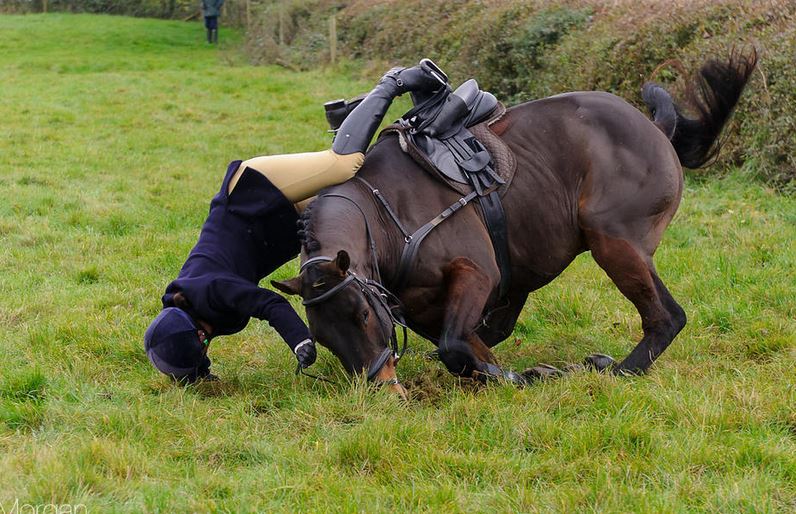
National Football League/industry/government consortium funds research by riding helmet manufacturer to reduce sport-related head injuries. / Nico Morgan photo
Charles Owen, a leading developer and manufacturer of protective equestrian head wear, has been selected as one of five finalists to receive funds for the further development of new materials for protection from head injuries. Funding for the research has been made available by Head Health Challenge III, a partnership of the National Football League (NFL), Under Armour, General Electric, and the U.S. Department of Commerce’s National Institute of Standards and Technology (NIST).
Helmet design expert, Roy Burek, President and CEO of Charles Owen Inc., in collaboration with Cardiff University (Wales), Cambridge University (UK), and the High Performance Computing Center (Wales), has been working on the development of new energy absorbing materials based on the ancient Japanese art of origami. By using super-computers to analyze new material structures that fold, hinge, and compress, Burek aims to create new multi-reaction materials capable of protecting against soft falls differently than harder falls, oblique impacts differently than direct impacts. Their revolutionary material is called C3.
Eleven Years of England’s Hunting Act
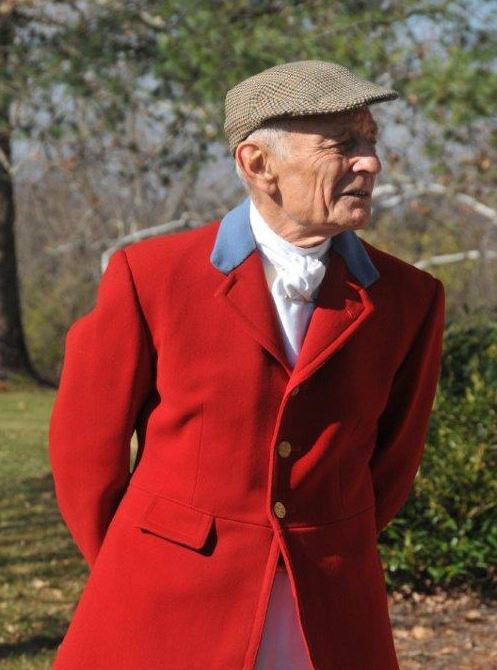
Liz Callar photoIt’s been eleven years since England’s Hunting Act of 2004 was enacted by the Labour government, and ten years since the Act was put into effect. So what happened this year?
After the May elections, Prime Minister David Cameron found himself leading a Conservative Party majority government for the first time. Pro-hunting Conservatives were ecstatic and looked to Cameron to make good on his pledge to bring a free vote to the floor in Parliament. They sought first to abolish the Act, then later hoped to at least modify the Act. Cameron, however, was never sufficiently confident to bring either proposal to the floor. Too many members of his own party, not to mention the Liberal opposition, pledged to oppose him on the issue.
That was the bad news. There was news this month, however, with potential for positive development.
Eleven Years of England’s Hunting Act
Liz Callar photoIt’s been eleven years since England’s Hunting Act of 2004 was enacted by the Labour government, and ten years since the Act was put into effect. So what happened this year?
After the May elections, Prime Minister David Cameron found himself leading a Conservative Party majority government for the first time. Pro-hunting Conservatives were ecstatic and looked to Cameron to make good on his pledge to bring a free vote to the floor in Parliament. They sought first to abolish the Act, then later hoped to at least modify the Act. Cameron, however, was never sufficiently confident to bring either proposal to the floor. Too many members of his own party, not to mention the Liberal opposition, pledged to oppose him on the issue.
That was the bad news. There was news this month, however, with potential for positive development.
2006 Masters Seminar Featured Distinguished Panelists
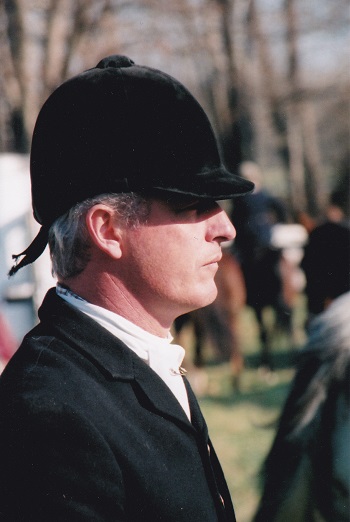
Tony Leahy, MFH moderated a distinguished panel.
The New Masters Seminar, organized by the MFHA and held in Chantilly, Virginia on April 8, 2006 was designed to provide guidance for new Masters. In testimony to the strength of the panel, however, the Seminar attracted over forty Masters, many of whom could hardly be considered ‘new.’ While five of the Masters who attended had less than ten years hunting experience, seven had been hunting for more than forty years, and fully half of the group had more than twenty years hunting experience each.
The panel was composed of five former MFHA presidents: Benjamin H. Hardaway, III; J.W.Y. ‘Duck’ Martin, Jr.; Dr. John W.D. McDonald; C. Martin Wood, III; and James L. Young. This august group came to the party offering a total of 270 years of foxhunting experience!
Among the topics discussed were: Managing the Breeding Program; Managing Professional Staff; Private, Subscription, or Membership Packs; Land Conservation; Breeding Hounds for Coyote or Fox; Sportsmanship; and Tradition. The Panel Moderator was Tony Leahy, MFH.