Foxhounds With a Difference
Mr. Stewart’s Cheshire Foxhounds (PA) boasts a sporting field of superb horsemen and women that love to gallop and take their own lines over the post-and-rail line fences in their country. Seven years ago, the Cheshire Masters and staff embarked on a bold experiment to breed a new foxhound for that country. Our feature article below tells of their decision to cross the The Old English (also called the Traditionally-Bred English) foxhound and the Penn-Marydel foxhound.
Their plan was a gamble because the two breeds are about as dissimilar in type as foxhounds get, and the crossing of the two types would produce litters that varied greatly from pup to pup. However, the Cheshire Masters and huntsman believed that the strong points of each type would tend to compensate for the perceived weaknesses in the other and result in a foxhound superior to either type.
Here are some examples of the perceived differences between the types. Just remember that generalizations are only generally valid!
Peer Pressure
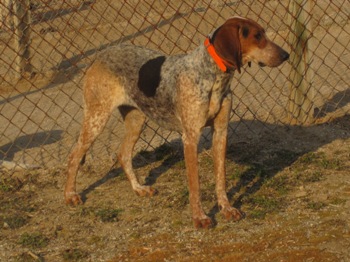
Emmy LouHounds are fascinating to watch, even after so many years at this game. Consider a recent Carrollton (MD) hound exercise, for example.
We were exercising the pack around the kennels and introduced our new entry, Emmy Lou, a blue tick Penn-Marydel that was recently drafted from a hunt in the Carolinas. I picked her up last week from Doc Addis who transported her for us from the Huntsman’s Weekend down in Emporia, Virginia. She is a pretty, petite thing—timid—but seems to have loads of personality. We have all fallen in love with her, and she is getting used to her new home.
As we walked out, she ran about sniffing and exploring with the pack. Occasionally we had to tell her to “pack in,” which she readily responded to. At one point as we were going up a rise, deer bounded out of the woods to our right. I turned to face our pack, and huntsman Dulany Noble told them to “steady up.” She counted the deer: one, two, three, and up to eight, not more than fifty yards or less above us. Our pack watched intently but did not break. Suddenly Emmy Lou broke and went after them. My heart sank. Huntsman Dulany told everyone—canine and human alike—to steady up and she raised her new horn to her lips and blew a lovely melodic note. Emmy Lou stopped, turned, and came running back. We were so pleased, but here’s the cool thing.
Introducing James Barclay, ex-MFH
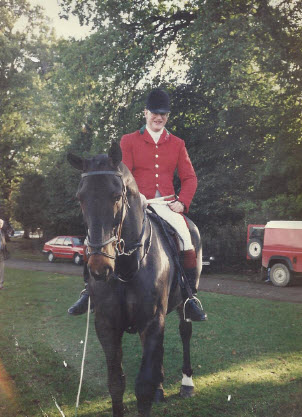
A young James Barclay while Master of the Fitzwilliam Foxhounds (UK)Allow me to introduce James Barclay, a retired Master of Foxhounds in England and descendant of a distinguished foxhunting family. I am pleased and honored to announce that Foxhunting Life will be publishing James’s informative and thoughtful essays in future issues.
James’s family roots are with the Puckeridge Foxhounds, a hunt in Hertfordshire dating back to 1725. His sister has served as Master since 1987. Two brothers, his mother, father, grandfather, and great-grandfather also served as Masters of the Puckeridge, that dynasty starting in 1896.
James’s first day of hunting was with the Puckeridge back in the 1960s. He was astride a donkey, and, by tradition, he wore a small version of the family scarlet coat which each family member going back at least three generations had worn on their first hunt!
The Road to the Kentucky Derby
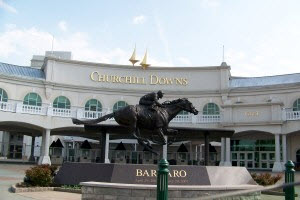
Odds are high that most Foxhunting Life readers will tune in to the Kentucky Derby on the first Saturday in May to watch “the most exciting two minutes in sports.” It’s arguably the finest show of racing talent each year from the horses to the trainers to the jockeys who are all aiming for the glory of winning the Kentucky Derby cup and sharing in the two million dollar purse.
Websites like www.kentuckyderbybetting.com are excellent resources to get you up to date on the background and history of the ‘Run for the Roses.’ There is also a section on Kentucky Derby horse odds which is invaluable if you are planning on increasing the excitement by having a flutter on your favorite contender this year.
It’s easy to get emotionally attached to a horse that you believe can win the big prize. Some foxhunters take the connection even further by buying retired racehorses and giving them a whole new lease on life. Here’s a recent FHL article on Thoroughbreds in the hunting field.
The Silver Horn
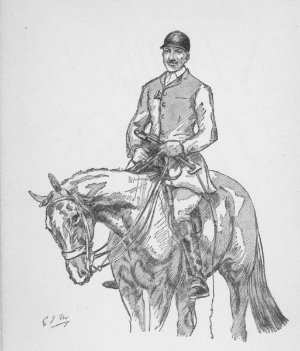
Colonel John Weatherford, MFH by Eleanor Iselin MasonGordon Grand is one of my favorite sporting authors, and his short story, “The Silver Horn,” is one of my favorite foxhunting stories. The reader is transported, in the early part of the twentieth century, to “that venerable hotel on Albemarle Street” in London, which we may readily assume is Brown’s Hotel. Colonel John Weatherford, MFH is relating Florence’s story as she told it to him upon their chance meeting in the hotel dining room after breakfast. I have extracted just the kernel of the story to reproduce here.
Returning from the theater and supper [Florence] had drifted off into a sound sleep, from which she was gently and fancifully awakened without sensing the cause. Her watch showed three o’clock. The roar and rumble of London had faded to its lowest murmur. A midsummer moon filtered through and illuminated the street below. What was it that had so illusively awakened the sleeper? Again she listened. The faint mellow note of a hunting horn drifted up from Piccadilly.
Guilt by Association
We recently ran an article by Anne Hambleton titled “Thoroughbreds: Kings of the Hunting Field.” The article received many enthusiastic Comments and was posted by readers through the social media. Yet despite all the enthusiasm and warm feelings the article generated for this majestic breed, one Thoroughbred retirement organization may have lost the support of an important donor.
Anne wrote about some famous race horses—Steppenwolfer, McDynamo, Lonesome Glory, Private Attack, Buck Jakes—who found second homes in the hunting field. Those horses loved foxhunting, and their riders, sitting atop a fleet, supremely athletic, and bottomless horse that moves like a cloud would have it no other way. Anne made a case for the breed, and she also encouraged foxhunters to look at some of the wonderful candidates available at the many Thoroughbred rescue organizations.
One major retirement organization mentioned the Foxhunting Life article on their Facebook page and proudly told of some of the racetrack retirees they have successfully re-homed for second careers as field hunters. They received several positive responses, then heard from a long-time major donor who left a negative comment about foxhunting being a cruel sport and threatened to stop donating to the organization. Guilt by association.
Naturalist’s Notebook: The Red Fox
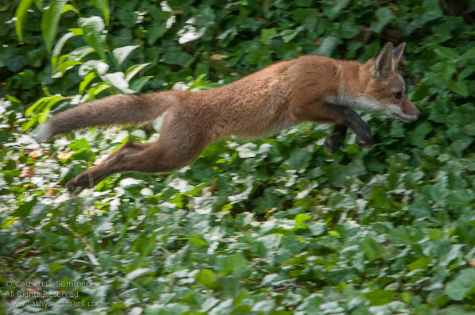
Cathy Summers photo
The red fox (Vulpes fulva) is one of the best-known characters in history and legend, widely spread over the temperate and northern regions of the world. For its combination of beauty and grace and intelligence it has had the attention of artists, poets, and naturalists, and merits the attention of those who would read the signs of the out-of-doors.
The Future of Foxhunting: We Have Seen the Enemy and He Is Us

Foxhunting is and will continue to be embattled on two fronts: (1) animal rights activism and (2) loss of open space. The good news is that we have strategies for dealing with these pressures. The uncertainty rests with our own will and dedication, as Walt Kelly’s cartoon character Pogo told us many years ago. Now and in the future, we need to look harder within…at us.
Thoroughbreds: Kings of the Hunting Field
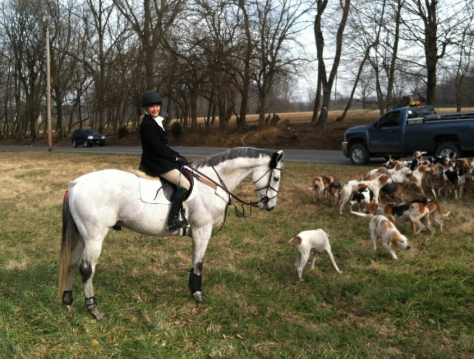
Nina Siepel on Steppenwolfer, out with the Cheshire hounds this year
Consider the happy life of Steppenwolfer (by Aptitude out of Wolfer): lots of treats; a big field with clover and buddies; and, from September to March, running around the countryside with a lot of other horses chasing a pack of hounds. A far distance from running third to Barbaro (by Dynaformer out of La Ville Rouge) in the Kentucky Derby and second in the Arkansas Derby in 2006.
Gelded and purchased by Gail and Dixon Thayer as a steeplechase prospect, his short steeplechase career wasn’t as stellar as hoped for. But he’s one happy puppy now. And Nina Siepel, who hunts him with Mr. Stewart’s Cheshire Foxhounds (PA), always wears a big grin, as if she still can’t really believe her good fortune. I’m not sure who is the luckier of the two.
Dedicated Website Lists Field Hunters for Sale
Looking for a Field Hunter? Try FoxhuntingHorse.com, a website dedicated to our discipline. Certainly, horse marketing websites have been used successfully for years, but if you were looking for an experienced foxhunter, you had to wade through a lot of horses in a lot of other disciplines.
Many of those ads, after telling you that the horse is a great mover, snaps its knees, has four flashy white socks, and is schooling successfully over two feet, finish with the line, “Would make a great field hunter.” Well, maybe, but not just yet.
FoxhuntingHorse.com was created by Lisha Marshall, an experienced horsewoman and foxhunter. The website segregates field hunters into categories: First Flight, Second Flight, Hilltopper, Child’s Hunter, Staff Horses. Each horse’s experience is described in terms that are meaningful to the foxhunter.