
The Fox’s Morning & Other Stories
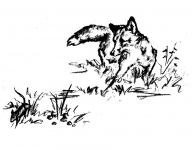
W.H. DeCourcy Wright suffered a fatal fall from his horse while foxhunting on February 3, 1951. The horse stepped in a groundhog hole, throwing his rider heavily and breaking his neck. For years after that, Wassie Ball, another larger-than-life personage from the distant mists of Elkridge Harford Hunt Club history, albeit from a slightly more recent era than Mr. Wright, would thrill local youngsters by showing them that exact groundhog hole and then poking around in the loose dirt and stones surrounding the hole to find tiny shards of glass, ostensibly from the deceased foxhunter’s spectacles.
For my part, other than having a vague knowledge that DeCourcy Wright was one of the defining personages from the glory days of our hunt club before and after The War, and having an exact knowledge of which groundhog hole brought about his demise, I knew little about him.
Little, that is, until his grand-daughter Ann McIntosh left in my mailbox the collection of his writings that comprise this book. It turns out that this is one of the freshest, brightest, most brilliant and original collection of “sporting” pieces I have ever read. By the way, “sporting” is intended to be descriptive, not limiting. This is wonderful writing, period.
To Evoke an Emotion
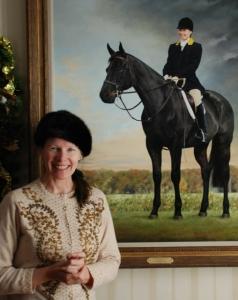
I was born in France, raised in Holland, and came to the United States in 1988. While visiting friends over Christmas, I met my future husband and decided to study Fine Arts. I graduated summa cum laude from Northern Virginia Community College, and summa cum laude from the University Of Maryland in Studio Fine Arts. In 1993 I moved from Washington, DC to our farm in Loudoun County, Virginia, and established my studio.
I had been painting large abstract paintings in art school, so I began painting impressionistic landscapes. One day a neighbor asked if I could copy a George Stubbs painting of Mares and Foals from a table coaster. Since horses are my second love, I gladly accepted my first commission. A second Stubbs commission followed, and I started to develop an interest in sporting art.
Horse Tales and Hunt Talk
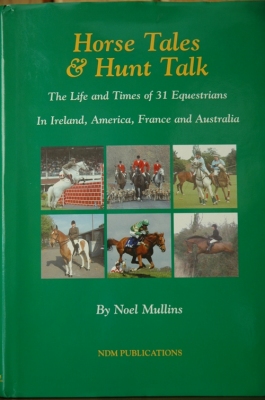
Where else but in the hunting fields of Ireland could you have found such larger-than-life and totally disparate characters as Lady Molly Cusack-Smith, Elsie Morgan, American John Huston, and Thady Ryan? Sadly, those four have passed on, but others—Michael Dempsey, Willie Leahy, and Aidan O’Connell—wear big shoes as well and are very much with us still! Also included in this delightful book of personality profiles are North America’s Nancy Penn-Smith Hannum and a smattering of French and Australian characters whom you should also meet.
Photo-journalist Noel Mullins is a regular contributor to The Irish Field, and his work has also been published in Horse and Hound, Baily’s, Hunting and Country Illustrated in England, and The Chronicle of the Horse and Foxhunting Life in the U.S.
“I started hunting with the Galway Blazers with Michael Dempsey when I was eight years old in 1952 on the milkman’s pony, Teapot, but only after I helped him on his delivery rounds!” recalls Mullins.
Sporting Art with Punch
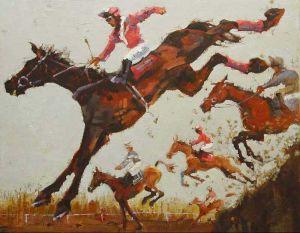
When I look at Susan Smolensky’s oil paintings I hear horses splattering brush, I feel the jocks’ precariousness as they go airborne. Grass flies and a horse grimaces momentarily as it’s snagged in the mouth. There’s not a strip horse in the lot, but the artist’s exaggerations add to the dynamics of the instant.
The Art of Foxhunting
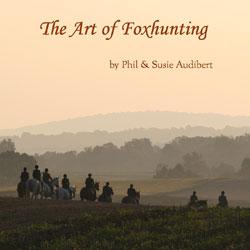
The title of this captivating book is obviously a play on words. It showcases the photographic art of Phil and Susie Audibert and at the same time opens our eyes to the inherent artfulness of our sporting endeavor. I have used photographs by the Audiberts in Covertside, in the Millwood House foxhunting calendar, and in Foxhunting Life with great pleasure in the past, so I admit that I am not an impartial reviewer.
The photography is beautiful, not only by virtue of the artistic talent of the shooters in seeing and composing balanced and flowing images, but also because they have done the hard work in the field away from the meet—waiting in the country, sometimes in vain but occasionally rewarded by the opportunity for that single-chance shot of action and beauty. And in all kinds of weather! Some of my favorite images that resonated with old memories were dull, cold, wet hunting scenes blurred by falling snow and sleet.
Secretariat
 Secretariat
by Raymond Wolfe
Updated Edition
Foreword by Ronald Turcotte
The Derrydale Press
224 pages, color
The toss of a coin determined the ownership of the foal that was to become the greatest racehorse ever bred. By losing the toss, Penny Chenery had to settle for the colt that was foaled the following year. When it finally arrived she named it Secretariat.
Some track pundits laughed when the big, fat colt with the ravenous appetite came to the track in training. He was even-tempered and relaxed but possessed a clownish streak. Trainer Lucien Laurin teamed him up with Gold Bag who “wasn’t much of a hoss” according to the grooms, but Gold Bag still worked faster than Secretariat. Then one early morning the youngster flashed by and trainer Lucien Laurin looked at his stopwatch in disbelief.
The Simple Game: An Irish Jockey’s Memoir
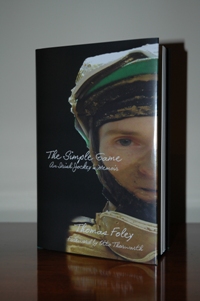
The Simple Game:
An Irish Jockey’s Memoir
by Thomas Foley
Foreword by Otto Thorwarth
Caballo Press of Ann Arbor Book, Ann Arbor, Michigan
2010, 163 pages, ISBN-13: 9780982476659
Thomas Foley was an empty-headed (by his account) seventeen-year-old when he came to America from Ireland to pursue a career in jump racing. This month he will be seen by millions of movie goers as he plays the part of Secretariat’s exercise boy in Walt Disney’s long-hyped movie about the great racehorse. Between the two events, which bracket a period of twelve or thirteen years, young Foley has experienced a bit of life.
I Live What I Paint
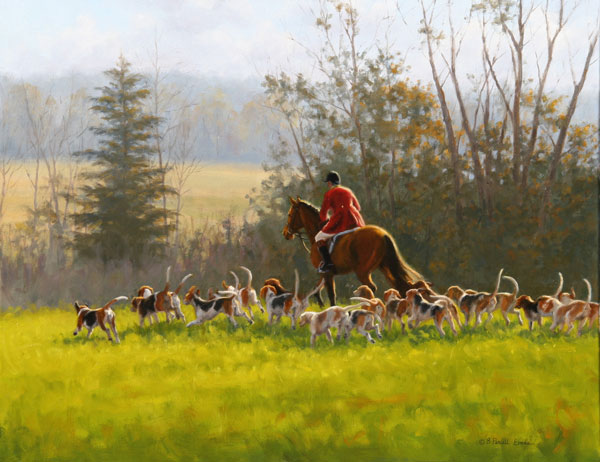
I live what I paint, immersing myself in my subject matter and painting the animals and subjects that I know intimately. My art training includes six years of commercial and fine art instruction. I have been a professional fine artist for thirty-two years, painting mostly horses and equine sporting scenes. Canine and wildlife subjects are also a passion.
A horse owner and rider for forty-two years, my competitive days have given way to more time in the studio, creating paintings that I hope will stir emotion in the viewer. My paintings are found in collections nationally, in Europe, and also in galleries and shows in this country.
Foxhunting Forever
Last month FHL published Ema Klugman’s winning entry in the United States Pony Club annual Hildegard Neill Ritchie Joys of Foxhunting Writing Contest for 2010. Her excellent poem Foxhunt has since passed from the Home Page, but can be found under the Horse and Hound drop-down menu by clicking on Literature.
This month, we bring you Maria Filsinger’s well-written entry, Foxhunting Forever, which was awarded second place in this year’s contest. As one of the contest judges, I liked how Maria tied age to youth as it relates to the continuum of foxhunting.
Blair’s Memoir: An Astonishing Claim
In an astounding revelation, former British Prime Minister Tony Blair claims to have deliberately sabotaged the Hunting Act of 2004 so that foxhunting would continue.
In his newly published memoir A Journey (Random House), Blair says that the hunting ban was “one of the domestic legislative measures I most regret.” He claims to have (1) engineered sufficient loopholes in the Act so that hunting could continue and (2) instructed his Home Office minister to steer the police away from enforcing the law.