Six Centuries of Foxhunting: An Annotated Bibliography

Book Review by Norman Fine
Six Centuries of Foxhunting: An Annotated Bibliography by M.L. Biscotti, Foreword by Norman Fine, Rowman & Littlefield, 2017, 499 pages, illustrated, $85.00 hardbound, $80.00 eBookWithin Six Centuries of Foxhunting, Matthew “Duke” Biscotti has collected the essential facts of every bit of literature on the subject of foxhunting that was published prior to the year 2000. A lot of years, a lot of sport, a lot of huntsmen, horses, hounds, and foxes for many lifetimes.
Biscotti’s volume is destined to be a bible for antiquarian booksellers, scholars, collectors, and writers of sporting literature. But the book’s appeal will be a great deal broader. Biscotti gives us so much related and fascinating information about the listed author, the subject, and the times that the volume invites browsing, as does a good encyclopedia.
How to Tame a Fox (and Build a Dog)
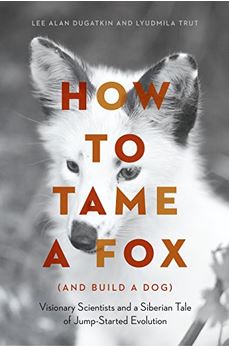
How to Tame a Fox (And Build a Dog) by By Lee Alan Dugatkin and Lyudmila Trut, The University of Chicago Press, 2017, 216 pagesIt is accepted science that dogs evolved from wolves about fifteen thousand years ago. One can imagine, back in primitive times, certain needy wolves sidling up to man for food and shelter. Or orphaned cubs being saved by primitive families. In those relationships that proved successful, both wolf and man discovered advantages. Even disregarding love and companionship (those were harder times), the wolf was assured access to food and shelter in all seasons, and man discovered a hunting partner that contributed to his well-being and that of his family. The domesticated wolves, genetically disposed to the relationship, bred with others so disposed, and succeeding generations over the millennia evolved into purpose-bred dogs.
But just how did that evolution occur? It hasn’t been recorded. What if you could speed up the process and witness it? Two Soviet geneticists tried to do just that. They wanted to try to breed foxes as friendly to people as dogs, and this is their story—“part science, part Russian fairy tale, and part spy thriller,” says The New York Times Book Review.
Rockbridge Hunt’s Reading Group: A Win for Foxhunting
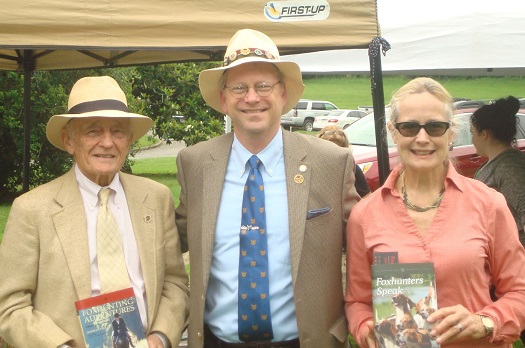
Rockbridge Hunt Joint-Master Hugh Brown (center), described his hunt’s successful reading group to writers Mary Kalergis and Norman Fine.
“Tell me a story,” is one of my favorite sentences in the English language. So I responded enthusiastically when Hugh Brown, MFH told me about the reading group organized by the Rockbridge Hunt (VA). The Masters hit a responsive chord. Even members of nearby hunts have been attracted to join.
By keeping the literature of foxhunting alive, the Rockbridge Masters have found another way to further engage their members into this sport we all love. What better way to absorb our history and traditions while reveling in the humor and entertainment of a good story?
“The reading group is the brainchild of longtime Master Cindy Morton,” says Brown who raided his extensive library to help kick-start the operation. “We specifically didn’t want to limit it to Rockbridge Hunt members, and we definitely wanted to focus on foxhunting. We’ve had great discussions on related subjects like big game hunting in Africa and bear hunting, but we always return to the fox (and coyote).
The Epping Hunt
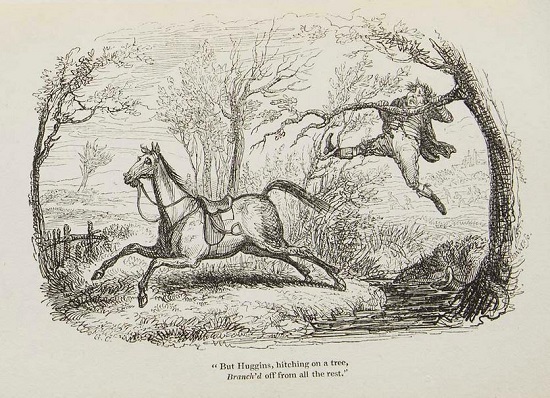
Here are selections from The Epping Hunt, Thomas Hood’s humorous 1829 epic poem about shopkeeper John Huggins, who goes hunting one day astride a horse that he shares with his neighbor, Fig.
George Cruikshank was the illustrator for Thomas Hood’s epic poem.
A stolid man of business was John Huggins…
Six days a week beheld him stand,
His business next his heart,
At counter with his apron tied
About his counter-part.
With a sporting core…
For all the live-long day before,
And all the night in bed,
Like Beckford, he had nourish’d “Thoughts
On Hunting” in his head.
The Horse of Your Heart
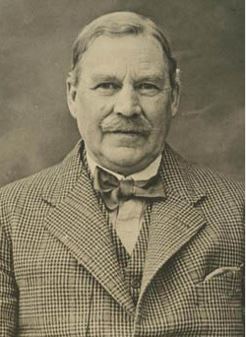
William Henry Ogilvie was born in Scotland, but spent the decade of his twenties in Australia, a country that captivated him. He had a deep love of horses and traveled down under breaking horses and droving at the cattle stations. He explored the outback widely, camping as he went, and much of his poetry was written in and about Australia. Upon returning to England Ogilvie settled into a countryman’s life of riding, foxhunting, and writing.
William Henry Ogilvie / John Kinmont Moir portrait, 1937When you’ve ridden a four-year-old half of the day
And, foam to the fetlock, they lead him away,
With a sigh of contentment you watch him depart
While you tighten the girths on the horse of your heart.
There is something between you that both understand
As it thrills an old message from bit-bar to hand.
As he changes his feet in that plunge of desire
To the thud of his hoofs all your courage takes fire.
The Ride of My Life: Memoirs of a Sporting Editor

The Ride of My Life: Memoirs of a Sporting Editor by Michael Clayton, Merlin Unwin Books, $30Before his retirement, author Michael Clayton probably had the best job in the world—editor of Horse & Hound magazine in Great Britain. He led the magazine for more than two decades—from hunting’s heyday through the bad times, when laws were passed to prevent hounds from chasing a fox. Now Clayton has given fellow foxhunters a chance to share his adventures in his memoir, The Ride of My Life: Memoirs of a Sporting Editor. And we are lucky to get to go along for the ride.
Clayton writes that he once read that a happy adult is one who feels he made his childhood dreams come true. An only child, his youth was overshadowed by World War II, and he remembers nights dashing to the family air-raid shelter at the foot of the garden. “If this sounds grim,” he writes, “it was not. We were generally safer in Bournemouth than those living in London.…”
But horses beckoned. When he was seven, Clayton, an only child, announced that he wanted to learn to ride, and to his surprise, his parents agreed instead of saying wait until after the war. The Longham Riding Stables, a bit run-down and shabby, were just a thirty-minute bike ride from his home and were “my first gate-way to horsemanship and the hunting field.”
Taking a Toss
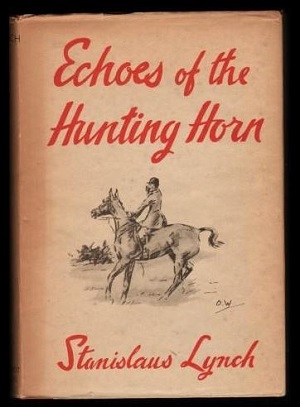
Another short story from the author’s Echoes of the Hunting Horn. Every foxhunter with warm blood will relate to the jumble of self-accusations tumbling through the author’s mind after getting tossed.
Hounds are running hard for the past twenty minutes. Not a semblance of a check. The pace is terrific over a magnificent line of country with big sensible banks. One fairly-wide river, the honest variety, no slime or sponge-like edges; not a trace of wire anywhere. Horse never put a foot wrong since the Gone-Away . . . blowing somewhat now, though; last big wall took some negotiating. It seems to have thinned the already select field to a mere dozen. Thank Heaven for the down-hill gallop after that last stiff hill; horse’s wind feels easier now. Out on the left, riders are heading for a gate. It seems a long way off, and this wall does not seem such a terrifying rasper. Come on, old Challenger, the wall will save time. Steady now, not so fast. Slower still, slower I say, Hup! Over! God bless us, oblivion.
Mr. Nappie’s Grey
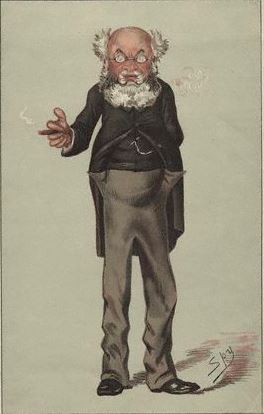
This story, extracted from Trollope’s The Eustace Diamonds, is populated by just about every character you ever met in the hunting field.
Anthony Trollope by Spy in Vanity FairMounted on a bright-skinned, lively steed, with her cousin on one side and Lord George de Bruce Carruthers on the other, with all the hunting world of her own county around her, and a fox just found in Craigattan Gorse, what could the heart of woman desire more? This was to live. There was, however, just enough of fear to make the blood run quickly to her heart. “We’ll be away at once now,” said Lord George with utmost earnestness; “follow me close, but not too close. Just check your horse as he comes to his fences, and, if you can, see me over before you go at them. Now then, down the hill;—there’s a gate at the corner, and a bridge over the water. We couldn’t be better. By George! there they are,—all together. If they don’t pull him down in the first two minutes, we shall have a run.”
Lizzie understood most of it,—more at least than would nine out of ten young women who had never ridden a hunt before. She was to go wherever Lord George led her, and she was not to ride upon his heels. So much at least she understood,—and so much she was resolved to do. She would ride as fast as Lucinda Roanoke. That was her prevailing idea.
Esmé
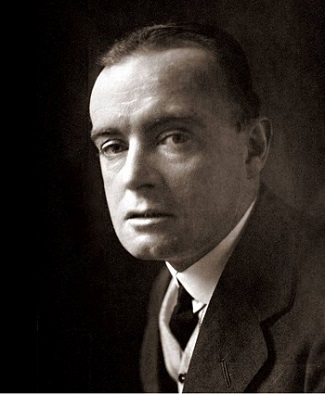
Writing under the pen name, Saki, British writer Hector Hugh Munro (1870–1916) was considered a master of the short story. Influenced by Oscar Wilde, Lewis Carroll, and Rudyard Kipling, Munro himself influenced A. A. Milne, Noël Coward and P. G. Wodehouse.
His witty and sometimes macabre stories satirize Edwardian society and culture. Here’s one that falls into the macabre, the Baroness lacking that measure of sensitivity with which many of the Edwardian British upper class were comfortably unencumbered.
“All hunting stories are the same,” said Clovis; “just as all turf stories are the same, and all…”
“My hunting story isn’t a bit like any you’ve ever heard,” said the Baroness. “It happened quite a while ago, when I was about twenty-three. I wasn’t living apart from my husband then; you see, neither of us could afford to make the other a separate allowance. In spite of everything that proverbs may say, poverty keeps together more homes than it breaks up. But we always hunted with different packs. All this has nothing to do with the story.”
Cubhunting Starts

Illustration by Lionel Edwards The trees and the hedges both touched with a glory, The bracken all turning to gold,And grass in the mornings bejewelled and hoary, Are sights that are good to behold. September is with us, and soon we’ll be hearing, As mists roll away from the dawn,A note that is bandied from […]