
Here are selections from The Epping Hunt, Thomas Hood’s humorous 1829 epic poem about shopkeeper John Huggins, who goes hunting one day astride a horse that he shares with his neighbor, Fig.
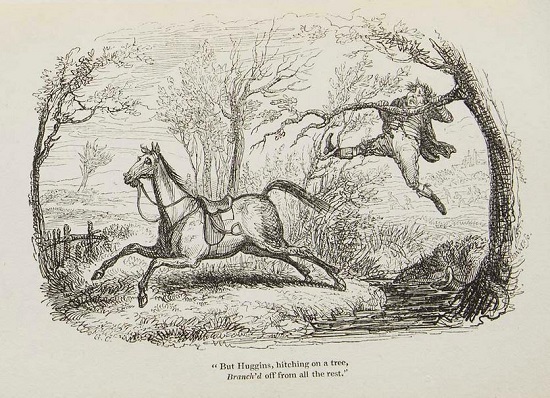 George Cruikshank was the illustrator for Thomas Hood’s epic poem.
A stolid man of business was John Huggins…
Six days a week beheld him stand,
His business next his heart,
At counter with his apron tied
About his counter-part.
With a sporting core…
For all the live-long day before,
And all the night in bed,
Like Beckford, he had nourish’d “Thoughts
On Hunting” in his head.
Our poet, Thomas Hood, loved to play with (and on) words…
Of horn and morn, and hark and bark,
And echo’s answering sounds,
All poets’ wit hath every writ
In dog-rel verse of hounds.
Still playing, describing the horses on the way to the meet…
Some long-ear’d jacks, some knacker’s hacks,
(However odd it sounds,)
Let out that day to hunt, instead
Of going to the hounds!
A canny, savvy old hunting man was John Huggins, like John Jorrocks who followed later in the century…
Now when they saw John Huggins go
At such a sober pace;
“Hallo!” cried they; “come, trot away,
You’ll never see the chase!”
But John, as grave as any judge
Made answers quite as blunt;
“It will be time enough to trot,
When I begin to hunt!”
A sociable man was John Huggins, who didn’t mind taking a drop…
And so he paced to Woodford Wells,
Where many a horseman met,
And letting go the reins, of course,
Prepared for heavy wet.
Playing on words again, speaking of all the tradesmen out hunting…
‘Twas strange to think what difference
A single creature made;
A single stag had caused a whole
Stagnation in their trade.
The stag was off, but so, apparently, were many riders…
Some lost their stirrups, some their whips,
Some had no caps to show;
But few, like Charles at Charing Cross,
Rode on in Statue quo.
Those that kept their seats were amused…
And hunters good, that understood,
Their laughter knew no bounds,
To see the horses “throwing off,”
So long before the hounds.
The carted stag quickly realized the peril of his freedom…
Away, away! he scudded like
A ship before the gale;
Now flew to “hills we know not of,”
Now, nun-like, took the vale.
Flying to the front…
But who was he with flying skirts,
A hunter did endorse,
And like a poet seem’d to ride
Upon a winged horse,
The tradesmen follow…
Some gave a shout, some roll’d about,
And antick’d as they rode,
And butchers whistled on their curs,
And milkmen tally-ho’d!
The race takes its toll…
But even those that galloped on,
Were fewer every minute,—
The field kept getting more select,
Each thicket served to thin it.
For some pulled up, and left the hunt,
Some fell in miry bogs,
And vainly rose and “ran a muck,”
To overtake the dogs.
John Huggins is still in the race, but…
No means he had, by timely check,
The gallop to remit,
For firm and fast, between his teeth,
The biter held the bit.
Trees raced along, all Essex fled
Beneath him as he sate,—
He never saw a county go
At such a county rate!
Our hero finally parts company with his nag…
Yet worse than all the prickly points
That enter’d in his skin,
His nag was running off the while
The thorns were running in!
One farmer runs out of horse and takes advantage…
Now seeing Huggins’ nag adrift,
This farmer, shrewd and sage,
Resolv’d, by changing horses here,
To hunt another stage!
Tho’ felony, yet who would let
Another’s horse alone,
Whose neck is placed in jeopardy
By riding on his own?
Our poet explains how horses are able to jump…
And here of Nature’s kindly care
Behold a curious proof,
As nags are meant to leap, she puts
A frog in every hoof!
Muddy and horseless, John Huggins drenches his sorrows in Wells. Our poet concludes with a moral…
Thus Pleasure oft eludes our grasp,
Just when we think to grip her;
And hunting after Happiness,
We only hunt a slipper.
THE END
Thomas Hood (1799 – 1845) was an English poet, author, and humorist. He wrote regularly for The London Magazine, the Athenaeum, and Punch. The Epping Hunt was republished by The Derrydale Press about a century after its first publication. The epic poem ran thirty-three pages and included six hand-colored plates after George Cruikshank’s original art. Derrydale’s original price for the volume was five dollars. Used editions—Derrydale’s and others—are still available at reasonable prices.
These selections appear in The Derrydale Press Treasury of Foxhunting edited by Norman Fine, 2003.
Posted May 31, 2017