The Hillmen
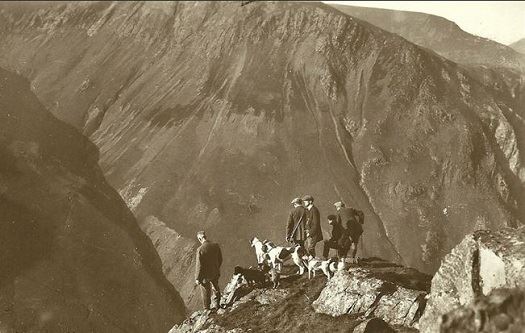
Foxhunters and foxhounds in Cumbria have been hunting the fox from time immemorial in the magnificent Lake District on the English-Scottish border. It is a hard and dangerous place for hounds and humans alike—climbing borrans (stone piles), crags (cliffs), and crossing the scree beds (fallen stone from the crags). It’s country that would ruin a horse the first time out, and so the hunting is on foot. Dangerous and exhausting enough to fill the Cumbrians with pride and feelings of purity for their special brand of hunting.
We don’t turn out in scarlet,
We are more at home in tweeds;
We have no aristocratic hounds
Or blood three figure steeds:
Our home is in the up-lands
Where the Great Creator spills
His richest browns and purples
On our everlasting hills
The Key to the Quarter Pole
Book Review by Norman Fine
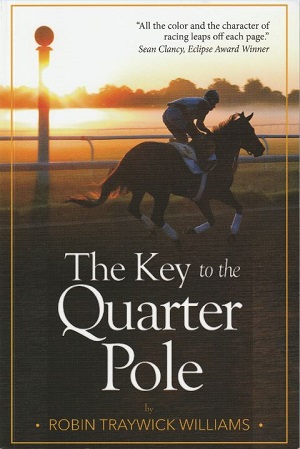
The Key to the Quarter Pole, Robin Traywick Williams, Dementi Milestone Publishing, VA, 2019, Soft Cover, 278 pages, $16.00A person who writes about horses and people has first to really know both subjects, then bring to the project a compelling way with words. Robin Traywick Williams delivers it all in The Key to the Quarter Pole. She’s a horsewoman and a foxhunter, and for six years was chairman of the Racing Commission for the Commonwealth of Virginia.
Plus, she’s been a feature writer for the Richmond Times Dispatch and a statewide finalist for UPI’s Journalist of the Year. She has several books to her credit, and this one is terrific—a page-turning novel filled with a variety of characters who inhabit that most exclusive inner sanctum of the horse world—the backstretch of the racetrack.
Louisa Ferncliff is one. She’s been beat up by a life with horses, but though her body is failing, she motors on with a will of steel. She knows very well that if she doesn’t take over the care and welfare of deserving racehorses, they will be raced and ruined. It happens all around the backstretch, but there are certain horses that she can’t let that happen to—especially the ones that give so much and expect so little. The principal object of her ministrations is Alice’s Restaurant, a horse with a fragile knee and a dubious future, who you’ll be rooting for every step of his tortuous way.
Running Commentary on a Point-to-Point
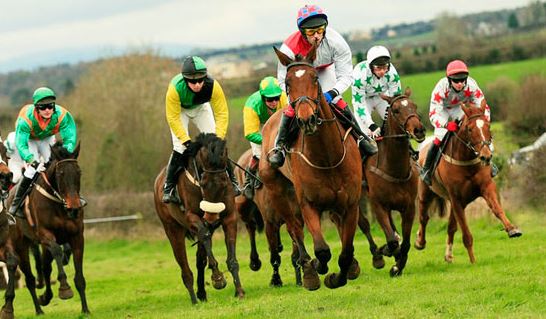
Will yis stop pushing behind there or you’ll land me into the ditch. Can you see the horses, Mary Ellen? They’re down at the starting post; and I’ll be down in this drain if yis don’t quit shoving. Haven’t you the whole country for a grand-stand, and why must you all crowd me off this one bit of a bank? There’s lashings of room for all, if yis id have a bit of —. Oh, be the lord Harry! They’re off! There’s the hunting horn. Can you hear it, Mary Ellen? Great God, how the sound of it warms my old heart.
What a wonderful start! There’s The Holy Terror lying third with our wee Jamesy riding him. Can you see his green jacket, Mary Ellen? They’re coming to the first jump. God be with the day when I could show them boys how to ride a Point-to-Point: but these old rheumatics—these old rheumatics! Now they’re at it. They’re over. Wee Jamesy’s there, Mary darling, and going like a Trojan. Now they’re coming to the first bank. Jamesy’s dropped back to fourth. That’s what I like to see! Holding his horse together: just what his father would have done. Leave the pace-making to someone else.
Riding a Point-to-Point
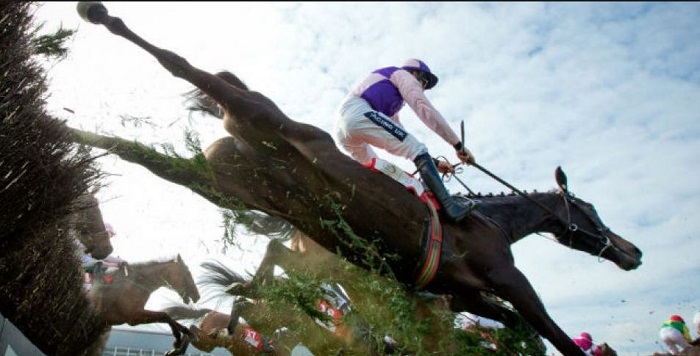
We are all lined up at the starting-post in the nearest thing to a straight line that a troublesome bay horse will allow. His green-clad rider is fighting desperately to prevent the brute from savaging every other fairly-well-behaved entrant in the race. Soon “Away you go! And good luck to you!” is heard as the flag drops; and the Starter sends a further God-speed to our thundering hooves with the merry notes of a “Gone Away” on his hunting horn.
The first fence looks like a strip of dark green canvas stretched between two groups of people. With a railing of human beings lining its approach on left and right, horses seem distracted, and treat the fence rather carelessly. Luckily it is only a simple gorse-built affair; though the horse on the left refuses it.
Flinging it behind, horses race away with renewed fury. The chestnut in front is setting a terrific pace. His rider endeavours to get him settled down, but with little success, and he leads over the first bank like a Derby winner. People are no longer crowding the fences and horses have less to distract them at their work. An open ditch yawns malevolently, but the pace affords scant opportunity for an examination of its width. A bank looms in front, and if that chestnut leads us to it at this pace some of us will see the inside view of an ambulance. Every stride makes it grow bigger. The chestnut’s at it he’s over; bay beside him crashes—went too close and hit his knees two horses out of it already. “Hey! Don’t ride me in on top of him! Pull over!”
Siegfried Sassoon, Foxhunting, and the Great War
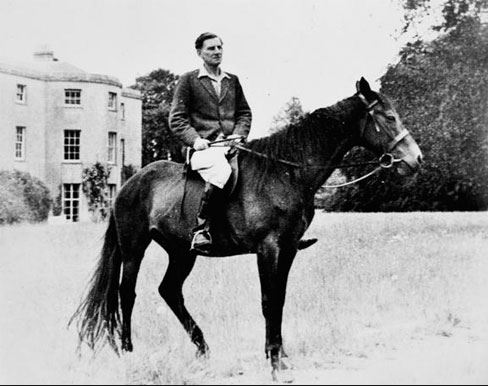
Siegfried Loraine Sassoon (1886-1967), poet and novelist, platinum print, wearing military uniform with the collar badges of the Royal Welsh Fusiliers and hat, Beresford’s stamp and copyright line on verso, 6 x 4½ in (15.2 x 11.5 cm). Accessed via Wikimedia Commons, January 2019.The National Sporting Library in Middleburg, Virginia, holds some 956 books on “foxhunting,” ranging in date from J. Roberts, An Essay on Hunting (1733) to Alastair Jackson, Lady of the Chase: The Life and Hunting Diaries of Daphne Moore (2018). Anyone likely to be visiting this website will know all the familiar names, from the prolific Nimrod and Robert Smith Surtees, to the less widely published William Scarth Dixon and Willoughby de Broke (Richard Greville Verney), to writers primarily known for one seminal work: Anthony Trollope, Hunting Sketches (1865), or George Whyte-Melville, Riding Recollections (1878).
The Library’s holdings from the twentieth century alone total an impressive 602 works. They also include many by familiar names, such as the “standards” J. Stanley Reeve and A. Henry Higginson or, more recently, Michael Clayton and Alexander Mackay-Smith, as well as a number of influential works by women writers, such as Lady Diana Shedden and Lady Apsley, “To Whom The Goddess . . .”—Hunting and Riding for Women (1932), Lida Fleitmann Bloodgood, Hoofs in the Distance (1953), and E.V.A. Christy, Cross-Saddle and Side-Saddle (1932), one of many books on equitation that include the demands of riding across country.
Many of the 20th century works, most of them held by NSLM, date to the interwar years. Citing 177 examples, Anne Grimshaw (see list of Works Cited below) has estimated that books specifically on hunting published in England between 1919 and 1945 accounted for “25% of the total output of equestrian literature” (Grimshaw, 160). Included in this group is at least one title of signal literary merit: Memoirs of a Fox-Hunting Man, published by the distinguished poet Siegfried Sassoon in 1928 as the first volume of what would become a Great War trilogy, The Complete Memoirs of George Sherston (1937).
The Thaw
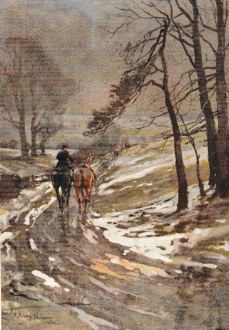
“By the road where the ditches are ready to run!” / Lionel Edwards illustrationHark to the avalanche snow from the roofs
O’er eaves where the icicles melt in the sun!
Hark to the musical suck of the hoofs
By the road where the ditches are ready to run!
On the slope of the hill is a patchwork of green
And the fallows are spotted with spaces of brown,
While woodlands and copses and hedges between
Have lost the white burden that weighted them down.
The Fox Meditates
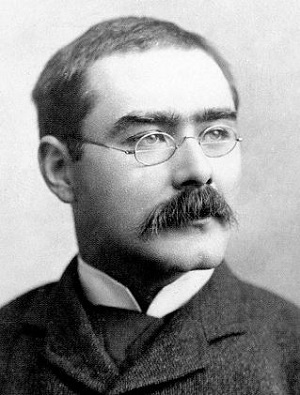
It’s been eye-opening to discover the many celebrated authors of classical literarature—like Rudyard Kipling—who have produced foxhunting poetry. In addition to those poets known for their sporting literature and published in these pages, Foxhunting Life readers have enjoyed the foxhunting poems of Sir Arthur Conant Doyle, William Shakespeare, Dylan Thomas, and William Butler Yeats.
What follows is a brief history of foxhunting in seven stanzas, written in the fox’s voice by Rudyard Kipling.
When Samson set my brush afire
To spoil the Timnites barley,
I made my point for Leicestershire
And left Philistia early.
Through Gath and Rankesborough Gorse I fled,
And took the Coplow Road, sir!
And was a Gentleman in Red
When all the Quorn wore woad, sir!
When Rome lay massed on Hadrian’s Wall,
And nothing much was doing,
Her bored Centurions heard my call
O’ nights when I went wooing.
They raised a pack-they ran it well
(For I was there to run ’em)
From Aesica to Carter Fell,
And down North Tyne to Hunnum.
A Foxhunter’s Childhood Memories of WWII England
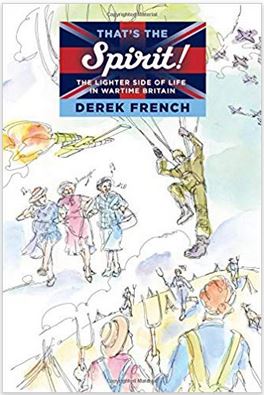
Book Review by Norman Fine
Spirit: The Lighter Side of Life In Wartime Britain, Derek French, with watercolor illustrations by Shelagh Armstrong, paperback, 309 pages, $19.95, available at AmazonDerek French, ex-MFH of the Eglinton and Caledon Hounds (ON), was raised during World War II on his family farm just twenty miles south of London in Kent. He emigrated to Canada in the 1950s with his wife, Bobbie, and began foxhunting with Eglinton and Caledon in 1988. He was appointed Master in 2000, and, after a seven-year term, continued to serve the hunt as a road whip and still writes articles for the hunt’s Stirrup Cup magazine, several of which have been republished in Foxhunting Life.
In his recently published, highly readable, and often amusing account of his war years—Spirit: The Lighter Side of Life In Wartime Britain—Derek recounts his boyhood memories as the war unfolded in the skies above the farm and upon the village below. What follows is a brief introduction to Derek, then our review of this wartime memoir as experienced by a normal, active young boy. We recommend this book enthusiastically.
Hard-Riding Dick
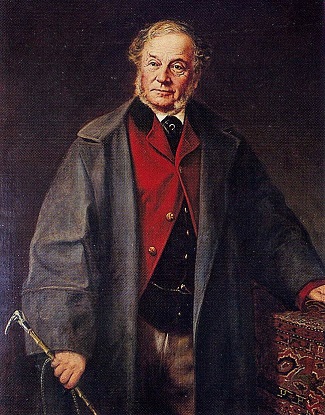
The author of this rather obscure poem was born in England in 1804. A landowner and nephew to the local baronet, he was known as the poet laureate of the Taporly Hunt, and indeed of the County of Cheshire. This hunting song, which coaxes the reader into a galloping rhythm, was selected by A. Henry Higginson, MFH, for inclusion in his 1930 collection, “As Hounds Ran.” It’s a stirring hunting poem and a fine ode to a whipper-in. (My favorite stanza is Number IX.)
I
From the cradle his name has been ‘Hard-riding Dick,’
Since the time when cock-horse he bestraddled a stick;
Since the time when, un-breech’d, without saddle or rein,
He kick’d the old jackass along the green lane.
II
Dick, wasting no time o’er the classical page,
Spent his youth in the stable without any wage;
The life of poor Dick, when he enter’d his teens,
Was to sleep in the hayloft and breakfast on beans.
’Ware Holes
A sportin’ death! My word, it was!
An’ taken in a sportin’ way.
Mind you, I wasn’t there to see;
I only tell you what they say.
They found that day at Shillinglee,
An’ ran ‘im down to Chillinghurst;
The fox was goin’ straight an’ free
For ninety minutes at a burst.
They ‘ad a check at Ebernoe
An’ made a cast across the Down,
Until they got a view ‘ullo
An’ chased ‘im up to Kirdford town.