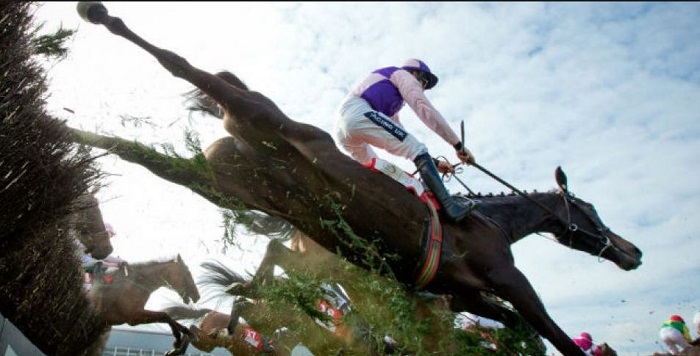
We are all lined up at the starting-post in the nearest thing to a straight line that a troublesome bay horse will allow. His green-clad rider is fighting desperately to prevent the brute from savaging every other fairly-well-behaved entrant in the race. Soon “Away you go! And good luck to you!” is heard as the flag drops; and the Starter sends a further God-speed to our thundering hooves with the merry notes of a “Gone Away” on his hunting horn.
The first fence looks like a strip of dark green canvas stretched between two groups of people. With a railing of human beings lining its approach on left and right, horses seem distracted, and treat the fence rather carelessly. Luckily it is only a simple gorse-built affair; though the horse on the left refuses it.
Flinging it behind, horses race away with renewed fury. The chestnut in front is setting a terrific pace. His rider endeavours to get him settled down, but with little success, and he leads over the first bank like a Derby winner. People are no longer crowding the fences and horses have less to distract them at their work. An open ditch yawns malevolently, but the pace affords scant opportunity for an examination of its width. A bank looms in front, and if that chestnut leads us to it at this pace some of us will see the inside view of an ambulance. Every stride makes it grow bigger. The chestnut’s at it he’s over; bay beside him crashes—went too close and hit his knees two horses out of it already. “Hey! Don’t ride me in on top of him! Pull over!”
A long stretch of uphill gallop draws one level with the green-clad rider, on the big difficult bay, who has earned a reprimand for swerving-in at the last fence: “Have you no reins?”
“Reins, my Uncle! I never laid eyes on this horse till to-day. They told me I could hold him with a silk thread should have said an anchor-chain! He’s a good jumper, but a headstrong maniac. That fellow on the chestnut must be going for the doctor. Steer clear a bit, this horse may do anything at the wall.”
I manoeuvre “Mimosa” well out of any danger zone that the troublesome bay may create. A backward glance shows me the grim-set, courageous face of his green-clad rider. He seems determined to ride his mount hard at this stonework, irrespective of whether it be loose-built or as solid as the Great Wall of China. The chestnut skims it like a swallow. A little grey, who has been going extremely well, treats it like a brush-through fence, and pays for his flippancy by a somersault. Three out of it, five left, and two miles to go.
The green-clad, swerving friend draws level again, going down towards the drop ditch. ‘They told me this horse was green at walls. His shins must be black and blue by now. He took a ton of stones with his forelegs and never as much as lost a stride; must have iron legs as well as an iron mouth.” I felt that there must have been some equally-durable substance in the speaker’s make-up; he was having a grueling ride on an impossible horse, and instead of showing any signs of distress was gradually convincing the unmannerly animal that at last he had met his master. Conversation flowed from him as easily as if he had been in an arm-chair in his club. “Heaven look down on me at this drop ditch!” and Heaven looked down very kindly on him and all of us, and watched us, a tiring handful, squelch along a sweep of low-lying meadow towards the crowd of spectators that waited anxiously for an aquatic display at the sullen-looking river.
Shortness of breath seems an unknown complaint with my friend of the green silk, for he speaks at my stirrup: “Are you married ? . . . . well, you’re lucky! and if you ever do, never let your wife see you ride at a river. She may think you’re a regular Adonis in the saddle, but after a taste of bog-water a fellow looks like something the cat brought in. I suppose mine’s in this crowd; and she has a camera, too.” If that film is ever developed it should show five horses, almost together, clearing a water jump in gallant style.
Scarcely half a mile to go; horses are blowing, the chestnut has been overhauled and now lies third. From the corner of one’s eye one can glance an added grimness in the faces of the riders alongside. All are concentrating on the Big Double. Are horses unduly fatigued by the terrific pace set by the now-tiring chestnut ? Will someone fumble at the big bank and bring grief ? Better not have fallen horses interfering; better lead. How gamely Mimosa answers to the request! After three grueling miles it is wonderful to feel her response. With an undemonstrative spurt she forges to the lead, props an instant, hooks the bank, changes feet, flicks over the yawning ditch and lands a good four lengths in advance of her nearest rival.
Up on the hill crowds are hurrying to the winning post; horses are asked for a supreme effort. Only one fence divides us from the flags that lie along that aisle of green in that sea of human beings. Mimosa still holds the lead; the crowds are frantic; cheers greet us. The swish of whalebone sounds behind a bay head creeps up to her girth. “Come on, Mimosa! I knew you would! Don’t let him creep any further. He’s back to your quarter keep him there, Mimosa, keep him there! One fence more and the race is ours!”
“Always ride the last fence as if it wasn’t there,” is the old saying.
But it was there.
“His eyelids are moving, doctor. Thanks be to God! I thought he was killed.”
“Oh, he’ll be all right in a few minutes. He got a devilish spill, but there’s nothing broken.”
“And Lord! he had the race in his pocket only for that last trick of a jump, doctor. And the favourite was beaten at the post by an outsider. I don’t know the name of the horse, but he had a green jockey.”
Somewhat dazed, one gazes upwards through a circle of anxious faces to the restful colourings of a February sky. Hazily one remembers a big, difficult horse, a green-clad rider and a hard-bitten courageous face and, somehow, one feels strangely pleased.
Posted April 28, 2019
Stanislaus Lynch, who died in 1983, was a huntsman, journalist, author, broadcaster, poet, and producer of Irish Draught Horses and Connemara Ponies. This piece was from his Echoes of the Hunting Horn. Use the FHL “Search” function to find other stories and rhymes by Lynch previously published in Foxhunting Life.