Outward Bound
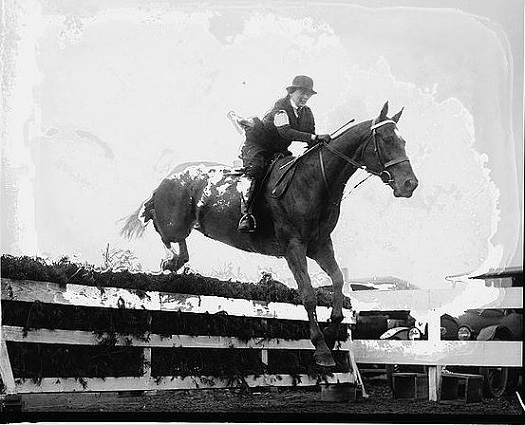
In juxtaposition to these times of fast and affordable air travel to and from England and Ireland for hunting holidays, here’s a look back to a 1924 account of a leisurely (and dramatic) father-daughter sea voyage—their first—to go foxhunting on the other side. It was also a different era for world events, as readers will note.
Author Charles D. Lanier was MFH of the Fairfield County Hounds (later the Fairfield and Westchester Hounds) from 1915 to 1921. His seventeen-year-old daughter, referred to as “B,” was Becky Lanier, later Becky Sharp, MB of the Nantucket Beagles, and still later Joint-MB of the Nantucket-Treweryn Beagles, who, along with her husband Joint-MB David “Bun” Sharp passed away in 1987.
Becky Lanier, 1920
What follows is a condensed version of Chapter 1, “Outward Bound,” from Charles Lanier’s We Go Foxhunting Abroad: A First Venture with the Irish Banks and English Downs published in 1924. Subsequent chapters in condensed form will appear through the remaining summer months.
A Fox in the Family
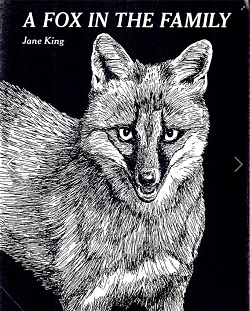
Take two gray fox cubs that need a home and one family of tender-hearted animal lovers. Put them together, and you’ve got a charming menagerie that includes horses, dogs, a grumpy cat, turtles, two little boys, frogs, mice and birds.
A Fox in the Family, Jane King, Xlibris LLC, illustrated, 96 pages, $22.49 (hardcover), $14.40 (softcover), available at Amazon and Barnes and NobleA Fox in the Family is Jane King’s reminiscences about life with a smart, funny, wild animal with loads of personality. Jane and her husband Jim were known for rescuing and rehabbing animals on their farm in Indiana. So when a neighbor salvaging an old barn discovered a family of foxes under the dilapidated structure, he knew whom to call.
The Kings went home with two cubs, promptly named Frisky and Friendly by their young sons. Unfortunately, Friendly did not make it, succumbing to a mysterious malady, but Frisky went on to become a member of the family, accepted by everyone except the cat. Frisky and his best friend, the terrier, Bandit, managed to get into all kinds of trouble, including breaking their legs at the same time in a dust-up with the horses. Their favorite playtime activity was a rousing game of snatch-the-tennis-ball, and they spent hours playing before collapsing together on the sofa to nap.Their other favorite sleeping place was under the covers with the boys.
The Thrill of “Tally-Ho!”

The works of Irish sporting journalist Stanislaus Lynch were published in and around the middle of twentieth century. Earlier this month Foxhunting Life re-published a short story from his book, Echoes of the Hunting Horn. We heard from so many readers who enjoyed it, we decided to re-publish another.
One reader in the UK wrote, “I enjoyed it so much I bought the book from a second hand book shop, and it’s lovely!” Another reader forwarded it to a friend in Ireland who actually remembers hunting with Lynch on a day he had a frightening fall. We’ve included her account at the end of this story.
“A wave of dappled fury” / Illustration by Olive Whitmore
There are some delightful occasions in outdoor life when immediate happenings are so engrossingly interesting that any misbehaviour of the elements is completely overlooked, and one forgets one is being slowly, but surely, soaked to the skin. A coat-collar may be turned up, the action being more mechanical than protective. The shelter of a high hedge may even be sought, but high hedges seldom exist on a bleak mountain-side, as the mountain wind rarely allows tall whitethorns to add syncopation to the weird monotony of its rhythm. One can only stay still, forget the down-pour, and watch hounds.
The Worst Hunt on Record
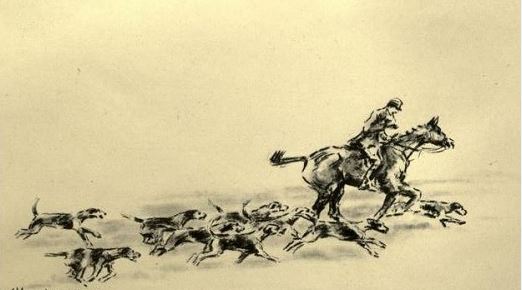
I’m wondering how many foxhunters will identify with this escapade. Your editor certainly does. Though, thankfully, in the two experiences I have in mind, the rascals were at least honest enough—indeed more than enthusiastic enough—to jump the fences!
Illustration by Olive Whitmore
I knew by the wag of his head that he was a bit-of-a-lad. When I mounted him he flung his bit-bars in truculent resentment. When I jogged off, his jaws took a vice-like hold of the bit, his head poked sideways and, if horses wore hats, his would have been very definitely “on the Kildare side.” I soon discovered that it was a waste of energy to attempt to alter his head-position. His jaws were rigid, his neck inflexible, in fact, everything in front of the saddle seemed to be set in reinforced concrete. Reins are ornamental accoutrements on hobby-horses: mine were just as effective.
I had been told he was the heart and soul of a rascal, but as I have ridden, and occasionally fallen off, every conceivable brand of rascal, I felt I could forestall any equine acrobatics which he might have under consideration. His owner had given me the animal’s whole character; that is, of course, assuming that there was a shred of it left to give to anyone; and I had gladly accepted the offer of a day’s hunting, character or no character! Two stable companions had had a hard hunt the previous day, a third was lame and a fourth had a cough; so it was ride this old reprobate or nothing.
Strike Hound
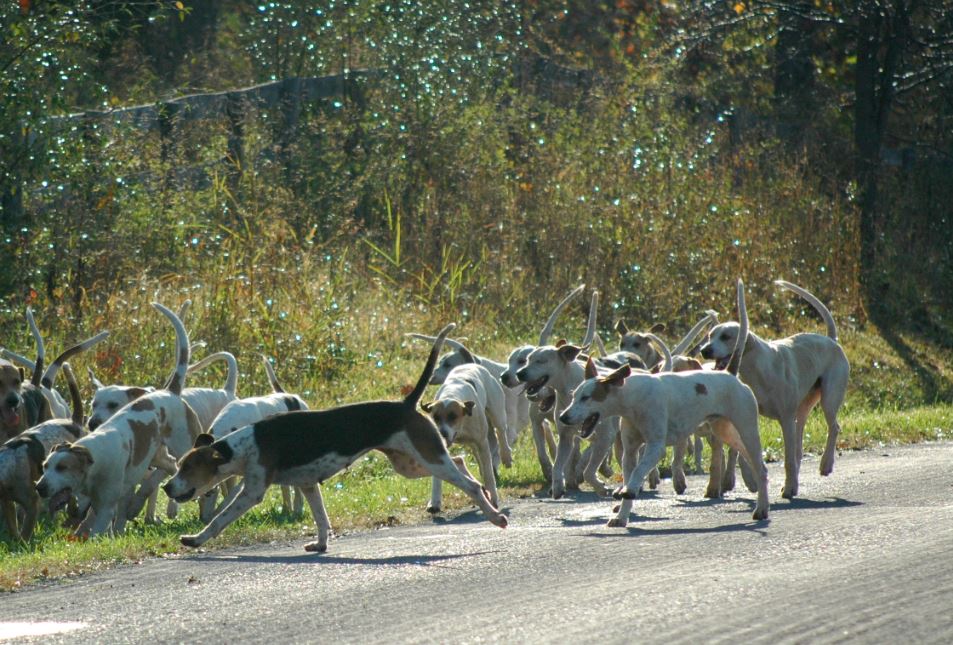
Nancy Kleck photo The fox crossed here, a car followerPoints as the foxhound pack roils roadside,Takes the scent up onto the asphalt, Loses the line, circles back to churn againWhile one tri-color, by herself, crosses over, Scrambles up the stone wall, squeezes Through the boards on top, runs nose-downSerpentines until she finds, gives tongue On […]
‘Dimple,’ A Memory of ’94
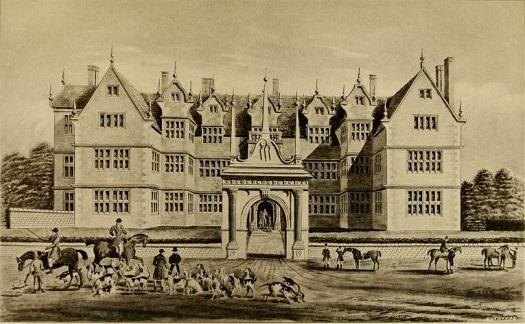
The Old Pytchley Hall
This poem, published in Baily’s in 1896, is not just timely (with Christmas and the New Year), but it links directly to contemporary subjects in two of our articles below: James Barclay’s “Sporting Tour“ and “Remembering the Curre on Boxing Day.” It’s a wistful poem, beginning with the mystery of whence this wonderful hound named Dimple. The mystery is resolved at the end, but no hope of ever seeing her like again is imagined. Why? Because she comes from Wales, and the type of hound anointed as stylish and desirable by the elite English foxhunting establishment of the time would never even consider a different way.
However, the very fact that this poem was written demonstrates that some foxhunters of the time, indeed even the superlative Pytchley huntsman, Young Will Goodall,* yearned for something better. But change in the form of a direct challenge to the establishment wasn’t to come until the twentieth century, and even then the process was painful for all concerned. So, here’s what can be considered a poetic prelude to both the Modern English foxhound and the American-English Crossbred foxhound of today.
The Pytchley Hounds are running hard across the Badby Vale;
They fly like swallows on the wing, altho’ it blows a gale.
’Twould make an old man young, I swear, to see so brave a sight,
As scarlet flashes past, and gleams the Pytchley collar white.**
See You at Second Horses
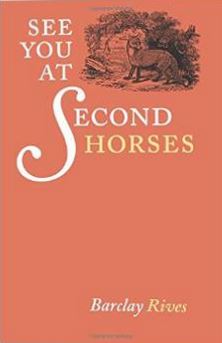
See You at Second Horses, Barclay Rives, Aterlerix Press, New York, 2014, Paperback, illustrated, 184 pages, $13.50, available at retail outlets including Horse Country Saddlery, Warrenton, VirginiaThe foxes! Oh, the foxes! When Barclay Rives undertook a marathon of foxhunting in 1999, when he went out with nine English hunts in ten days, it seemed like there was a fox popping out of every covert.
Rives, an honorary whipper-in for the Keswick and Bull Run Hunts (VA), writes about his English sporting adventure in See You at Second Horses, a delightful read that puts us galloping behind some great packs in the glory days before the infamous Hunting Act of 2004 banned hunting with hounds in the traditional manner in England and Wales.
Rives is an avid hunter who once hunted one hundred days a season, sometimes going out with Keswick in the morning and Bull Run in the afternoon. Saying he was gung-ho is an understatement. He jumped at the chance to join his friends Grosvenor and Rosie Merle-Smith to hunt with packs dating back to the 1700s: the Quorn (twice), the Cottesmore, the Fernie, and others, including a foot pack—the High Peak Harriers—after rabbits.
Images of Opening Meet
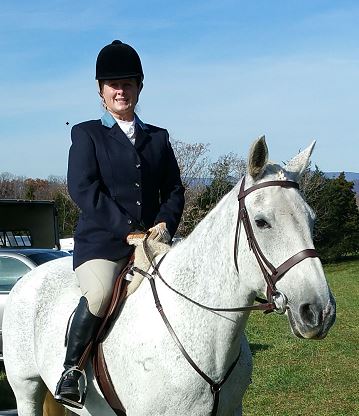
Here’s a poetic kaleidoscope of Opening Meet images conjured up by Martha Drum the evening before, while braiding her horse and cleaning her tack.
Opening Meet! Hounds assemble
Veterans chitchat, newbies tremble
Chilly wind, sky clear blue
Scent on frost, turning dew
Youngest rider nods and yawns
Oldest recalls many such dawns
Gents and ladies grin and greet
Ponies yank to reach and eat
Scarlet coats, mounts in braids
Flasks, in case courage fades
Some in perfect kit adorned
Others serviceably well-worn
Green horse wheels and tries to buck
Old horse naps beside the truck
Drop Your Hands
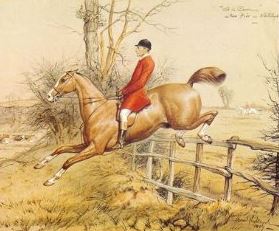
Tom Firr, huntsman to the Quorn, nineteenth centuryTom Firr indulged in a very big bit
(Always in pictures he’s seen using it),
“Plenty of iron; you don’t need to use it.”
“Yes, Firr—quite right, but so many abuse it!”
A light-mouthed puller’s a difficult horse,
A short-cheeked bridle will suit him, of course;
A snaffle’s the bit for a horse that takes hold
(At least, it’s all right if the rider is bold).
The acme of bliss when you’re hunting the fox
Is riding a horse who will jump off his hocks;
While quite the worst feeling, and one to be banned,
Is a horse who will only jump off his fore-hand.
Goodall’s Practice: A Huntsman’s Guide
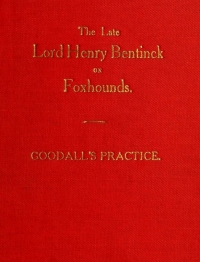
The highest praise that can be given to a huntsman is for a fool to say, ‘We had a great run and killed our fox; as for the huntsman, he might have been in bed!” –Lord Henry Bentinck
This week we look at another legendary huntsman of the past, William Goodall, huntsman in the nineteenth century to the Duke of Rutland’s Belvoir foxhounds (UK).
Goodall’s methods greatly impressed Lord Henry Bentinck, one of the leading MFHs of the day. Captain Simon Clarke, MFH of the New Forest foxhounds (UK) tells us that Lord Henry hunted three horses a day, kept copious notes, compared the best of England’s huntsmen, and thought William Goodall to be the premier huntsman in England.
When in 1864 Lord Henry sold his famous hound pack, he wrote a letter to the purchaser, Mr. Henry Chaplin, describing William Goodall’s hunting methods. The information in the letter so impressed Mr. Chaplin that, some years after Lord Henry’s death, he had it published under the title, The Late Lord Henry Bentinck on Foxhounds: Goodall’s Practice.
“Goodall’s Practice,” says Captain Clarke, “is the best treatise on hunting hounds ever written.” The revered Master and hound breeder Isaac “Ikey” Bell, the single individual most responsible for the modern English foxhound, is said to have had Goodall’s Practice painted on the ceiling over his bathtub. If you watch while hunting this season, you may see and recognize some of these same practices being used by your own huntsman. Here’s an extract.