 The highest praise that can be given to a huntsman is for a fool to say, ‘We had a great run and killed our fox; as for the huntsman, he might have been in bed!” –Lord Henry Bentinck
This week we look at another legendary huntsman of the past, William Goodall, huntsman in the nineteenth century to the Duke of Rutland’s Belvoir foxhounds (UK).
Goodall’s methods greatly impressed Lord Henry Bentinck, one of the leading MFHs of the day. Captain Simon Clarke, MFH of the New Forest foxhounds (UK) tells us that Lord Henry hunted three horses a day, kept copious notes, compared the best of England’s huntsmen, and thought William Goodall to be the premier huntsman in England.
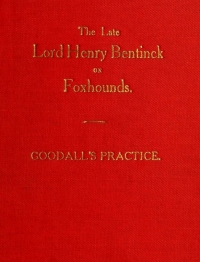
When in 1864 Lord Henry sold his famous hound pack, he wrote a letter to the purchaser, Mr. Henry Chaplin, describing William Goodall’s hunting methods. The information in the letter so impressed Mr. Chaplin that, some years after Lord Henry’s death, he had it published under the title, The Late Lord Henry Bentinck on Foxhounds: Goodall’s Practice.
“Goodall’s Practice,” says Captain Clarke, “is the best treatise on hunting hounds ever written.” The revered Master and hound breeder Isaac “Ikey” Bell, the single individual most responsible for the modern English foxhound, is said to have had Goodall’s Practice painted on the ceiling over his bathtub. If you watch while hunting this season, you may see and recognize some of these same practices being used by your own huntsman. Here’s an extract.
“In handling his hounds in the open, with a fox before him, he never had them rated or driven to him by his whips; never hallooed them from a distance. When he wanted them he invariably went himself to fetch them, anxiously watching the moment that the hounds had done trying for themselves, and felt the want of him. He then galloped straight up to their heads, caught hold of them, and cast them in a body a hundred yards in his front, every hound busy before him with his nose snuffling the ground….When cast in this way, the huntsman learns the exact value of each hound, while the young hounds learn what old hounds too believe in and fly to, and when the scent is taken up no hound is disappointed. When the huntsman trails his hounds behind him, four-fifths of his best hounds will be staring at his horse’s tail, doing nothing.
“The hounds came to have such confidence in Goodall, that with a burning scent he would cast them in this way at a hand gallop, all the hounds in his front making every inch of ground good; while with a poor scent he would do it in a walk, regulating his pace by the quality of the scent; the worse the scent the more time the hounds want to puzzle it out….
“(2) When the fox was gone, in place of galloping off after his fox without his hounds, blowing them away from downwind from such a distance that half the hounds would not hear him and he would only get a few leading hounds still further separated from the body; Goodall would…quick as lightning turn back in the opposite direction, get upwind of the body of his hounds [fox and hounds in front of him], and blowing them away from the tail, bring up the two ends together giving every hound a fair chance to be away with the body.
“It is impossible to overestimate the mischief done to a pack of hounds by unfairly and habitually leaving a hound behind out of its place; it is teaching them to be rogues. For this purpose Goodall had one particular note of his horn never used at any other time except when his fox was gone, or his fox was in his hand; the hounds, learning the note, would leave a fox in covert to fly to it. Hounds are very sagacious animals; they cannot bear being left behind, nor do they like struggling through thick covert; but if that note is ever used at any other time the charm is gone, the hounds will not believe it; you cannot lie to them with impunity. This was Goodall’s great secret for getting his hounds away all [together] on the back of a fox….
“(3) Goodall’s chief aim was to gain the hearts of his hounds. He considered that hounds should be treated like women—that they would not bear to be bullied, to be deceived, or neglected with impunity. For this end he would not meddle with them in their casts until they had done trying for themselves, and felt the want of him: he paid them the compliment of going to fetch them; he never deceived nor neglected them; he was continually cheering and making much of his hounds; if he was compelled to disappoint them by roughly stopping them off a suckling vixen or dying fox at dark, you would see him, as soon as he had got them stopped, jump off his horse, get into the middle of the pack, and spend ten minutes in making friends with them again. The result was that the hounds were never happy without him, and when lost would drive up through any crowd of horsemen to get to him again….”
The full text of Goodall’s Practice is available online, courtesy Internet Archive.
Posted July 20, 2014