Edward Troye, Harry Worcester Smith, and Alexander Mackay-Smith: Archival Research Connects the Dots
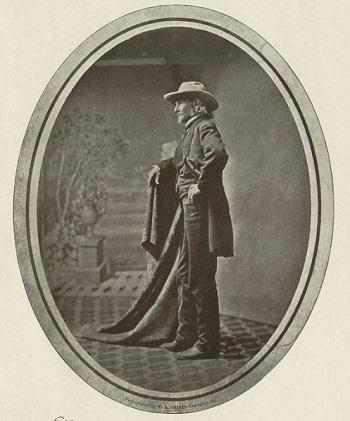
Edward Troye gained artisitic renown painting America’s greatest bloodstock of the mid-twentieth century. / 1872 photographic print, National Sporting Library and Museum Archives, Harry Worcester Smith papersFoxhunting Life is proud to publish this preview of the stories behind one of the most important exhibition of the works of Edward Troye ever mounted.
It is said that “traces of the soul can be found in boxes in the archives.” Where letters, scrapbooks, newspaper clippings, jotted notes-to-self and snippets of individuals’ lives are kept, distractions lurk and surprises are inevitable. And patience is rewarded with a story.
The archives of the National Sporting Library and Museum in Middleburg, Virginia contain the story of three men whose lives spanned two centuries, whose interests overlapped, and whose souls were kindred: Artist Edward Troye (1808-1874), the indomitable sportsman Harry Worcester Smith (1864-1945), and the scholar, chronicler, and author Alexander Mackay-Smith (1903-1998).
Antique Hunting Scene or War?
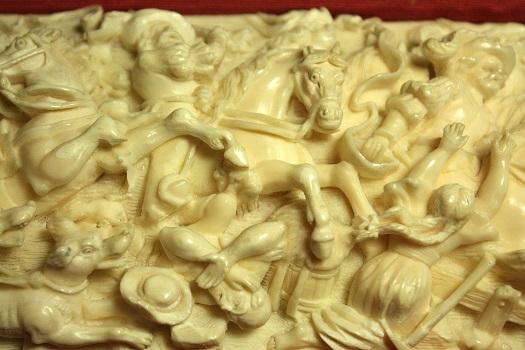
Closeup view
Grotesque as this sculptured scene may appear—men and women trampled under a rush of mounted riders on horses, accompanied by dogs on leads—the collector believes that this antique ivory carving is a fox hunt, not a war scene, because of the dress, dogs, and accouterment. He has asked Jaynie Spector at Dog and Horse Fine Art in Charleston, South Carolina to offer this carving.
Ms. Spector has studied with Sotheby’s in London, worked as an art advisor, worked at Christie’s Contemporary Art Department, and spent years at a Soho art gallery in New York before starting her own art gallery in Charleston. While the carving boasts provenance from a gallery in Paris, Spector believes it is the work of a German sculptor.
The Foxhounds of John Emms
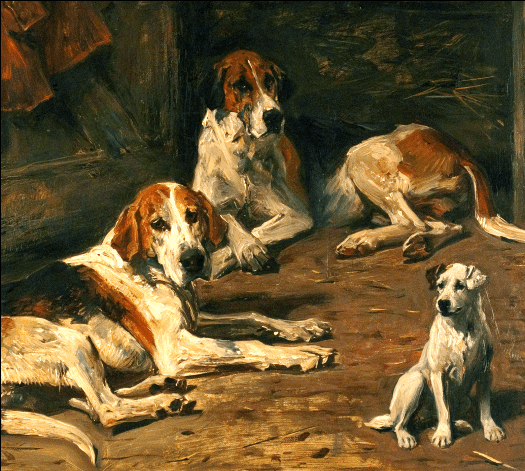
Foxhounds and Terrier / painting by John Emms
A major exhibit and sale of paintings by John Emms (1843–1912) will be mounted by the William Secord Gallery in New York City from February 8 to March 15, 2014. This will be the largest and most comprehensive exhibition of Emms’ work and is timed to coincide with this year’s Westminster Dog Show. More than fifty paintings of foxhounds, terriers, spaniels, and other sporting breeds are included. Foxhunters visiting New York during the MFHA Annual Meeting week are invited to visit the Gallery for a preview of the entire exhibit.
Born the son of an amateur artist in Norfolk, England, the young Emms moved to London where he apprenticed with the great academic painter, Lord Frederick Leighton. Emms soon went on his own, painting images that capture the beauty of English country life. An avid foxhunter, Emms maintained studios in London and in the New Forest area of England.
Foxhunting Museum Gallery Open for Holiday Shopping in Middleburg
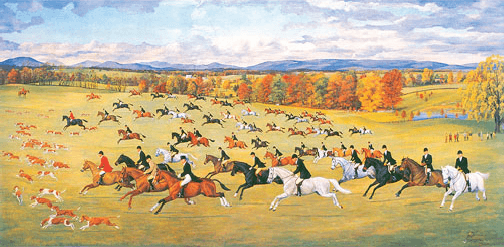
Scurry of the Orange County Hunt by Jean Bowman
A satellite gallery of the Museum of Hounds and Hunting at Morven Park is open in Middleburg for art-minded Christmas shoppers. Sporting art—original paintings, signed prints, and sculptures by contemporary American artists are for sale at prices ranging from $385.00 to $9,600.00 with all sales benefitting the Museum.
Modestly priced items—books, calendars, note cards, and sporting novelties—are also available. Whether or not you are ready to shop, it’s worth a stop if only to see what today’s talented, contemporary artists are producing and to learn more about the Museum, its permanent exhibits, and its programs.
One of the surprising items for sale is the limited edition print of the late Jean Bowman’s brilliant 1989 Scurry of the Orange County Hounds. Four of these prints were recently found safely in storage, Jean Bowman having been a member of the Museum Advisory Committee and a generous supporter. Two of the prints are signed by Ms. Bowman, and the price is still a very reasonable $385.00. The prints come with a key identifying the figures, among them James L. Young, MFH; Governor Bruce Sundlin; Jacqueline Kennedy Onassis; the Hon. Charles Whitehouse; Senator John Warner; Melvin Poe, huntsman; the artist herself; and sixty-six other notable members.
Other artists represented in the benefit sale include Anita Baarns, Cynthia Benitz, Jean Clagett, Mary Coker, Mary Cornish, Teresa Duke, Sandra Forbush, Juli Kirk, Nancy Kleck, Gail Guirrei Maslyk, Alice Porter, Belinda Sillars, Dana Lee Thompson, and Cathy Zimmerman.
Inaugural Sporting Art Auction
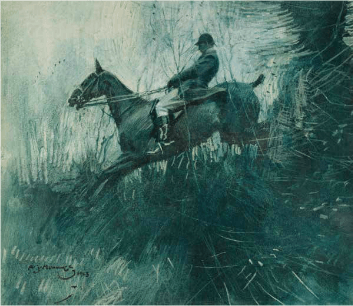
Over the Ditch by Sir Alfred MunningsPut the expertise of the world’s largest Thoroughbred auction house—Keeneland—together with Gregg Ladd’s premier gallery of sporting art—Cross Gate—both located in Lexington, Kentucky, and you get what should turn out to be an exceedingly important auction of sporting art. This inaugural Sporting Art Auction will take place on Wednesday, November 20, 2013 at 4:00 p.m.
To be sold are 174 lots, both paintings and sculptures. The focus is on sporting art by nineteenth and twentieth century American and British artists—realists and impressionists—such as Sir John Frederick Herring, Sir Alfred Munnings, John Emms, Pierre Jules Mene, John Skeaping, Lionel Edwards, Edward Troye, Franklin Voss, Peter Curling, Peter Biegel, Michael Lyne, three generations of Wyeths (N.C., Andrew, and Jamie), Mary Cassatt, and Andre Pater.
From Toy Box to Art Gallery
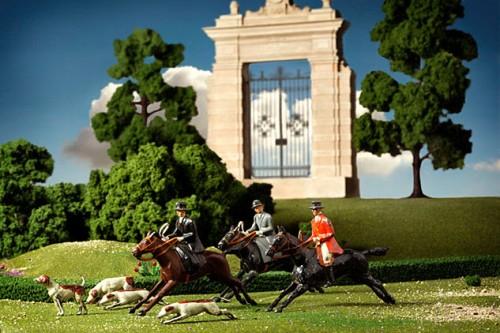
What happens when a noted photographer stumbles across a set of vintage (1930s) British cast lead toy figures of foxhunters and hounds? Award-winning photographer/author/film maker Robert Trachtenberg was captivated by the various poses and old patina on the figures. He placed them into scaled-down landscapes, illuminated them romantically, and produced a suite of seven photographs […]
The Sporting Art of Juli Kirk
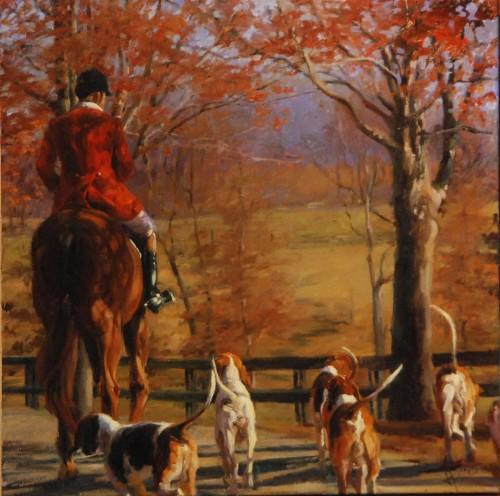
Autumn Avenue by Juli Kirk, oil on canvas, 20 x 20 inches
Juli Kirk is a classically-trained artist who prefers to work from her imagination. The results to me are both Impressionistic and Expressionistic—the former where the play of changing light on realistic shapes and visible brush strokes stimulate the viewer’s imagination, and the latter where moods and feelings are evoked.
Kirk lives and paints in Easthampton, Massachusetts and Warrenton, Virginia. She is a cum laude graduate of Boston University’s School for the Arts and has also studied art at Queens College (NY), New York Studio School, Cabrillo College (CA), and the University of Santa Cruz (CA).
Juli continued to paint daily while raising three children, riding for a sale barn, running a boarding stable where she gave riding lessons, and training horses on a freelance basis. She was taught to ride by her mother, who was a show rider competing in her youth at the top shows, including Madison Square Garden. Juli got into racing on the fair circuit in western Massachusetts and eventually traveled to Virginia to work with a cousin, Sharon Maloney, who broke racehorses. During that time, a broncy horse at the sale barn bucked her off. The fall resulted in severe back problems.
Fox Hunt by Winslow Homer
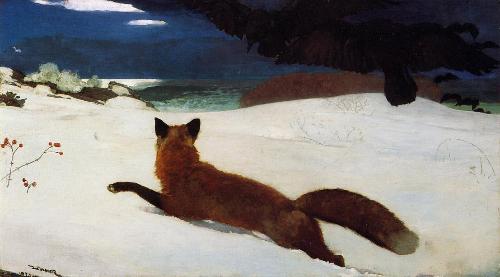
Fox Hunt is one of the well-known works of the renowned American artist, Winslow Homer (1836–1910).
In this ominous painting, a fox struggles through the snow in search of a meal. The Atlantic roils below, and the sky above is dark with another approaching storm. The fox has captured the attention of a flock of equally hungry crows that circle above, the nearest threatening to blot out the entire scene in blackness. It was not unusual in the long Maine winters to see a flock of crows attack a weakened fox adrift in deep snow. The red berries peeking through the snow drift provide the only relief to this somber moment.
Hunting with King Louis XV
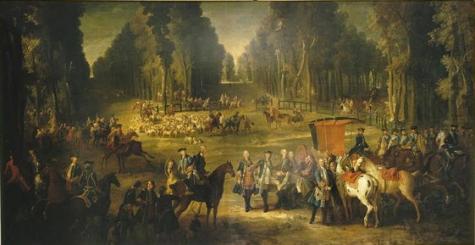
Rendez-Vous…in the Forest of Compiegne: preliminary painting for the tapestry by Jean-Baptiste Oudry at Fountainebleu
As a John H. Daniels Fellow at the National Sporting Library in Middleburg, Virginia, last fall, I did research concerning a series of nine large tapestries woven for Louis XV between 1736 and 1753 at the Gobelin manufacture. Called The Royal Hunts or The History of Louis XV, these tapestries decorated Louis XV’s favorite hunting chateau at Compiègne, just north of Paris. The artist who designed the tapestries, Jean-Baptiste Oudry* (1686-1755), was the official painter of the royal hunts who followed the hunt as part of the king’s entourage. He also painted numerous portraits of the royal hunting dogs.
Louis XV was known for his love of the hunt, and the series was meant to document the ritual of the hunt, the well-managed royal hunting grounds, and, of course, to glorify Louis XV. In the tapestries, as well as in the preliminary paintings for the tapestries now at the chateau of Fontainebleau, there are recognizable portraits of Louis XV, his hunt officers, his favorite horses and dogs, and specific sites in the royal forests of Fontainebleau and Compiègne. I was endeavoring to learn exactly what was transpiring in the images by consulting the eighteenth-century hunt treatises and manuals in the collection of the National Sporting Library.
The Fox and the Bee
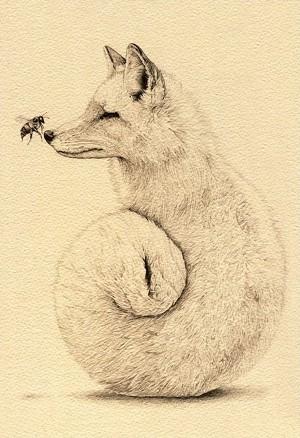
Drawing by Amy DoverUsing only graphite pencil, Amy Dover has attracted attention to her work throughout Great Britain. Her art has been widely exhibited and has inspired thoughtful and introspective articles in the media there. She focuses on animals, often depicting the dark side of their enduring battle against man and civilization. While many of […]