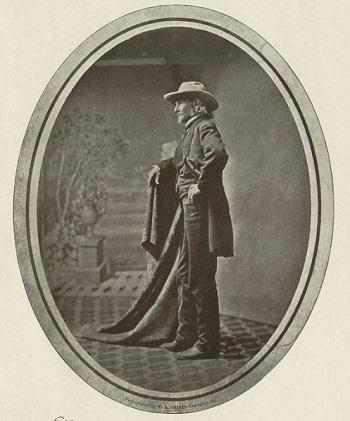
 Edward Troye gained artisitic renown painting America’s greatest bloodstock of the mid-twentieth century. / 1872 photographic print, National Sporting Library and Museum Archives, Harry Worcester Smith papersFoxhunting Life is proud to publish this preview of the stories behind one of the most important exhibition of the works of Edward Troye ever mounted.
It is said that “traces of the soul can be found in boxes in the archives.” Where letters, scrapbooks, newspaper clippings, jotted notes-to-self and snippets of individuals’ lives are kept, distractions lurk and surprises are inevitable. And patience is rewarded with a story.
The archives of the National Sporting Library and Museum in Middleburg, Virginia contain the story of three men whose lives spanned two centuries, whose interests overlapped, and whose souls were kindred: Artist Edward Troye (1808-1874), the indomitable sportsman Harry Worcester Smith (1864-1945), and the scholar, chronicler, and author Alexander Mackay-Smith (1903-1998).
Edward Troye arrived in America from England in 1831, a trained artist determined to follow the tradition of the great English animal portraitists. His ambition, in his own words, was to paint “after the style of Stubbs and Sartorius” referring to George Stubbs (1724-1806) and the Sartorius family—four generations—of British turf and field artists. By the middle of the nineteenth century Troye had painted America’s greatest racing thoroughbreds and trotters, her finest blood-stock, including cattle, as well as portraits of the families for whom these works were commissioned.
Crowning his career in 1855, he traveled to Arabia with his young patron Alexander Keene Richards from Lexington, Kentucky in search of pure Arabian bloodstock and to paint, en plein air, emblematic scenes from the Holy Land.
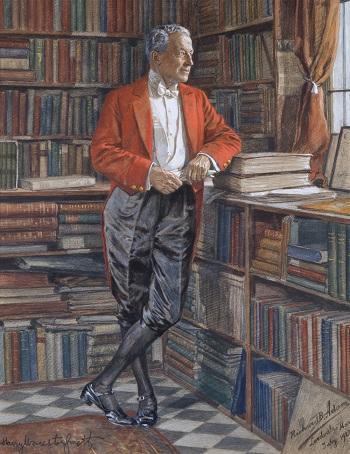 Harry Worcester Smith was one of the most influential Masters in organizing mounted foxhunting and in promoting the American foxhound. / Portrait by Richard Benno Adam (German, 1873-1936), 1928, watercolor and pencil heightened with gouache; National Sporting Library & Museum Permanent CollectionAlmost a century later, Harry Worcester Smith “discovered” Edward Troye while attending a New York Jockey Club banquet where he “saw at once the value of Troye’s paintings in turf history.” Smith subsequently took it upon himself to track down, uncover, restore if necessary and exhibit wherever possible Troye’s work. Smith saw his quest as one more effort toward his oft-repeated mission in life: “For the Sake of Sport in America.” By November, 1938, when the Newhouse Galleries in New York City, with the “zealous research and unflagging labors of Mr. Harry Worcester Smith,” held the first gallery exhibition of Edward Troye’s work in America, Smith had resurrected two-hundred forty of Troye’s paintings and succeeded in convincing the art world of their overall worth.
Alexander Mackay-Smith met Harry Worcester Smith on the hunt field in Virginia’s Piedmont, where Harry Worcester Smith had been foxhunting since the 1890s. When Alexander Mackay-Smith co-founded the National Sporting Library in 1954, it was on the basis of their friendship that Harry Worcester Smith’s grandchildren donated their grandfather’s papers, including letters, clippings, typescripts and hand-written notes about his near-obsession with Edward Troye.
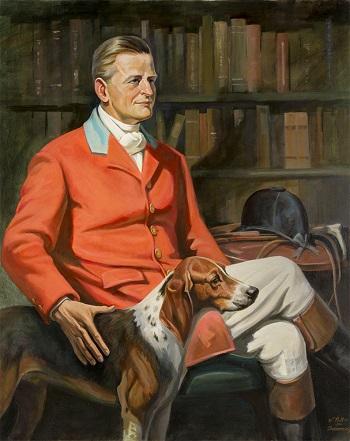 Alexander Mackay-Smith was the most prolific scholar/author/editor of the twentieth century on the subject of horses and hounds in America. / Portrait by Wallace Nall (American 1923-2003), 1999, (copy after painting by Jean Bowman, 1955), oil on canvas, National Sporting Library & Museum Permanent CollectionNear the end of his life Edward Troye attempted to publish, by subscription, a volume titled Race Horses of America containing his life’s work in painted photographs. The venture was an economic and artistic failure. A small number of an inferior text were printed, but few, if any, sold. Decades later, Harry Worcester Smith told Alexander Mackay-Smith that he intended to write a definitive text on Edward Troye, toward which Harry Worcester Smith gave a great deal of thought and complied an enormous amount of material, but the text was never completed. Within the National Sporting Library’s Harry Worcester Smith Archives, Alexander Mackay-Smith found inspiration to combine and complete both of his predecessors’ work: The Race Horses of America, 1832-1872; Portraits and Other Paintings by Edward Troye. More than thirty years after it’s publication, it is still considered the definitive text on Edward Troye.
“When I write a book,” Alec told a friend, “I want it to be so thorough that no one will ever have to write another one on the subject.” There is no arguing that Alexander Mackay-Smith achieved his, and presumably those of his foregoers’, goals.
The story of the intersection of these three men’s lives across the nineteenth and twentieth centuries will be told in an essay published in the upcoming Edward Troye exhibition catalogue and through art and artifacts from the NSLM’s archives in the Forest E. Mars, Sr. Exhibit Hall.
Coming Home Series: Edward Troye opens in the National Sporting Library Museum on October 26 and runs through March 9. Downstairs, in the Library’s Forest E. Mars, Sr. Exhibit Hall, Edward Troye: Exhibition, opens on September 26 and runs through January 3.
Posted August 28, 2014