The Mockers and Lionel Edwards
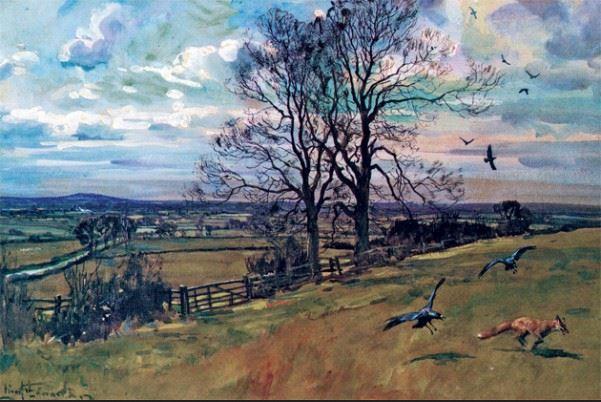
The Mockers, 1925, by Lionel Edwards, gouache (click painting for a larger version)
In a recent Country Life article, Michael Clayton proclaims The Mockers by Lionel Edwards to be his favorite painting.
Clayton is former editor of Horse and Hound, author of numerous books, and well-known as Foxford for his long-running series of hunting reports in “Foxford’s Hunting Diary.” Clayton has probably hunted with every hunt in the UK over his long career as a sporting correspondent, and has personally known certainly all of the British contemporary artists of note. Because I respect Clayton’s opinion, because I’ve loved Lionel Edwards’s work ever since I first started hunting, and because I was sufficiently struck by the drama of the scene, I thought that Foxhunting Life readers might appreciate the painting as well.
“I have seen foxes ‘mocked’ in this way by birds,” says Clayton in the Country Life article. “It symbolises just how tough nature can be.”
Indeed, the fox is not only running from a pack of hounds, seen as mere white dots in the far distance at the left, but is being cruelly mobbed by the diving, swarming crows. The masterful rendering of the landscape under a somber sky, typical to the English Shires, was one of Lionel Edwards’s special talents. What was not so typical was this view of quarry and birds in the foreground, with horses and hounds—Edwards’s usual subjects—mere suggestions in the background.
JoAnne Helfert Sullam Fuses Art and Activism
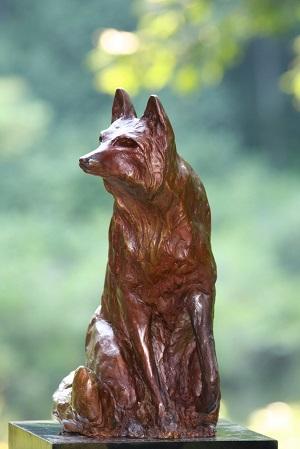
The Fox, bronze. See more examples of Ms. Sullam’s art on her website; she is represented by the Chisholm Gallery.Born in Brooklyn, New York, JoAnne Helfert Sullam is a celebrated animal and wildlife artist. Her award-winning works have been featured in the New York Times, Who’s Who in America, Art Business News, “The Best of Sporting Art” in Polo Players magazine, and on the on the cover of The Chronicle of the Horse. She received Special Congressional Recognition for Work in the Arts from then U.S. Senator Hillary Rodham Clinton. Ms. Sullam’s paintings and sculptures have been displayed in solo and group exhibitions in galleries and cultural centers thoughout the country.
An advocate for conservation, Ms. Sullam also writes, lectures, and produces films about wild and domestic animals. She is the author of a children’s book and has interviewed personalities such as Richard Gere, Bobby Kennedy Jr., and concert pianist/animal activist, Helene Grimaud.
William Dunlap: The Walker Foxhound as an Allegory
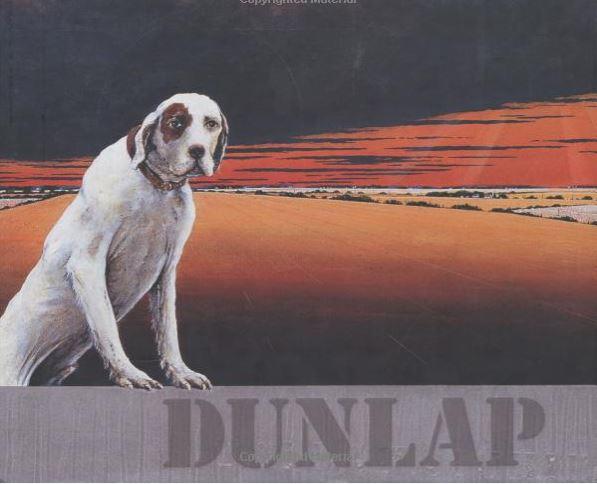
“Dunlap” by William Dunlap; foreword by Julia Reed, essay by J. Richard Gruber; Jackson, MS: University of Mississippi Press, 2006; available at Amazon
William Dunlap is an important contemporary artist of the South with a powerful affinity for southern landscapes and Walker foxhounds. Dunlap’s work may be seen in many prestigious collections, including the Metropolitan Museum of Art and the Corcoran Collection of the National Gallery of Art.
His book, Dunlap, features more than one hundred works, produced over a thirty-year period. It was published in a trade hardback and a limited edition of two hundred signed, bound-in-linen covers, housed in a matching linen-covered clamshell box. A signed, numbered print featuring four Walker foxhounds is included in the box. The book’s cover features a surrealist landscape with a white Walker foxhound, Delta Dog Trot, appearing ready to climb right out of the painting, a nod to nineteenth-century trompe l’oeil techniques. The painting, “Delta Dog Trot, Landscape Askew” hangs at the Alluvian Hotel in Greenwood, Mississippi.
Dunlap’s grandfather was “a foxhunter of the old school,” Dunlap writes. “He bred and hunted generations of pure blood Walker Hounds. With names like Lucky, Mary, Speck, Sally, and Bo, these dogs were all legs, lungs, nose, and heart. They lived to run but spent most of their lives laying around the kennel, eating, sleeping, stretching, and occasionally giving off the deep-throated mouth that would send any fox in earshot scurrying for the nearest hole.
William Dunlap: The Walker Foxhound as an Allegory
“Dunlap” by William Dunlap; foreword by Julia Reed, essay by J. Richard Gruber; Jackson, MS: University of Mississippi Press, 2006; available at Amazon
William Dunlap is an important contemporary artist of the South with a powerful affinity for southern landscapes and Walker foxhounds. Dunlap’s work may be seen in many prestigious collections, including the Metropolitan Museum of Art and the Corcoran Collection of the National Gallery of Art.
His book, Dunlap, features more than one hundred works, produced over a thirty-year period. It is published in a trade hardback and a limited edition of two hundred signed, bound-in-linen covers, housed in a matching linen-covered clamshell box. A signed, numbered print featuring four Walker foxhounds is included in the box. The book’s cover features a surrealist landscape with a white Walker foxhound, Delta Dog Trot, appearing ready to climb right out of the painting, a nod to nineteenth century trompe l’oeil techniques. The painting, “Delta Dog Trot, Landscape Askew” hangs at the Alluvian Hotel in Greenwood, Mississippi.
Dunlap’s grandfather was “a foxhunter of the old school,” Dunlap writes. “He bred and hunted generations of pure blood Walker Hounds. With names like Lucky, Mary, Speck, Sally and Bo, these dogs were all legs, lungs, nose and heart. They lived to run, but spent most of their lives laying around the kennel, eating, sleeping, stretching and occasionally giving off the deep-throated mouth that would send any fox in earshot scurrying for the nearest hole.
The Charm of Watercolor
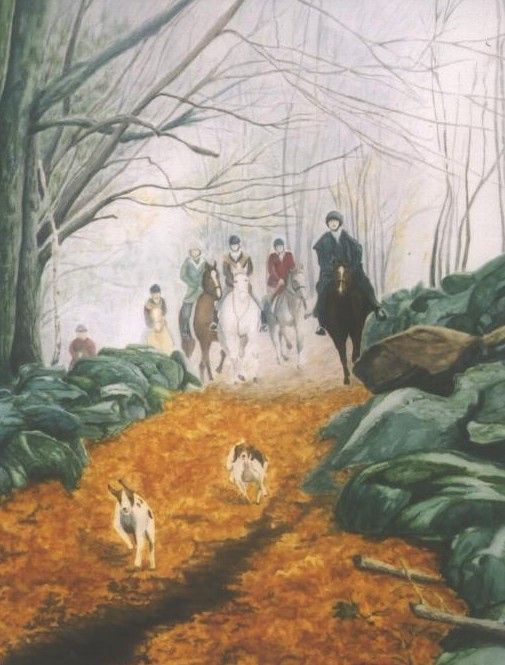
Morning Fox Hunt at Shady Lane Farm by Emily Thornton. Giclee prints of original watercolor are available.
I try to reveal the beauty of nature in my artwork through realism. From a young age I was drawn in by nature and my surroundings, from hiking in the woods to being an avid lover of animals and flowers. As I grew I became quite eclectic in my pursuit of art, but watercolors have remained my favorite medium with their opaqueness that can be full of surprises. Watercolor courses filled all my electives in college as I finished my degree in Psychology.
For twenty years now I have painted my own Christmas cards each year. Many of them were of animals, flowers, lighthouses or covered bridges. I became interested in foxhunting when a close friend and my daughter began actively foxhunting in the New England area.
Will Ersland’s Style
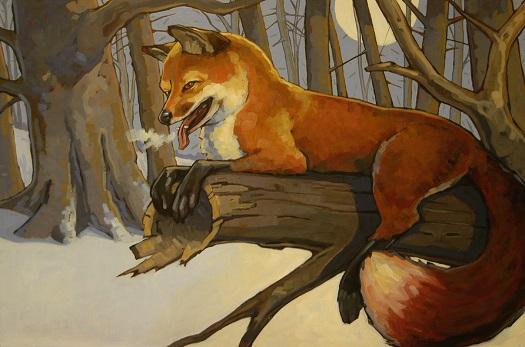
Hunters Moon by Will Ersland, courtesy of Cindy Piper, MFH, Long Lake Hounds (MN) Someone once told Will Ersland, “The horses and people in your paintings have great action—even when they’re standing still!”
Ersland sees himself as a visual journalist. “My paintings record a moment in time,” he says. “They are cropped the way I see the action, and each brush stroke is laid down with confidence and purpose based on my academic background and decades of drawing and painting.”
Ersland’s use of short, flat, planar brush strokes to highlight rounded shapes strikes me as an effective and unique element of his style.
“My style is dictated by the medium—acrylic paints—which dry very fast,” he explained. “I don’t even try to blend them. Instead, I build up form by starting with the darkest values and layering on the lightest values, usually following the form of the object with my brush strokes.
Maureen Riley and the Zennor Fox
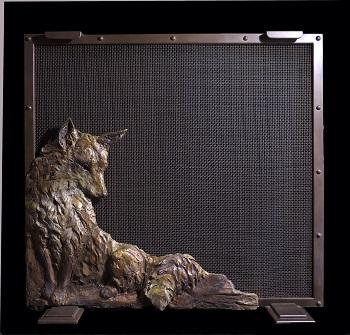
“I felt that the story of the Zennor fox needed to be remembered,” writes Michigan artist Maureen Riley. “It tells the story of a fox, but more than that it tells of a sportsman’s love for a good day of sport and a sense of fair play.”
Maureen Riley is a sculptor and painter who has been steeped in the sporting life from an early age. She learned about gun dogs from her grandfather and about sculpture from his friend, Walter Midener. Shooting, fishing, and horses have always been a part of her life, and country sports are at the root of her art.
From her studios in Michigan, Maureen has exhibited her work at Safari Club events and at international exhibits in both Milan and Portofino, Italy. Her work has also been shown at the Smithsonian. She is a member of the Society of Animal Artists and the National Sculpture Society.
Maureen has just created an interesting new platform from which to present her bronze works—a fireplace screen that serves as a blank canvas for her limited edition and custom relief sculptures. Her first design on this “blank canvas” is titled the “Zennor Fox.” The work was inspired by a 1913 foxhunt with the Western Hounds near Zennor Hill in Cornwall. Here’s the conclusion of the hunt as written by a participant, the renowned English equine artist Sir Alfred J. Munnings.
Country Pursuits: The Mellon Collections
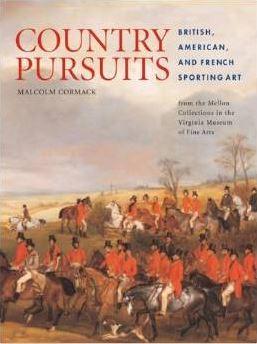
Country Pursuits: British, American and French Sporting Art from the Mellon Collections in the Virginia Museum of Fine Arts, by Malcolm Cormack, Published by the Virginia Museum of Fine Arts in association with the University of Virginia Press, 2007, 474 pages, illustrated, $62.00What a debt we all owe the late philanthropist Paul Mellon, whose love of horses and horse sports was expressed through the fabulous art collections that he so generously shared with us.
The Eclipse Award-winning breeder saddled legendary Thoroughbreds Sea Hero, Arts and Letters, and Mill Reef, just to name a few. His first British art purchase, in 1936, was a painting of a racehorse, “Pumpkin with a Stable-lad” by George Stubbs, said to be his favorite painting by one of his favorite artists. Pumpkin won sixteen out of his twenty-four races at Newmarket turf in the late 1770s and was described as an excellent runner.
“It was my very first purchase of a painting,” Mellon recalled later, “and could be said to be the impetus toward my later, some might say gluttonous, forays into the sporting art field.”
That Stubbs painting was donated to his alma mater, Yale, but the Virginia Museum of Fine Arts was another lucky recipient of Mellon’s “gluttonous” obsession with sporting art. Mellon’s donations are explored in Country Pursuits: British, American and French Sporting Art from the Mellon Collections in the Virginia Museum of Fine Arts by Malcom Cormack. Cormack was the Paul Mellon Curator at the VMFA in 1991 until his retirement in 2004. He also once served as the Curator of Paintings at the Yale Center of British Art established by Mellon.
Two-Part Edward Troye Exhibit at NSL&M
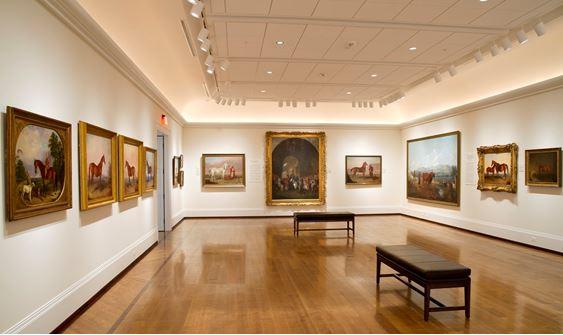
The National Sporting Library and Museum (NSLM) in Middleburg, Virginia has mounted a comprehensive exhibit in two parts: the paintings of Edward Troye and the archives of his biographers, Harry Worcester Smith and Alexander Mackay-Smith. The paintings (on view in the Museum) and the archives (exhibited in the Library) may now be seen through March 29, 2015.
Troye played an important role not only in American art but also in preserving the images of leading American Thoroughbreds of the nineteenth century. Highlights of the exhibit include many of Troye’s most recognized portrayals of important racehorses, jockeys, and trainers of the antebellum period.
Your Human Faces Are Showing
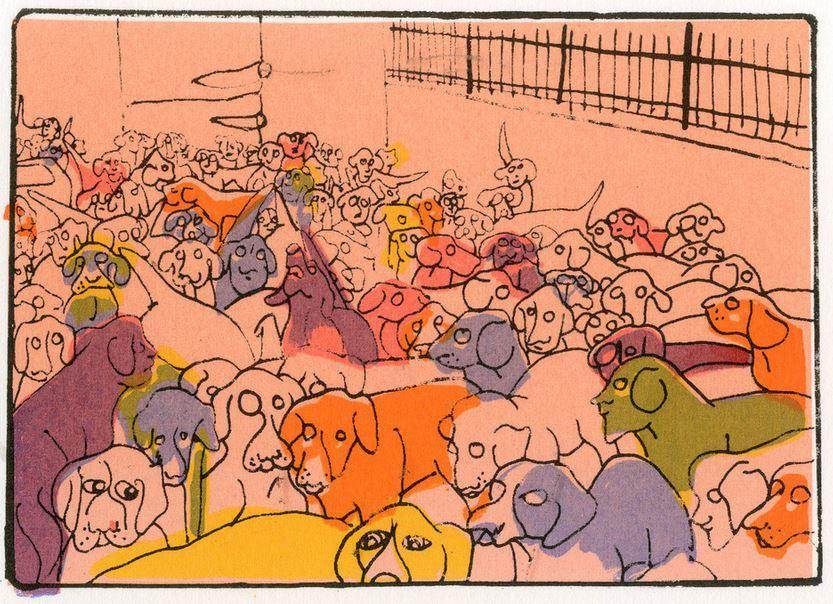
Perhaps because I’ve seen so many serious photographs of hounds in kennels, I was arrested and amused by this whimsical print by Emily Robards, daughter of a well-known huntsman and author. Emily’s dad has hunted hounds in Ireland and in North America, and Emily has whipped-in to him and spent most of her younger years in or near the kennels. I asked her to tell us about her art.
“Your Human Faces Are Showing” by Emily Robards
I am a visual artist who works in a variety of media such as photography, printmaking, collage, embroidery and paint. My work draws from dreams and memories, linking the spiritual, human, and animal worlds together with an underlining narrative of innocence and the uncanny. The work arises from the self, drawing from my past, while trying to take control of the present. I also work a lot with vintage photographs and text combining them to create new narratives.
The piece, “Your Human faces are Showing,” is a seven-colour limited edition screen print, approximately 11.4 x 8 cm. The print is slightly off register so they are not all exactly the same, which is called a print variable.
The print is based on an old photo my grandmother took of the County Limerick Foxhounds. The piece started out as a doodle in my sketchbook a few years ago, and stayed that way until my last year of college when I made it into a print. The drawing is relaxed, almost comical. I wasn’t worried about it being exact or anatomically correct. This relaxed idea towards the drawing I feel is what makes it a success.