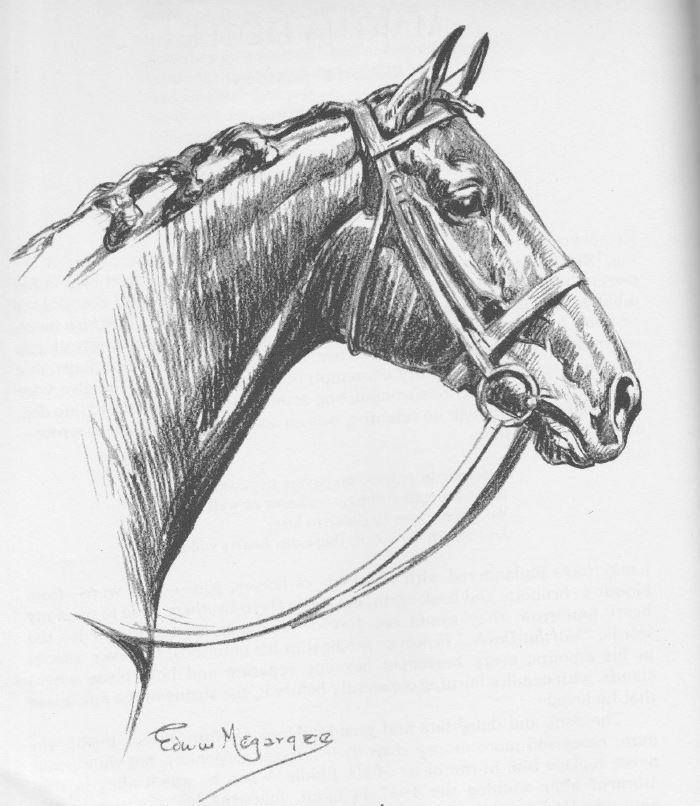
 Martha Doyle illustration by Edwin Megargee
Permit me, Muse, to sing the praises of Martha Doyle, a great lady in her own right and the noblest hunter I have ever seen or known. If I ever did see a better, I would not admit it, for that would be disloyalty to Martha’s memory and I am the High Priest of her cult. Many admire her, a certain few revered her greatness, but I adored her. She had my heart and perhaps, in a grudging, spinsterish, slightly contemptuous way, I had hers. You give your heart, I believe, to only one woman, one countryside, one horse, and one dog.
She was a brown mare, about sixteen-two, with a white streak on her face and two white stockings behind. A Canadian filly, she was sired by a Thoroughbred named Martin Doyle, of whose antecedents or performance I am entirely ignorant. I never even knew the name of her dam and, although frequently assured that Martha was “in the book,” no papers were shown to prove it. I do not believe that she was clean bred, but the “nick” that produced Martha Doyle from the mating of a little-known sire and an unknown dam is one of those mysteries which makes horse breeding and racing so fascinating.
Peter Roche, of Leominster, Massachusetts, picked her out and bought her, a shaggy, rough young thing hardly halter broken. She had a deceptive mouth, and even so superlative a horseman as Peter rated her a three-year-old when, as we afterwards discovered, she was just two. Peter clipped her and cleaned her up, bitted and backed her in his big stable and indoor ring, schooled her once or twice, and then entered her in the show at Worcester. This was in the days just after the War when the Worcester show brought out some excellent competition. She won the high jump at six-feet-four with a wild, “sprangling” jump, landing all abroad but triumphant on the ground. My wife was so impressed with the gallantry and the looks of the young mare that she promptly bought her and brought her home to Groton. I must have show by the yearning in my eyes that I coveted my wife’s horse, for on my next birthday morning I found, under my pillow, a sheet of note paper with the two words on it: “Martha Doyle”; and a nobler gift or a more unselfish giver I have never know.
As a three-year-old we hunted her in the summer drags at the Norfolk Hunt Club, thinking her a year older. The sight of hounds filled her with a fine careless rapture. Hunting was her destiny and her delight. All she wanted on earth was to be—not up with hounds—but up with the leading hound, of a trifle ahead of him.
Mind you, there was no vice in her, only an unconquerable determination to be “first in the rush and come home with the brush.” Keenness is a fine quality, but, of course, it can be exaggerated. In fact the case looked almost hopeless until I thought of Peter Roche, and asked Mr. Henry Vaughan, the Master of Norfolk, if he would permit him to ride my mare in one of the Norfolk drags. He consented and Peter drew up in due season. He rode Martha in a plain snaffle and he rated her up and down the hunt, in front, in the middle, or with the stragglers. She was completely docile and apparently did not pull an ounce. I asked this great horseman how he did it. He laughed in the embarrassed way one laughs at a foolish question; I dunno Mr. Danielson,” he said, “I tell ’em they just got to do what they’re told.” Apparently it’s just as simple as that. The trouble is that I’ve never been able to tell them anything.
That lesson taught Martha Doyle, to a certain extent, the sweet virtues of obedience and, with the help of a gag snaffle we were able to restrain her natural exuberance. The gag was discarded the next season, and from then to her retirement the only bit we used with her was a simple pelham.
I couldn’t begin to recount her exploits or tell you her virtues. Hunting folk will understand when I say that I hunted her, roughly, twice a week, for eleven years, with only two falls, neither of which was in any sense her fault.
Martha’s greatness was not in the fact that she was a natural jumper, not that she had enough foot to stay with any hounds in the world, but that she had a heart as big as the biggest barn. She never asked what was on the landing side. I think if you had headed her at a house and given her “the office,” she would have tried to crash the second story windows and bull her way through the other side. I rode her with complete and utter confidence, knowing that, barring accidents, she would carry me anywhere.
I have always felt a sense of guilt that I didn’t do right by Martha. Instead of being a local phenomenon, she could have been made into a national figure. She was a show hunter of indefinite potentialities. It so happens that I dislike horse shows and the showing of horses—a boring business in my opinion. Consequently I never took Martha to any but local shows when we wanted entries for our own—on the principle of “you scratch my back and I’ll scratch yours.” In the show ring Martha was an actress. Not only did she perform with almost faultless precision, but she pranced and curvetted and put on all those acts which are so appealing in the case of a lovely mare and so annoying when performed by a Roman-nosed gelding. She knew quite definitely the color of her ribbons and if, as sometimes happened, she was awarded the red, her disgust was manifest. Mostly she won with monotonous regularity, being Champion Hunter at such shows as Worcester, Norfolk, Millwood, and several times at Groton. I should have trained her and showed her at Bryn Mawr and Devon and the National. I should have turned her over to the Army as a candidate for the Olympic team. But I didn’t. I hoarded her as my priceless possession, more precious than rubies. I think she knew that I had kept her from the fame that was her due, hence her sense of disappointment and frustration. I felt it.
In her later days she gave me to understand by baleful glances and gestures of impatience that she knew perfectly well that she was entitled to see her name in electric lights on Broadway and that I, for selfish reasons, had kept her out of the Big Time. She was right, and I am ashamed. This is my apology to her memory.
The end? If she could have broken her neck in the hunting field, I would not mourn, as I do, the sad anticlimax of disease and disabilities which made it seem humane and proper to bestow oblivion. I do not know, for I have never asked, at whose hand or just when she was sent down “that short, dark passage to a future state.”
I do not know if we shall ever meet again or if in the Elysian Fields her ears will prick forward once more to the cry of hounds. I know she is buried in the horse cemetery in our place in Groton on the banks of the Nashua River. On her gravestone are the two words “Martha Doyle,” just that—as they were on the note paper under my birthday pillow. I couldn’t inscribe that gallantry, that personality, that beauty on stone. What more could I say? What more could I say?
Posted July 6, 2018
This condensed version is from the title story in Martha Doyle; And Other Sporting Memories by Richard E. Danielson, illustrated by Edwin Megargee, New York, The Derrydale Press, 1938
Richard Danielson, a New Englander, graduated from Yale, attained the rank of Captain in World War I, and settled in Groton, Massachusetts upon the end of hostilities. In 1921, he built kennels on his estate and started a pack to hunt the local foxes. The hunt was formally established in 1927 as the Groton Hunt Club. Both Danielson and his wife served successive terms as Master until 1941. The hunt was disbanded in 1964.
(A personal note. That same year, a group of Groton Hunt members, wishing to continue hunting in the nearby Pepperell, Massachusetts and southern New Hampshire country, organized the Nashoba Valley Hunt, your editor’s first hunt club, which he joined shortly after, not so much in pursuit of the fox, but rather in pursuit of a girl named Joan.)
Danielson, having a literary bent, founded The Sportsman magazine in 1924. He served as editor and contributed much of the content. It was for a time the official publication of the MFHA.