The Refugee Foxhounds
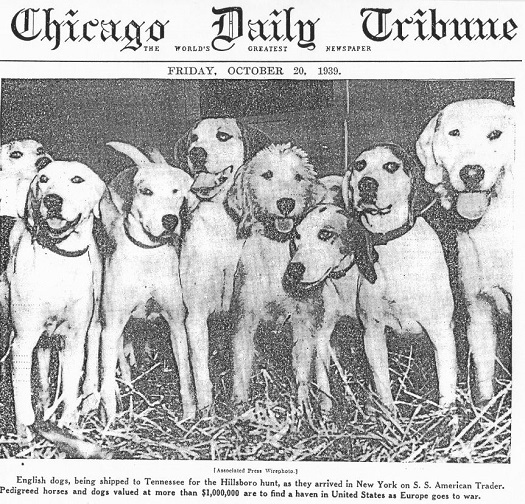
With the seventieth anniversary of V-E Day, May 8, 1945, just days away, we’re reminded of two sportsmen—one in America and one in England—who together tried to preserve the best bloodlines of the modern English foxhound as that type was developing and gaining acceptance over the heavy and ponderous English foxhounds of the so-called “Shorthorn Era.”
Mason Houghland, MFH of the Hillsboro Hounds (TN) and Major W.W.B. Scott, MFH of the North Cotswold Foxhounds (UK) were good friends. As Hitler invaded Poland (September, 1939), and war threatened to engulf Europe for the second time in the century, English foxhound breeders prepared yet again for their government’s mandate of destruction. (In World War I, thousands of foxhounds had been destroyed by the English authorities as a measure to conserve food and grain supplies.) Houghland received the following cablegram from Scott:
“Can you take seventeen couple of hounds for the duration of the war? Lend to friends those you have no room for. Please reply.”
John Woodcock Graves: John Peel’s Boswell
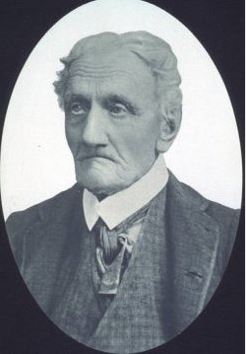
John Woodcock Graves (1795–1886)We’re all familiar with “John Peel,” surely the most well-known foxhunting song of all time. We’re perhaps less familiar with the songwriter, John Woodcock Graves, who turns out to be a most fascinating and unpredictable character—rogue some might say—in his own way. We owe this insight into Graves’ life to our Cumbrian friend, Ron Black, who sent us excerpts from A Ramblers Notebook at the English Lakes (H. D Rawnsley, 1902).
In an earlier article, Foxhunting Life describes that night in 1829 when John Woodcock Graves sat in his parlor in Caldbeck, in England’s Lake District, with John Peel. Peel was a farmer, horse dealer, and foxhunter whose hounds were highly celebrated by the local sheep farmers. From the adjoining room, Graves overheard his son’s granny singing an ancient Irish melody to the child. Graves took that old melody and wrote a new set of lyrics to honor his friend, John Peel.
“I sang it to poor Peel,” Graves wrote, “who smiled through a stream of tears which fell down his manly cheeks, and I well remember saying to him in a joking style, ‘By Jove, Peel, you’ll be sung when we’re both run to earth!’’
Just a few years after that cozy night, however, Graves became embroiled in a violent altercation with an employee, the aftermath of which induced him to leave England forever. His adventures were just beginning.
Southern Hound Show Kicks Off the Season
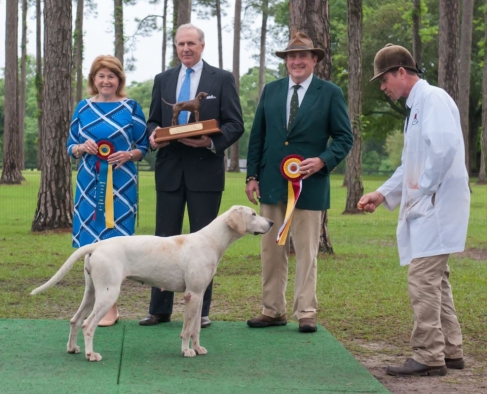
Live Oak Fanfare ’10 is Grand Champion of the Southern Hound Show. (L-R): Daphne Wood, MFH, Live Oak Hounds; Michael Ledyard, Esq., MFH Mr. Stewart’s Cheshire Foxhounds; C. Martin Wood III, MFH, Live Oak Hounds; Dale Barnett, huntsman
Captain Ian W. Farquhar, MFH of the Duke of Beaufort (UK), who judged at this show seven years ago, was joined in the ring by John J. Carle II, ex-MFH of the Keswick Hunt (VA).
Ian Farquhar, huntsman for thirty-eight seasons, judged his first show forty-two years ago and has bred nineteen Peterborough champions. Jake Carle, who hunted hounds for twenty-eight seasons, has judged for over forty years at all the major hound shows in the United States. Over the course of the weekend these two very senior judges enjoyed each other immensely and got along famously in the ring despite their English and Bywaters leanings respectively. Interestingly, thirty-four ribbons were won by Crossbreds, and twenty went to English hounds. Two Champions were Crossbred, and two were English.
John B. Glass: Gentleman, Scholar
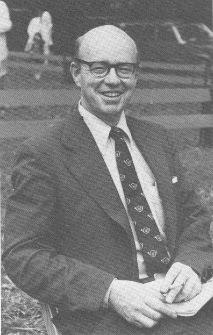
John B. Glass, who served as Clerk and Keeper of the Foxhound Kennel Stud Book for the Masters of Foxhounds Association (MFHA) from 1973 to 1995, died on Friday, April 10, 2015, in Concord, Massachusetts. He was eighty-six years old.
John was the second of only three men to supervise the MFHA office in the 107 years since the founding of the association; he succeeded the late Joe Jones upon the latter’s retirement. John began his twenty-two-year career in the old MFHA headquarters on Water Street in Boston, moving to Morven Park in Leesburg, Virginia, when the directors relocated the office. John was the first to recommend computerizing the Foxhound Kennel Stud Book, and he personally wrote the code and implemented the first computer program to do that. John’s “Fox Dog” program was used for years by the MFHA until commercial programs written in newer, higher-level language became available.
The son of a West Point army officer who served in two wars, John was born in Hawaii and spent his formative years in such far-flung locations as Virginia, Texas, Wyoming, Guatemala, and Germany. He majored in economics at Yale and earned a Ph.D. in archaeology at Harvard. He became an authority on Pre-Columbian hieroglyphic manuscripts, publishing numerous papers and books on the subject, most notably as a major contributor to the academic encyclopedia The Handbook of Middle American Indians.
The Making of a Book…Starting From the Ending
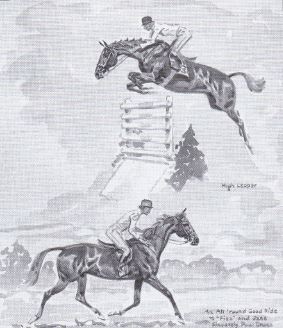
Jane Pohl and Fitzrada, painted by Paul BrownIn 2001 the Museum of Hounds and Hunting in Leesburg, Virginia, mounted an exhibit of the works of artist Paul Brown, famed for his elegant rendering of horsemen, horsewomen, and horses—racing, showing, and foxhunting. I was, at the time, a member of the Museum Advisory Board, and on the night of the exhibit I watched with curiosity and interest a slim, elderly, and proudly composed woman being carried in her wheelchair up the narrow back steps inside the Westmoreland Davis mansion to the second floor where the exhibit was hung.
I didn’t know whom she was, nor did I even meet her. Two months later she was dead, and I was equally unaware of even that occurrence. Her name, I was to learn some years later, was Jane Pohl, and, though she was terminally ill the night I saw her, she was determined to attend the exhibit, her last outing, because she had lent some of the Paul Brown art depicting her and her horse Fitzrada for the exhibit. I couldn’t know at the time that I was witnessing the ending of a story with which I was to become more than familiar.
Further Adventures of Jack and Pete
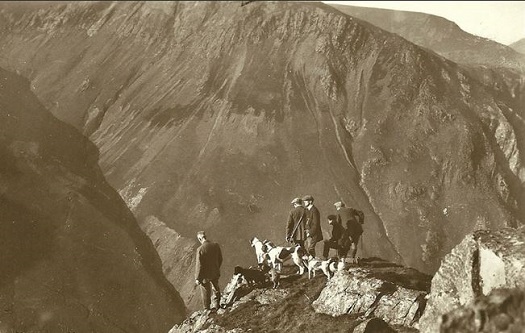
Foot hunting in the Cumbrian fells / photo courtesy of Ron Black
Further adventures of our old friends Jack and Pete in Cumbria, a majestic landscape populated by some who might see themselves as the only true purists of our sport. We hope mounted foxhunters won’t take too much offense at this story. A little will be well justified, though!
With the benefit of hindsight and a few drinks, there was a certain inevitability about the whole affair. It began innocuously enough, with Jack sitting in the pub telling us that a friend had invited him out for a day with hounds. “Wot pack?” said Pete, muscling in on the conversation.
Jack named a mounted pack some miles down the motorway. Pete took it all in and thought for a moment. “They ride,” he announced. “Not getting me on a hoss, smelly bloody things.”
Jack sighed. “We can follow in the Land Rover,” he said. “They will give us a guide.”
Horsey Sweet Briar College Sued Over Closure
For 114 years Sweet Briar College has represented a storybook version of the college experience for women, especially women who love horses. In 2015, Sweet Briar was recognized by U.S. News & World Report as the 116th “Best Liberal Arts College” in the nation. Lying in the foothills of the Blue Ridge Mountains near […]
Suspension
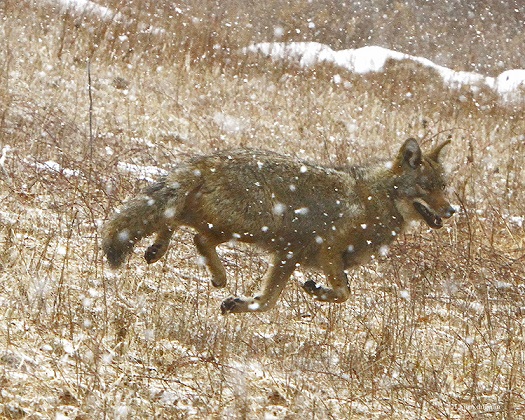
Snow on the ground or falling from the sky, no matter. The Golden’s Bridge Hounds (NY) and huntsman Codie Hayes are determined to keep coyotes on the move until the very last day in March. This coyote, writes photographer Jim Duggan, “kept circling as usual at this time of year with the mate and pups […]
Mark McManus: Huntsman and Mentor
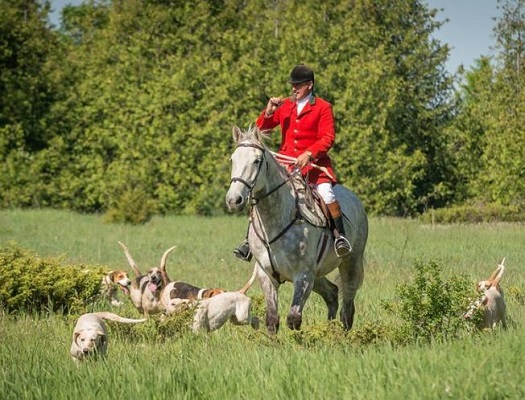
Mark McManus is the new huntsman at the Chagrin Valley Hunt (OH).
When a huntsman retires after a long and successful career hunting hounds for a respected hunting establishment, that vacuum creates a ripple effect throughout the hunting community. So it was when Larry Pitts retired after thirty-five seasons hunting hounds at the Potomac Hunt (MD). Pitts’s vacancy was filled by huntsman Brian Kiely from the Myopia Hunt (MA); the void at Myopia was filled by huntsman Philip Headdon from the Chagrin Valley Hunt (OH); and the Chagrin Valley opening will be filled this season by huntsman Mark McManus from the Ottawa Valley Hunt (ON).
During his time at Ottawa Valley, McManus definitely left his mark (pun intended). OVH Master Anne McKibbin lets sixteen-year-old whipper-in Carmen Powell-Sadik tell us how.
Mark is an enjoyable person to be around, with many a good story to tell depicting various scenes of humor and horror taken from an exciting and sometimes perilous life of foxhunting in his native Ireland. He remembers times of his childhood riding with his baby brother “sat in me lap” as he (much to his father’s chagrin) jumped the hedges!
Sporting Photographer Janet Hitchen

Douglas Lees photoPopular and widely-respected photographer Janet Hitchen (neé Goldberg) died at her home near Millwood, Virginia on Tuesday evening, March 24, 2015. She was seventy-one.
Brilliant at her art, she has, over the last few decades, recorded a magnificent visual historical record of people and events in the world of field sport in and around Virginia. I fervently hope that her collection of negatives and digital image files will be preserved in her name, in the custody of a capable and responsible archivist, for the benefit of sporting researchers and writers of the future.
Janet was my go-to photographer from the early 1990s on, whenever I needed an image for Covertside. When I published the first full-color foxhunting calendar for the American Foxhound Club in 1998, she was the first photographer I called. Two of her photos were included in that inaugural calendar, and her photos have graced the pages and covers of Covertside and our Foxhunting Life Calendars ever since.