
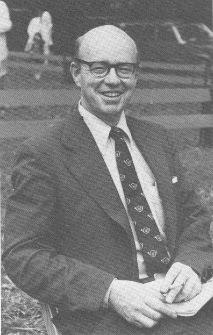
 John B. Glass, who served as Clerk and Keeper of the Foxhound Kennel Stud Book for the Masters of Foxhounds Association (MFHA) from 1973 to 1995, died on Friday, April 10, 2015, in Concord, Massachusetts. He was eighty-six years old.
John was the second of only three men to supervise the MFHA office in the 107 years since the founding of the association; he succeeded the late Joe Jones upon the latter’s retirement. John began his twenty-two-year career in the old MFHA headquarters on Water Street in Boston, moving to Morven Park in Leesburg, Virginia, when the directors relocated the office. John was the first to recommend computerizing the Foxhound Kennel Stud Book, and he personally wrote the code and implemented the first computer program to do that. John’s “Fox Dog” program was used for years by the MFHA until commercial programs written in newer, higher-level language became available.
The son of a West Point army officer who served in two wars, John was born in Hawaii and spent his formative years in such far-flung locations as Virginia, Texas, Wyoming, Guatemala, and Germany. He majored in economics at Yale and earned a Ph.D. in archaeology at Harvard. He became an authority on Pre-Columbian hieroglyphic manuscripts, publishing numerous papers and books on the subject, most notably as a major contributor to the academic encyclopedia The Handbook of Middle American Indians.
In 1955, he married Florence (Kerry) McKerrow, whom he had met on an archaeological dig he was supervising in Quemado, New Mexico, when Kerry was an undergraduate anthropology major at Beloit. In the early 1960s, Kerry took up riding for the first time since childhood and discovered the world of foxhunting. Within a few years, she became Master and huntsman of the Norfolk Hunt in Dover, Massachusetts, drawing John into her newfound passion. John, however, preferred the sport in its pedestrian form—and so, in 1965, John and Kerry founded their own pack of hounds, the Middlesex Fox Dogs, hunting on foot, at night, in large wooded areas near their home in Lincoln, Massachusetts, and in neighboring Concord, where I lived at the time. John and Kerry, with their hounds, would turn the corner upon which my house was perched, onto the dead-end road where trails led us to the Concord River and the soft hills and woods which defined that gentle place. Those were magical nights above the river, where I first experienced this uniquely American style of foxhunting.
“John was such a gentleman,” recalls Gail Andersen, MFH, “but with that came a quiet wit.” The scholarly historian displayed his wit (with an irreverent streak) in naming his pack the Middlesex Fox Dogs, a play on A. Henry Higginson’s famed Middlesex Foxhounds. Higginson’s pack was also kenneled in Lincoln, Massachusetts, albeit at an earlier time—from 1903 to 1919.
“Higginson was an ardent advocate of the English foxhound and an equally ardent critic of the American hound,” said John in an interview for a Chronicle of the Horse article. “He would have turned over in his grave at the thought of American hounds in Lincoln.”
The Middlesex Fox Dogs competed in foxhound field trials, with hounds judged on both performance and conformation. “One year,” John recalled, “one of our crossbred hounds almost won the four-day Brunswick trial, and that was one of the big thrills we had with our pack.”
“John was always organized,” says Anita Bailey, who worked for a time in the old Boston office of the MFHA. “He was a perfectionist who maintained high standards and was driven for accuracy in all his work, especially the Stud Book.”
Another project of John’s was the collection and organized assembly of data from the long-dormant records of every North American hunt—including historically significant but now disbanded hunts—listing milestones, Masters and huntsmen, and their terms of service. If published and maintained into the future, such a resource could contribute to North American foxhunting scholarship what Baily’s Hunting Directory does for researchers and writers delving into English and Irish hunting. I sincerely hope that John’s valuable papers will be preserved by a responsible archive for such purposes.
I always viewed John Glass as a gentleman-of-old, dignified and above the fray. He could easily have been cast as one of those admirable characters in a Gordon Grand story. John’s daughter Julia agrees. “His manners, and his sense of propriety and integrity, came from another age,” she wrote to me in an e-mail. “There’s no one else like him.”
John is survived by his wife, Kerry Glass, ex-MFH, who still lives in Lincoln; by their daughter, novelist Julia Glass, a 2002 National Book Award winner; and by two grandsons.
Posted April 15, 2015