My Holiday with Hounds
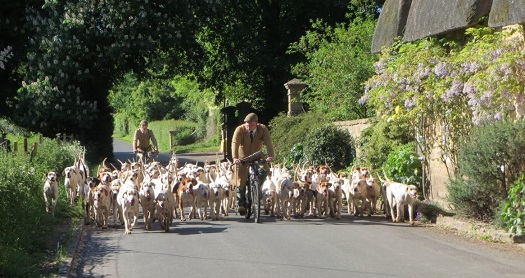
Kennel huntsman Nick Hopkins exercises the North Cotswold foxhounds through the village of Broadway. / Denya Massey Clarke photo
On holiday one spring day in 2008 my husband (non-horsey) and I were walking down High Street in Broadway, enjoying the charms of one of the most attractive towns in the Cotswolds. Suddenly I heard hounds.
I determined to find the source, while my husband is thinking, “Really? We’re on vacation, and she finds hounds? Out of the blue? Really?” I saw a lane called Kennel Lane, and there, one block off High Street, were the kennels of the North Cotswold Foxhounds!
I was enchanted by the hounds living right in town. It made them so accessible, yet they weren’t. The North Cotswold foxhounds are a beautifully bred, highly respected pack. I imagined seeing them out of their kennels on a hunting day, yet, since we travel regularly to the Cotswolds in May, that wouldn’t happen.
While planning our third trip to Broadway, I couldn’t resist. I knew that the Joint-Master of the North Cotswold, Mr. Nigel Peel*, was a contributor to Foxhunting Life—in fact a member of FHL’s Panel of Experts. I asked editor Norman Fine if it would be impolite to ask to see the kennels. He kindly offered to introduce me by email to Mr. Peel, who bred this beautiful pack, hunts them himself, and whose reputation as a breeder and judge of foxhounds is universally renowned.
Fast forward: the phone rings in our Cotswold ‘cottage.’ It’s Nick Hopkins, kennel huntsman for the North Cotswold Foxhounds, calling on Mr. Peel’s behalf to invite me to walk out with the hounds on the twentieth of May at 7:45 a.m. Of course, I say. Thank you. Oh, mentions Nick, we’ll have a bike for you. A what? A bike. Oh, ok…. We hang up.
Sure, And the Going Was Soft!
As the owner of a multi-media production studio, Steve Toepp knows what he wants to convey in his foxhunting videos but he finds it to be a challenging task. “Filming while mounted is the most difficult type of videography I have ever encountered,” Toepp says. “I am trying to develop riding techniques that keep […]
March Madness in Montford
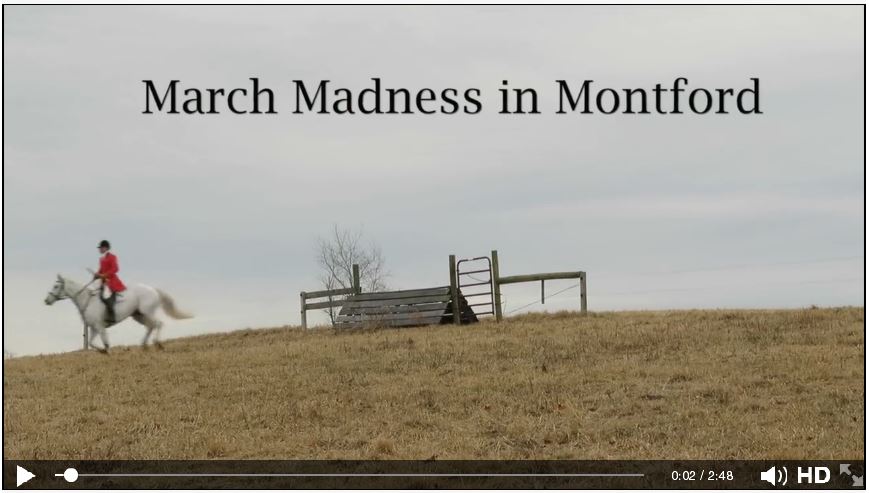
Photographer Phil Audibert in Gordonsville, Virginia has been practicing his artistry with the still camera in the hunting field for some time. Recently he’s been experimenting with the video camera. Here’s the Keswick Hunt (VA) in action with views of the hunted fox, Keswick’s pack of American hounds in full cry, and staff and […]
Hugh Robards to Hunt Hounds for Middleburg Hunt
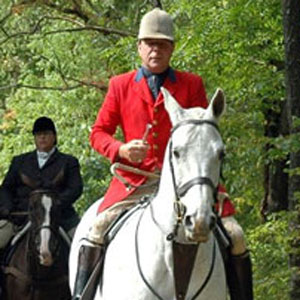
Hugh Robards cubhunting with the Rolling Rock HuntTalk about experience. Hugh Robards has spent fifty-three years in hunt service. He whipped-in to some of the legendary huntsmen in England—Brian Gupwell at the Eridge (later to become huntsman for the Duke of Beaufort), Percy Durno and Captain Ronnie Wallace at the Heythrop, and Charlie Wilkin at the Wynnstay.
Upon Captain Wallace’s recommendation to Lord Daresbury, MFH of the County Limerick Foxhounds, Hugh moved to Ireland to take up his first post as huntsman. There he remained for twenty-seven seasons showing world-class sport to the Irish—none keener—and visiting sportsmen and women from around the globe.
After parting from the Limerick, he came to the U.S. to help rebuild the Rolling Rock Hunt (PA), remaining there as Master and huntsman until 2007. From Rolling Rock he moved to the Saxonburg Hunt (PA) where he served as huntsman until coming to the Middleburg Hunt last year as first whipper-in to huntsman Barry Magner. (Barry is moving to Australia this season, and we hope to catch our readers up with him in another article.)
“Hugh continually reinvents himself because of his love for his work,” said Juli Robards, his wife. “Transcending change is one of his great qualities, and I’m unabashedly one of his biggest fans!”
Those who have hunted behind him are big fans as well. Tony Leahy, who grew up in Ireland, is first vice-president of the MFHA and serves as Master and huntsman of the Fox River Valley Hunt (IL). “Hugh is without question one of the best huntsmen I’ve seen,” said Tony. “I remember hunting behind him at Limerick, and I’ve seen him do amazing things!”
Fox River Valley Convoy Is Grand Champion at Southwest Hound Show
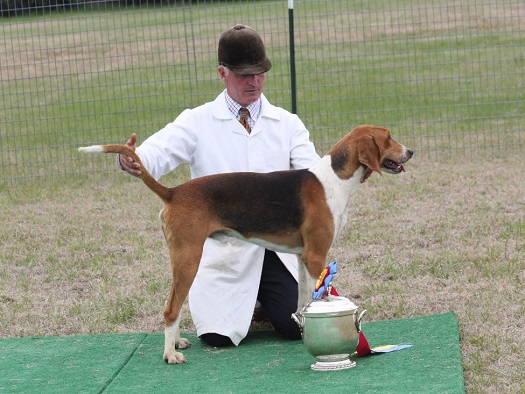
Fox River Valley Convoy, unentered Crossbred dog hound shown by Tony Leahy, MFH, is Grand Champion of Show at the Southwest Hound Show. / Sammy Buczkowski photo
Fox River Valley Convoy, an unentered Crossbred dog hound, was judged Grand Champion of Show at the Southwest Hound Show. Brazos Valley Mystic 2010—Grand Champion of Show for the last three years running—made a hard run at an unprecedented fourth consecutive title, but finished as Reserve Champion to Convoy.
The Southwest Hound Show was held on April 19, 2014 at Greenwood Farm in Weatherford, Texas. All hounds are shown in the same ring, and were judged this year by Tony Gammell, professional huntsman for the Keswick Hunt (VA).
“It’s a lovely, small show; you can walk around and see everyone, said Tony Leahy, Master and huntsman of the Fox River Valley Hunt (IL), who looks forward to entering Grand Champion Convoy in the fall. “It was my first visit to Texas, and the people couldn’t have been nicer, more accommodating, or more welcoming.”
How the Experts Judge a Class of Foxhounds
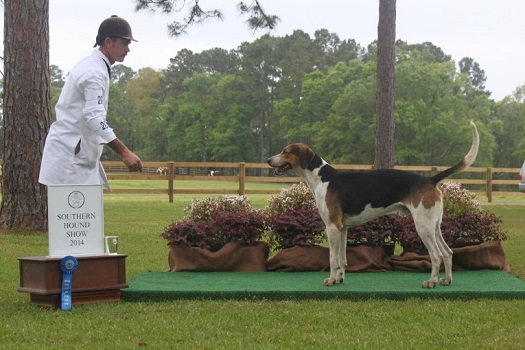
Live Oak Dandy was Grand Champion of Show at the Southern Hound Show this year. / Cathy Taber photo
The hound show season, now underway, provides an excellent opportunity to improve one’s eye for foxhound conformation by judging from ringside just for fun. The exercise not only makes the day more interesting, but educational as well. Especially when you can collar a friendly judge after the class and ask him why he didn’t like the hound you adored, or why he picked a hound you thought was common. (Obviously, you must frame your question such that the judge understands that you are seeking an education and not leveling criticism!)
It can be intimidating to watch a procession of foxhounds enter and leave the ring and wonder how in the world the judge can sort them all out. For example, how does he compare a hound he is looking at to one he saw ten minutes ago? Ten years ago, I asked some top judges how they judged a class, and here’s what I learned.
Excerpt from “Reynard the Fox”

This joyful image of foxhounds arriving at the meet, conscious all the while of the attentive whipper-in, is an excerpt from the chapter, Hounds, in John Masefield’s epic poem, Reynard the Fox, written in 1919. John Masefield was Poet Laureate of the United Kingdom from 1930 to 1967. [Note: Dansey is the whipper-in, and Maroon is his horse.]
There was a general turn of faces,
The men and horses shifted places,
And around the corner came the hunt,
Those feathery things, the hounds, in front,
Intent, wise, dipping, trotting, straying,
Smiling at people, shoving, playing,
Nosing to children’s faces, waving
Their feathery sterns, and all behaving,
One eye to Dansey on Maroon.
Forrard Aloft!
Photographer Adrian Jennings has discovered a unique way to follow hounds. Enjoy this short video clip of the Mooreland Hunt foxhounds in Alabama. Posted April 8, 2014
All Fox Pens Are Not Equal
Hunter (and foxhunter) Robin Traywick Williams recently addressed the fox pen issue in an article published in the Richmond Times-Dispatch. The subject has been in the news recently as the Virginia House of Delegates considers phasing out the practice of penning. (See Phase-Out of Fox Pens One Step Closer in VA, as reported in Foxhunting Life last month.)
In her article, Williams claims that for a few of the 37 pens operating in Virginia, activity is relatively light. Only a few hounds are in the pen at any one time; the fox population in relation to the size of the pen mirrors the density found in nature; and the vixens within are able to reproduce. This activity level would conform to the fox pen’s use as a training aid for young foxhounds.
In perhaps 12 of the pens, however, activity is heavier year-round. Competitive foxhound trials are held with many hounds in the pen at the same time and for longer periods; the fox population in one pen is 10 times the population density found in nature; fox mortality rate is high; and with no limit to the season, vixens are not reproducing.
“Dr. Joe”: An Appreciation
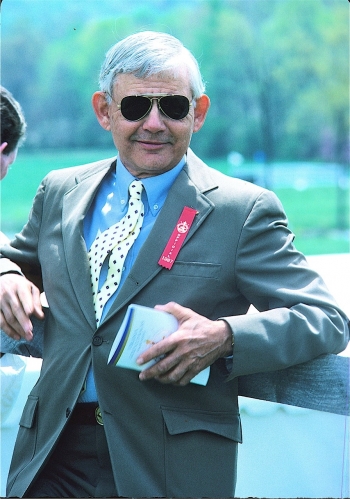
“Dr. Joe” Rogers, MFH / Douglas Lees photoDr. Joseph M. Rogers, who died March 8 at his beloved Hillbrook farm near Hamilton, Virginia, was of a rapidly disappearing breed of Virginians whose financial resources made possible the pursuit of a mission to preserve the countryside before it passed from reality to a lithographic memory.
These Virginians did not keep score with coin. The acquisition of land was not an egotist’s pursuit, and its preservation was not a beauty contest. Land was acquired and cared for because it represented an irreplaceable resource. That it provided the setting for pursuit of agricultural business and field sport was a cherished benefit, not a root rationale. To do otherwise, he believed, was to leave God’s earth to the vagaries of the marketplace.
“Dr. Joe,” as he was known by all, was at heart a man of that earth. He admired a craftsman who could build a proper four-panel fence or shoe a horse as much as he respected a man who made his fortune in business. In many cases, more so. He took pride in being able to train one species of canine to be capable of pursuing another much craftier, quicker, and agile species—a sport called foxhunting, in which the hunted had nearly insurmountable advantage over the hunter. It is a picturesque sport, photographed, illustrated, written about, and otherwise memorialized. But it was also a lot of hard work when you were in charge of bringing the show to the field.