
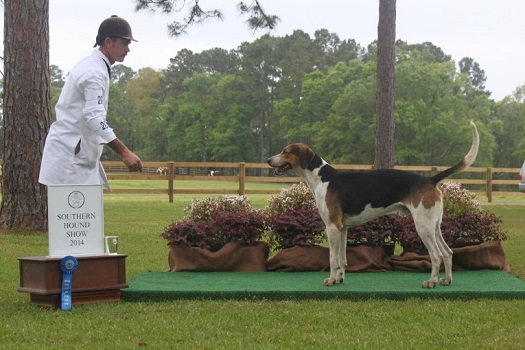
 Live Oak Dandy was Grand Champion of Show at the Southern Hound Show this year. / Cathy Taber photo
The hound show season, now underway, provides an excellent opportunity to improve one’s eye for foxhound conformation by judging from ringside just for fun. The exercise not only makes the day more interesting, but educational as well. Especially when you can collar a friendly judge after the class and ask him why he didn’t like the hound you adored, or why he picked a hound you thought was common. (Obviously, you must frame your question such that the judge understands that you are seeking an education and not leveling criticism!)
It can be intimidating to watch a procession of foxhounds enter and leave the ring and wonder how in the world the judge can sort them all out. For example, how does he compare a hound he is looking at to one he saw ten minutes ago? Ten years ago, I asked some top judges how they judged a class, and here’s what I learned.
The late Bill Bermingham, MFH of the Hamilton Hunt (ON) told me that some judges, Simon Clarke (UK) for one, are able to snap a mental picture of each hound as it enters the ring. Once Clarke snaps his mental picture, he never forgets it. Jake Carle, ex-MFH of the Keswick Hunt (VA) told me that the late Bill Brainard, MFH of the Old Dominion Hounds, could do the same. He never used a scrap of paper. He ranked hounds mentally as they entered the ring, remembered each, and usually pinned them that way. Most of the rest of us mortals need another system, for we cannot hope to operate at that level.
Bill Bermingham would first check the hound for all necessary body parts, then look at feet, toes, elbows, knees, shoulders, stern, head, mouth, underline, and topline. If the hound exhibited no obvious faults and it appealed to him, he would score it on a scale of one to ten, perhaps a seven. If the hound had faults or didn’t show to advantage, he would give it a four or five. He would then use the same procedure on the next hound to enter the ring, decide whether he liked it better or worse than the previous hound, and score it accordingly. Thus, at the end, he was not comparing a hound to one he saw ten minutes earlier, but to the one he had last seen. He would then call back the highest scoring hounds and compare the top four or five for the final placings.
Jake Carle’s system is to watch each hound as it enters the ring and jot down the names of those he likes. He then lets them sort themselves out when he asks them to move. If, when on the flags, he sees a dropped toe or a hound he particularly likes, he makes an adjustment in his placings.
Marty Wood, MFH and huntsman of the Live Oak Hounds (FL) has judged all the major hound shows in the U.S., Canada, and England, including England’s prestigious Peterborough Royal Foxhound Show. Here’s his method.
When hounds first enter the ring, Wood looks at each to draw an impression and jots down the name or number of the ones that catch his eye. Then, on the flags, he examines each hound in the class for overall structure, comparing each individual to an ideal standard stored in his mind. Hounds he doesn’t like are noted in his own shorthand, identifying the faults. Then he watches them move, looking primarily for balance and activity, and secondarily for a happy, springy, fluid, ground-covering stride. Before making his first cut, he looks carefully at those to be excused to be certain he has not made a mistake. If he has ten or so hounds remaining after the first cut, he trims that down to five or six, then puts them on the flags again, making a final cut to the last three or four. He carefully examines the finer points at this stage—splitting hairs. If he has been true to his standard, he expects to have all the same type when he pins the class. Structure, balance, and activity is Wood’s mantra, but, he warns, not all classes will have the depth of quality you hope for. “You’ve got to make concessions and judge what’s in front of you.”
Posted April 28, 2014
The substance of this article was previously published by the author in the March 2004 issue of Covertside.