Hedge Hopping with the Blackmore Vale
Here’s a view through the helmet-cam of a day with the Blackmore Vale (UK)—a hunting country where riders are free to take their own line over the hedges. Catch a ride with this young lady from Virginia jumping the hedges for the first time. Is she tickled, or what? Posted March 8, 2014
Foxhound in the House: Redux
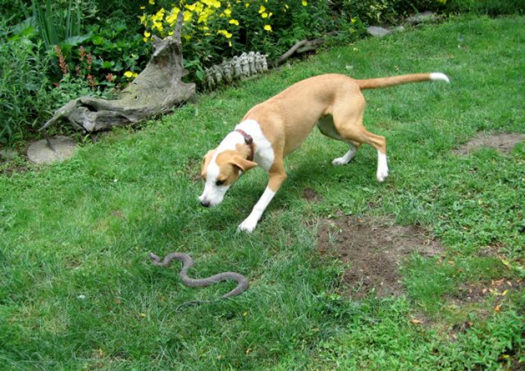
Just about one year ago, Cathy Eising wrote and asked Foxhunting Life if we could help with advice on how to raise her young “mostly foxhound” as a family dog in a suburban environment. She was especially concerned about whether or not she could curb its hunting instincts to the point where she could take it for long walks in the woods off the leash.
We submitted her question to our FHL Panel of Experts, the consensus of which cast some doubt on prospects for the achievement of Cathy’s goal, primarily because of the hound’s young age. Our Experts were right! Cathy has written to bring us up-to-date on her project:
“I’m not sure I would adopt another foxhound as family dog,” Cathy reports, “but I have learned much, stayed in good physical shape, and grown to appreciate the world of foxhunting.
“Although my first goal—having this animal walk off-leash and follow me in wooded areas—has not been achieved, much has been learned in the ongoing efforts to fulfill his energy and redirect his drives!
“License and Registration, Please.”
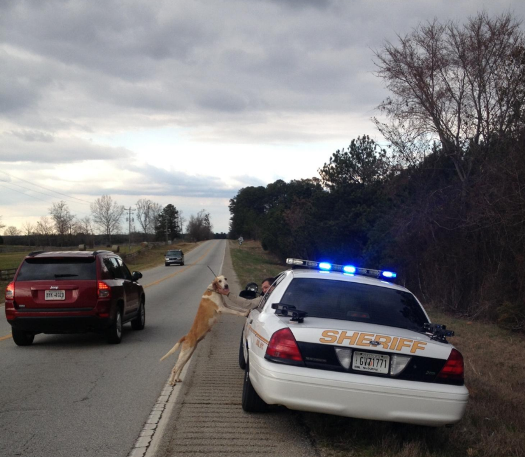
Ashley Twiggs photo Hunts seeking to recruit new members can take a page from the Belle Meade Hunt in Thomson, Georgia. Officer Mike Coke met this Belle Meade foxhound, Colleen, on the highway. The pair obviously hit it off to the extent that Coke, who had no previous experience with foxhunting, was sufficiently smitten by […]
The Foxhounds of John Emms
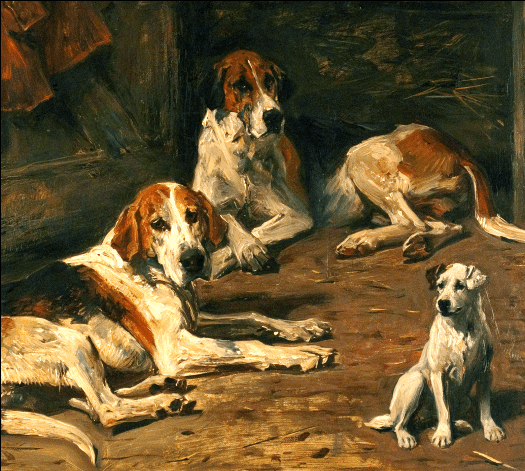
Foxhounds and Terrier / painting by John Emms
A major exhibit and sale of paintings by John Emms (1843–1912) will be mounted by the William Secord Gallery in New York City from February 8 to March 15, 2014. This will be the largest and most comprehensive exhibition of Emms’ work and is timed to coincide with this year’s Westminster Dog Show. More than fifty paintings of foxhounds, terriers, spaniels, and other sporting breeds are included. Foxhunters visiting New York during the MFHA Annual Meeting week are invited to visit the Gallery for a preview of the entire exhibit.
Born the son of an amateur artist in Norfolk, England, the young Emms moved to London where he apprenticed with the great academic painter, Lord Frederick Leighton. Emms soon went on his own, painting images that capture the beauty of English country life. An avid foxhunter, Emms maintained studios in London and in the New Forest area of England.
The Legitimate Sport of Drag Hunting
Karen L. Myers photoThe sport of drag hunting started as a competitive race in early seventeenth century England, developed into a fast dash over intimidating fences in early twentieth century North America, and evolved in more recent years into an artistic attempt to simulate live hunting.
Since foxhound packs that run a drag scent—either exclusively or periodically—account for about seventeen percent of all MFHA-Registered hunts in North America, we’re devoting much of this issue to a comprehensive view of the sport and its history, with observations, comments, and recommendations from some of today’s best practitioners.
Goshen Hounds Take a New Year’s Swim
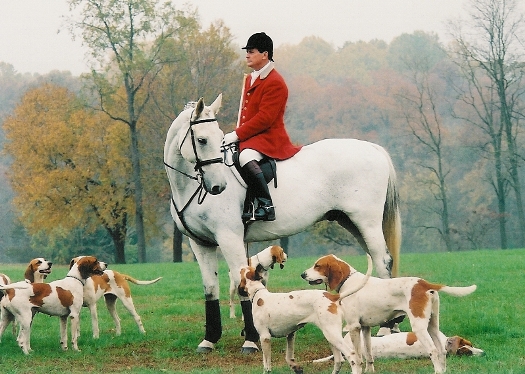
Robert Taylor, MFH and huntsman of the Goshen Hounds, had a memorable hunt with hounds on New Year’s Day.
Some days you simply wonder what the gods are thinking. Today, New Year’s Day, was a day that I simply could not hunt because of social obligations unrelated to the hunting world. No amount of explaining and squirming would have been adequate to allow me to meet with the Goshen Hounds (MD) today. Consequently, it was with some delight when I was finally able to quietly announce at about 2:00 pm that I thought I would “visit the kennels” for a short while.
When I arrived it was apparent the hounds were still in the field, so I drove to the usual draw down Middleton Lane and was greeted with the distant view of a whipper-in and the cheering of huntsman and Joint-Master Robert Taylor. I knew exactly where they were, but getting to them in my trusty Tahoe was a different matter. Undaunted, I proceeded on (in four wheel drive), but still could not quite make contact.
Several riders were coming in with tales of, “Wow! What a run! My horse is cooked!” In desperation, I gave up and headed to the kennels. Soon I was greeted with the sight of Robert and hounds coming in, and, oh, what tales they had to tell.
Foxhound Wins Best of Show at National Dog Show
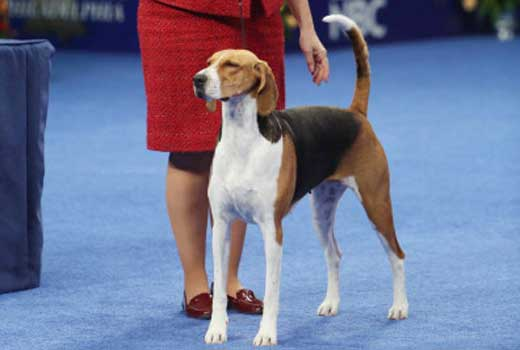
Jewel, the American foxhound barely edged out (according to knowledgeable observers) at Westminster by the affenpinscher last February, was judged Best in Show at the National Dog Show at the Greater Philadelphia Expo Center. More than 1,500 dogs were entered in the all-breed show. The three-year-old female, GCH Kiarry’s Pandora’s Box (aka Jewel), is the […]
Whipper-In: What’s In the Name?
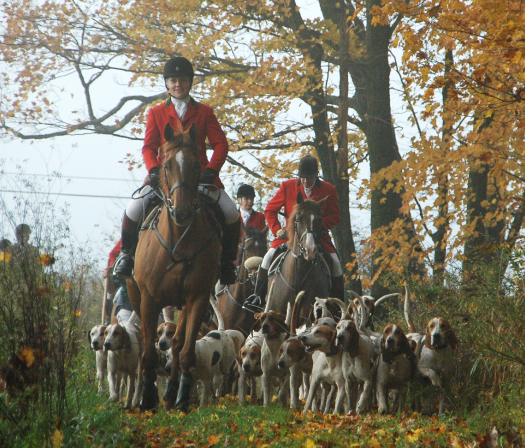
This article was first published in 2013. With an archive of thousands of articles available on our website, we hope you will agree that at least a few are worth republishing!
Booli Selmayr, professional whipper-in, Millbrook Hunt (NY): “A good day whipping-in is not having to be told, but instead, allowing natural instinct to guide me: listening to the horn and hounds, reading the terrain, and quickly distinguishing whether fox or coyote.” / Kirsten Edlund-Tunkel photoTo the uninitiated, the term whipper-in might conjure images of a callous fellow laying his whip across the backs of hounds for every infraction. In fact, the whip is used primarily for its loud crack as an attention-getter. The explosive noise breaks the concentration of hounds from whatever they are doing that the whipper-in wants to stop.
Whipper-In: What’s In the Name?
Booli Selmayr, professional whipper-in, Millbrook Hunt (NY): “A good day whipping-in is not having to be told, but instead, allowing natural instinct to guide me: listening to the horn and hounds, reading the terrain, and quickly distinguishing whether fox or coyote.” / Kirsten Edlund-Tunkel photo
Professional or Honorary
The world of whipping-in is split into two camps—professional and honorary. The professional whipper-in often fills the position to gain experience and recognition on his or her road to becoming a huntsman. As the title suggests, it is a paid position. The honorary whipper-in is not paid, is generally recruited from the ranks of the hunt membership, and generally does not aspire to become a huntsman. He or she may be a riding member or one of the Masters.
Professional hunt staff in England go through a structured period of apprenticeship. Years there are spent just doing kennel work before even being allowed to walk hounds out on exercise and before even being allowed on a horse. If recommended, they will finally be taken on as second whipper-in to a hunt. After a few moves, they may be recommended to fill an opening for a first whipper-in somewhere else. Under the system, they purposely move every few years from one hunt to another, gaining experience and exposure to different huntsmen and different methods before finally being offered a huntsman’s post. Clearly a strong foundation is laid through such a rigorous system.
Night Hunting with Dad
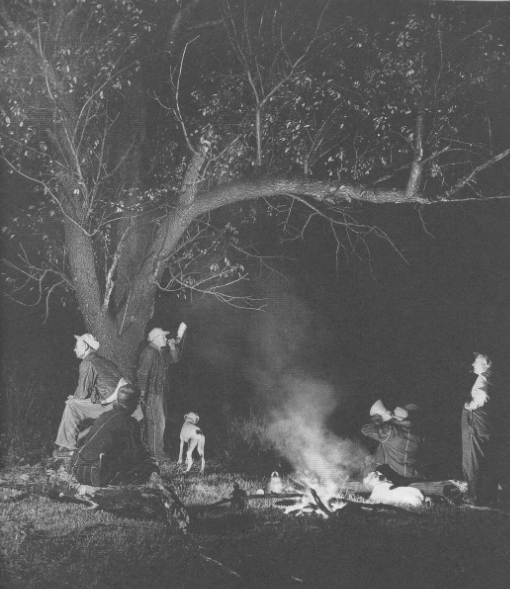
This is a true story as best as I can recollect. I was about six or seven years old that night, but as you can imagine this was a story told and retold around many a local foxhunter’s fire for many years thereafter.
Dad often took me foxhunting with him when I was little. I don’t have many memories of those hunts other than falling asleep in the back of whatever old car dad had at the time. The foxhunting that dad and his friends participated in did not involve horses or fancy scarlet coats. Their steeds were Ford and Chevy, GM and Oldsmobile; the uniforms worn were usually whatever work clothes they had been wearing that morning.