John Peel
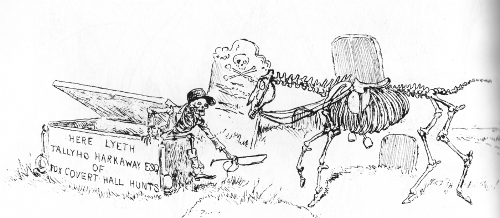
“Peel’s view-halloo would waken the dead” / Illustration by Frank Paton from “The Songs of Foxhunting” by Alexander Mackay-Smith, 1974
Like Tom Moody, John Peel owes his celebrity to a song, though I am bound to say that the Cumberland huntsman was far more worthy of such a distinction than the Shropshire whipper-in. And what canny Cumbrian is there, the wide world over, whose heart is not stirred within him by the dear, familiar words and tune of “D’ye ken John Peel,” even as the hearts of his Scottish neighbours across the Border are stirred by “Auld Lang Syne”!
It has been sung in strange places, that famous Cumberland hunting-song. Its chorus rang out hearty and homely from the huts at Balaclava and the dreary trenches before Sebastopol. It cheered the spirits of the band of beleaguered heroes in the Residency at Lucknow. The future King of England, our jolly sport-loving Prince, has been known many a time to join lustily in its spirit-stirring chorus. I myself have heard it sung on the boards of Drury Lane by some seventy comely lasses, whose shapely figures, clad in the hunting costume of the other sex, made one of the prettiest pictures I ever saw upon the stage, and gave an effect to the song which roused the audience to enthusiasm.
And yet, world-famous as the song is, I don’t suppose that one person in a thousand knows who wrote it, or has the faintest notion who or what John Peel was beyond the fact that he was fond of hunting. Indeed, I have often heard the question asked, whether John Peel was a real person or merely a mythical hero. Well, that question is easily answered.
New Book Explores Origins of Mounted Foxhunting
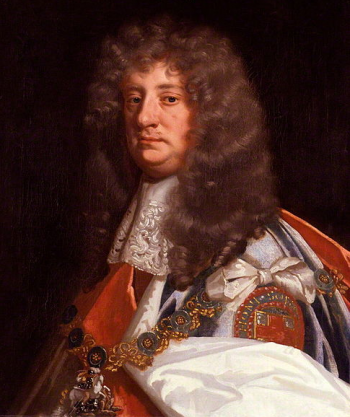
George Villiers, second Duke of Buckingham died of a chill caught while foxhunting. His mother bred some of the earliest Thoroughbred racehorses at Helmsley Stud. Portrait by Peter Lely, courtesy of the National Portrait Gallery.A new book on the beginnings of mounted foxhunting in the English shires—From the Deer to the Fox: The Hunting Transition and the Landscape 1600-1850—has been published by the University of Hertfordshire Press and released on September 15, 2013. Written by Bandy de Belin, the book disputes one commonly-held theory of why English sportsmen shifted from hunting the deer to hunting the fox as the primary quarry.
Traditional theory, according to de Belin, suggests that the disappearing woodlands and increased enclosures of the open space led to the decline of the deer population, so hunts, by necessity, turned to the fox.
Lilla Mason Is New MFH at Iroquois
Huntsman Lilla Mason joins Dr. Jack Van Nagell (left) and Jerry Miller (behind Lilla) as Joint-MFH of the Iroquois Hunt (KY) / Glenye Cain Oakford photo
It’s gratifying when sportsmen and women whom you have long known and respected are elevated to loftier positions in their hunts. Lilla Mason, former whipper-in, currently huntsman, has been named MFH at the Iroquois Hunt in Lexington, Kentucky.
Lilla is a soft-spoken and thoughtful woman who has earned her way by performing superbly at every stage of her foxhunting career with Iroquois. The first time I hunted with Lilla was in 1998, she was whipping-in to Jerry Miller, MFH at the time, and I had been invited to ride up with her.
As we headed out she turned in the saddle and said, “Be careful in this piece of country. You could get stuck in a bog.”
New Foxhunting Website Launched in England
James Barclay, ex-MFH, whose elegant prose has appeared (and will continue to appear) in Foxhunting Life, has launched a new subscription website titled, “For the Love of Hunting England. The new portal promises to be full of news, information, and features about hunting in Great Britain and further afield. James, whose family has been deeply […]
An English Summer of Mixed Blessings
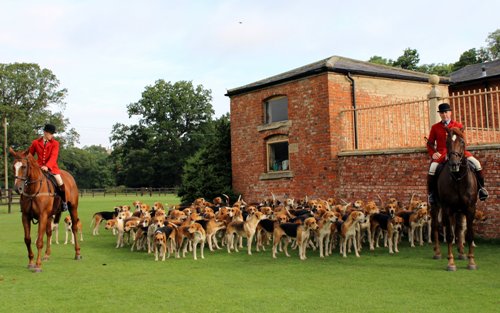
The Belvoir foxhounds at kennels after exercise / James Barclay photo
With the new season just about upon us, I thought I would have a look back over the last few months and see how we have been fairing. For the first time in some years now we can honestly say we have had something like a proper summer! Having said that however, the last two days have been nothing but torrential rain, which will have put the final week or two of harvest back somewhat. In June and July we bathed in endless days of sunshine which in many ways did much to pick up the gloom from previous years.
The hound shows began and some interesting results started to appear with the usual names not having it all their own way. This clearly demonstrates that the smaller packs over here now have an increasing amount of quality running through their kennels, which is not only a real pleasure to see for many, but it shows that the interest in breeding nice hounds is now not just with a few of the larger packs. For those who have produced hounds to a high standard for very many years, it must give them huge pleasure to see the others doing so well. After all, it will very likely be their lines that many of those winning today will go back too. Those in the past who have not only bred good hounds in their work but also to the conformation of body with which to last, deserve a great deal of gratitude. On a cautionary note however it would be wise that as Masterships are likely to change all too regularly nowadays, to have someone who can oversee the hounds, their welfare, and their breeding on a regular basis is a must.
Sadly, life being what it is, and with everything going along well as it was, something had to go wrong and sure enough it was not long before the dreaded kennel cough swept through large parts of the country, with some packs suffering badly.
New Huntsman, New MFH at Why Worry Hounds
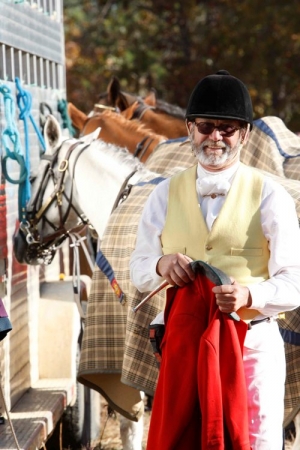
George Thomas, MFH of the Why Worry Hounds (SC) / Charles Sainsbury-Plaice photoWhen George and Jeanie Thomas organized their hunt twenty years ago near Aiken, South Carolina, they expressed their philosophy in naming it. Why Worry Hounds they called it, and now, after twenty years of managing hounds, horses, and country by themselves, they have made some organizational changes to re-establish that philosophy.
With George busier in his day job and Jeanie having conquered some pesky physical issues, the couple has taken steps to ease their burdens by bringing on board two well-known, immensely capable, and passionate foxhunters ready and wanting to shoulder a share of the responsibilities—Randy and Robin Waterman.
Randy, ex-MFH and former huntsman of the Piedmont Fox Hounds (VA), has been named huntsman of the Why Worry Hounds. Robin, who whipped-in to Randy at Piedmont, joins George and Jeanie as Joint-MFH at Why Worry and will whip-in to Randy.
Melvin Poe Celebrates 93rd Birthday; Hunts Hounds
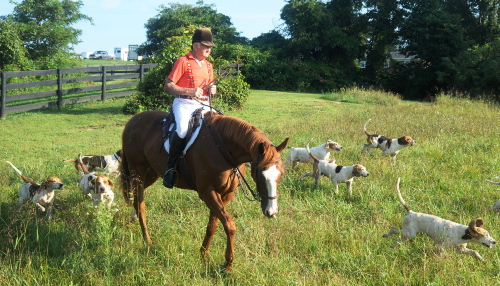
Betsy Burke Parker photo
World-renowned huntsman Melvin Poe celebrated his 93rd birthday Sunday, August 25 by doing what only comes natural to the living legend—going foxhunting. Riding his favorite hunter and surrounded by Peggy, his wife of some fifty years, his four daughters, a bevy of grandchildren, neighbors, and friends, Melvin handled the horn and the reins with the cool confidence of a man one-quarter his age at what had to be a historic hunt.
“I can’t believe he’s still going strong,” said Charlie Matheson, former president of the Orange County Hounds where Melvin served as huntsman some three decades. “He’s an amazing man. We’re so lucky to have him.”
Melvin Poe Celebrates 93rd Birthday; Hunts Hounds
Betsy Burke Parker photo
World-renowned huntsman Melvin Poe celebrated his 93rd birthday Sunday, August 25 by doing what only comes natural to the living legend—going foxhunting. Riding his favorite hunter and surrounded by Peggy, his wife of some fifty years, his four daughters, a bevy of grandchildren, neighbors, and friends, Melvin handled the horn and the reins with the cool confidence of a man one-quarter his age at what had to be a historic hunt.
“I can’t believe he’s still going strong,” said Charlie Matheson, former president of the Orange County Hounds where Melvin served as huntsman some three decades. “He’s an amazing man. We’re so lucky to have him.”
Legendary Show Jumper Snowman Took the Kids Foxhunting
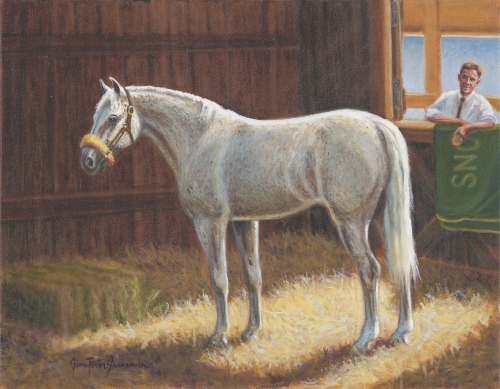
Snowman and Harry de Leyer. Painting by Joan Porter Jannaman, courtesy of the International Museum of the Horse, Kentucky Horse Park
Harry de Leyer’s first look at Snowman was between the slats of the truck bound for the killers. Harry had had trouble with his old station wagon, and he arrived late to the horse auction in the Pennsylvania Amish farming country. It was over, and there was only one trailer left in the parking lot. It was always the last trailer to load.
Midst the fearful and fidgeting horses crowded together on the bare floor for their last journey, one plain-looking gray stood apart for his calmness and self possession. Harry had driven to the auction in the hope of finding an inexpensive school horse for his riding students at the Knox School on Long Island, so he asked the trucker if he could see the gray. The gelding was missing a shoe, had bloody knees, and rubs on his chest from a heavy harness, but he was well-made and had a kind eye. The trucker had paid the “killer’s price” of sixty dollars. Harry was indecisive, but something in the horse’s composed demeanor spoke to him. Harry paid the man eighty dollars—the most he had planned to bid for any horse—and took him home.
Legendary Show Jumper Snowman Took the Kids Foxhunting
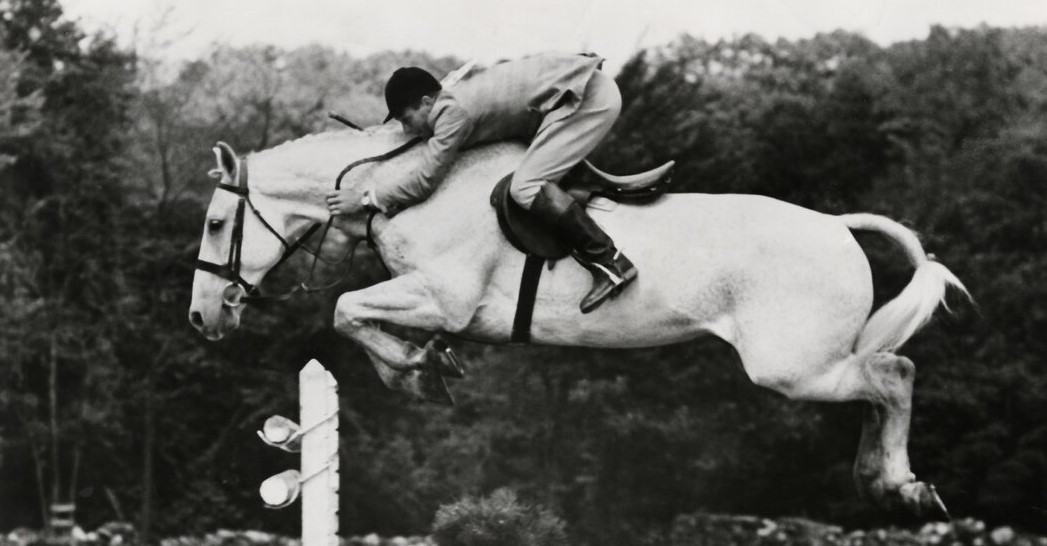
Harry deLeyer and Snowman
Harry deLeyer, born in the Netherlands in 1928, died last summer at the age of ninety-three.
After the Nazis rolled over the Low Countries and much of the European Continent in the spring of 1940, Harry’s family farm became a way-station for the Dutch resistance during World War II. Fallen Allied airmen attempting to return to their bases in England and Jews attempting to escape capture by the Nazis were sheltered in a cellar secretly dug out next to the barn and covered by a manure pile. After Allied bombing raids, twelve-year-old Harry would ride out at night, helping to search for surviving Allied airmen. One pilot died of his injuries at the deLeyer farm. Harry’ father buried him and mailed the dog tags to his family in North Carolina. Five years after the war ended, the pilot’s parents sponsored the deLeyer Family to emigrate to North Carolina. A few years later, the deLeyer family moved to Long Island, and Harry became a riding instructor at an all-girls school. And he needed one more school horse.