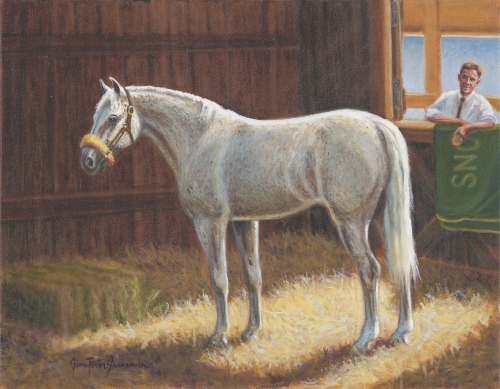
 Snowman and Harry de Leyer. Painting by Joan Porter Jannaman, courtesy of the International Museum of the Horse, Kentucky Horse Park
Harry de Leyer’s first look at Snowman was between the slats of the truck bound for the killers. Harry had had trouble with his old station wagon, and he arrived late to the horse auction in the Pennsylvania Amish farming country. It was over, and there was only one trailer left in the parking lot. It was always the last trailer to load.
Midst the fearful and fidgeting horses crowded together on the bare floor for their last journey, one plain-looking gray stood apart for his calmness and self possession. Harry had driven to the auction in the hope of finding an inexpensive school horse for his riding students at the Knox School on Long Island, so he asked the trucker if he could see the gray. The gelding was missing a shoe, had bloody knees, and rubs on his chest from a heavy harness, but he was well-made and had a kind eye. The trucker had paid the “killer’s price” of sixty dollars. Harry was indecisive, but something in the horse’s composed demeanor spoke to him. Harry paid the man eighty dollars—the most he had planned to bid for any horse—and took him home.
What happened subsequently is today enshrined in sporting history. The story of Snowman and Harry de Leyer is the subject of Elizabeth Letts’ number one New York Times bestseller, The Eighty-Dollar Champion.
Snowman, with de Leyer in the saddle, rose to the top of the show jumping world in the 1950s. In 1958, Snowman won the horse show triple crown: he was named American Horse Shows Association Horse of the year, Professional Horseman’s Association Champion, and Champion of Madison Square Garden’s Diamond Jubilee.
A valuable property for sure, but Harry de Leyer was from the old school that believed in recreation and diversity for the horse’s mind, well-being, and all-around education. Harry took students from the Knox School foxhunting with the Smithtown Hunt on Long Island, and Snowman went foxhunting as well.
“Sure, he went foxhunting,” said de Leyer. “A horse learns to take care of himself in the hunting field. He loved hunting. Anyone could hunt him. My kids hunted him when they were only nine or ten in just a rubber D-ring.
“Snowman had only one little problem out hunting,” said de Leyer with a chuckle. “He loved to swim. Whenever we got close enough to see the [Long Island] Sound, he wanted to go swimming! Oh, yes! He would swim away with you!”
Later, during most of the 1970s, Harry served as honorary huntsman for the Smithtown Hunt.
An oil portrait entitled “Snowman and Harry” is now part of the permanent collection of the International Museum of the Horse at the Kentucky Horse Park. The painting by Joan Porter Jannaman of Lakehill Studio in Hendersonville, Tennessee, was presented to the Museum in July of this year during a ceremony preceding the start of the Rood and Riddle $50,000 Grand Prix.
“It’s been an honor to have even a small part of celebrating the story of Snowman and Harry,” said Jannaman, who made certain to ask de Leyer for his input once the portrait was well underway.
“It brought tears to my eyes,” de Leyer told Jannaman. “You got the slope of his shoulder that made him such a good jumper. And his eyes, they are perfect—the soft eyes that I first noticed about him. It is exactly Snowman.”
Jannaman’s artwork has been published in numerous magazines and publications including The Chronicle of the Horse, Sidelines, Horses in Art, Polo Players Edition, and Steeplechase Times. Most recently her paintings have been chosen to show in the American Academy of Equine Art’s Fall Open Juried Show and the Best and the Brightest Show in Scottsdale, Arizona.
Limited edition giclée prints of “Snowman and Harry” are available for purchase with all of the proceeds being donated to support the Kentucky Horse Park Foundation and The Kentucky Equine Humane Center. Click to learn more about the prints.
Posted August 20, 2013