The Blue Birdseye Stock Tie: A Smashing Style from the Past
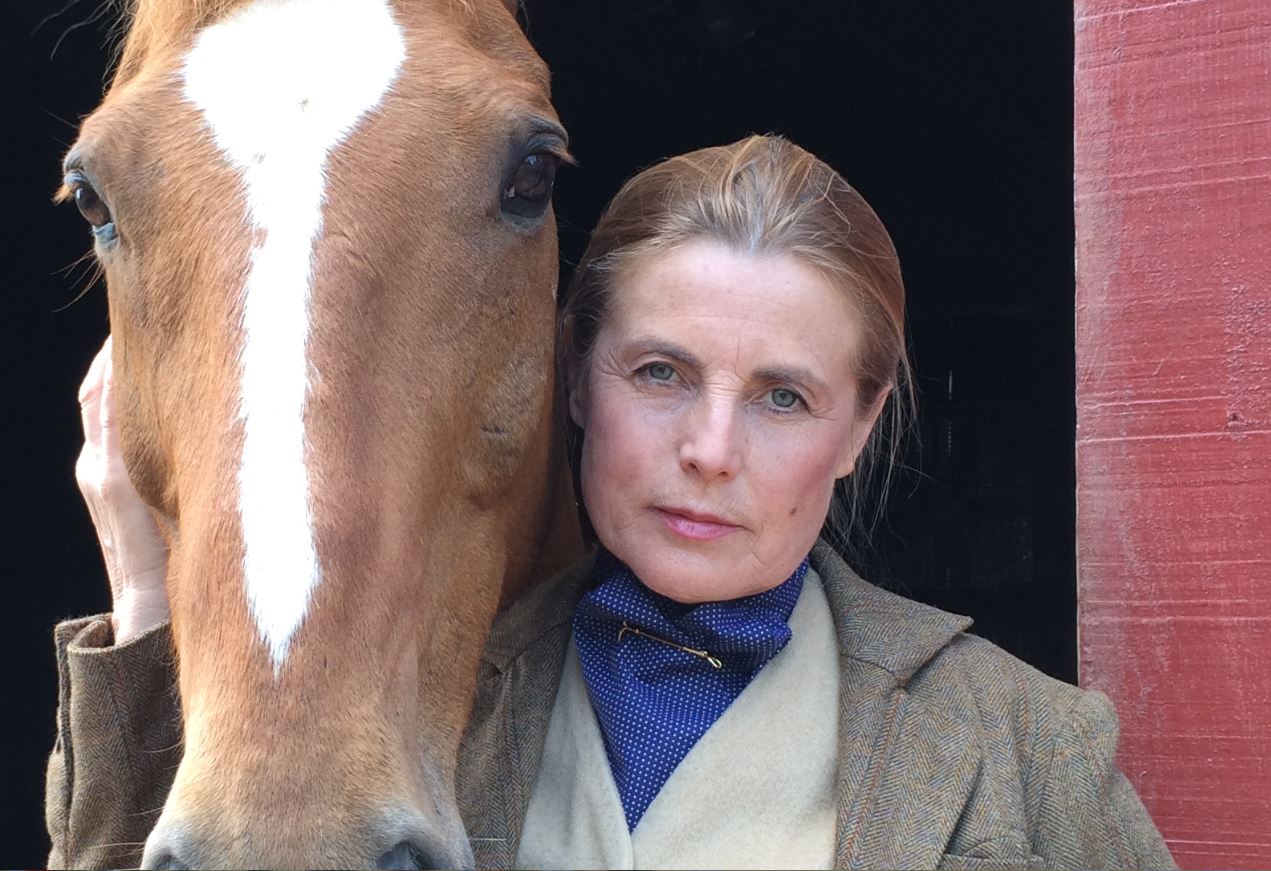
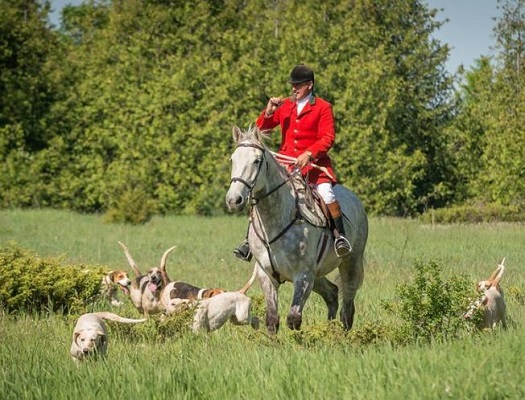
Karen Ewbank is ready for cubhunting in her blue birdseye stock tie.
I want to tell you about a little-known yet colorful article of foxhunting attire from the past that deserves to be resurrected. When I first saw it under the huntsman’s scarlet coat I asked myself, “What in the world is that man wearing about his neck?”
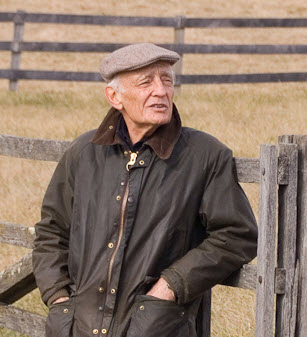
Here was an experienced foxhunter who had been a professional huntsman and whipper-in for world-class packs in England, Ireland, and America, yet he appeared to be oblivious to “proper” foxhunting attire. I’m referring to Hugh Robards, huntsman of the Middleburg Hunt. Robards is also an author, a student of the noble art, and possesses an extensive library. I thought he should have known better, but I didn’t want to embarrass him, so I didn’t ask.
It turns out that I was the ignorant one, but, I suspect, I’m not alone in this particular matter. Robards, I was to learn, was wearing a striking article of traditional foxhunting attire—a blue birdseye stock tie—under his scarlet coat. During his twenty-seven-year stint as huntsman for Lord Daresbury at the County Limerick (IRE), both he and Daresbury wore their blue birdseye stock ties through the autumn hunting season.
How many foxhunters of today have ever heard of such a thing, I wonder? The better question, though, is wouldn’t it be great fun to bring back this handsome stock tie into our own hunting fields?
Horse Collides with, Injures Racing Official at Gold Cup
Foxhunter and amateur whipper-in Peter Hitchen was injured while officiating at the Virginia Gold Cup Races at Great Meadow Park, Warrenton, Virginia, Saturday, May 2, 2015. Hitchen, who was on foot, was hit by a racehorse and suffered multiple breaks. Hitchen was taken to a hospital in Fairfax where the damage was assessed: fourteen broken […]
The Refugee Foxhounds
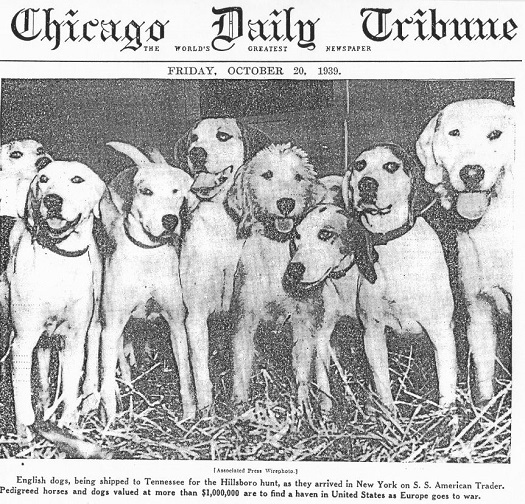
With the seventieth anniversary of V-E Day, May 8, 1945, just days away, we’re reminded of two sportsmen—one in America and one in England—who together tried to preserve the best bloodlines of the modern English foxhound as that type was developing and gaining acceptance over the heavy and ponderous English foxhounds of the so-called “Shorthorn Era.”
Mason Houghland, MFH of the Hillsboro Hounds (TN) and Major W.W.B. Scott, MFH of the North Cotswold Foxhounds (UK) were good friends. As Hitler invaded Poland (September, 1939), and war threatened to engulf Europe for the second time in the century, English foxhound breeders prepared yet again for their government’s mandate of destruction. (In World War I, thousands of foxhounds had been destroyed by the English authorities as a measure to conserve food and grain supplies.) Houghland received the following cablegram from Scott:
“Can you take seventeen couple of hounds for the duration of the war? Lend to friends those you have no room for. Please reply.”
John Woodcock Graves: John Peel’s Boswell
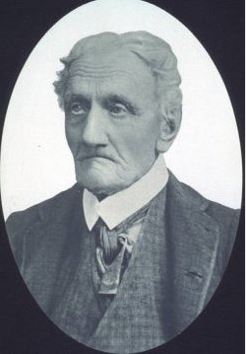
John Woodcock Graves (1795–1886)We’re all familiar with “John Peel,” surely the most well-known foxhunting song of all time. We’re perhaps less familiar with the songwriter, John Woodcock Graves, who turns out to be a most fascinating and unpredictable character—rogue some might say—in his own way. We owe this insight into Graves’ life to our Cumbrian friend, Ron Black, who sent us excerpts from A Ramblers Notebook at the English Lakes (H. D Rawnsley, 1902).
In an earlier article, Foxhunting Life describes that night in 1829 when John Woodcock Graves sat in his parlor in Caldbeck, in England’s Lake District, with John Peel. Peel was a farmer, horse dealer, and foxhunter whose hounds were highly celebrated by the local sheep farmers. From the adjoining room, Graves overheard his son’s granny singing an ancient Irish melody to the child. Graves took that old melody and wrote a new set of lyrics to honor his friend, John Peel.
“I sang it to poor Peel,” Graves wrote, “who smiled through a stream of tears which fell down his manly cheeks, and I well remember saying to him in a joking style, ‘By Jove, Peel, you’ll be sung when we’re both run to earth!’’
Just a few years after that cozy night, however, Graves became embroiled in a violent altercation with an employee, the aftermath of which induced him to leave England forever. His adventures were just beginning.
How to Find Our Old Articles
Since we posted our first article on Foxhunting Life five years ago, more than five hundred articles have been published. And they’re all still here…easily recovered.
When new articles are posted to the top of the Home Page, the older material is pushed down. The five most recent articles are always visible on the Home Page; the titles of the six articles published before those five articles are shown at the bottom of the Home Page; and the hundreds of articles that preceded those eleven are still available and recoverable.
There are four ways to find an old article: the Search function, the Full Article List, the Hunt Club Pages, or by Category.
A Cowboy in County Clare
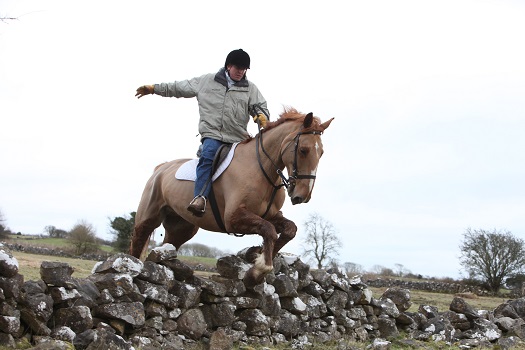
Kail Mantle from Montana: just like riding a bronc / Val Westover photo
Last year, while hunting with the Red Rock Hounds (NV), I met Renee and Kail Mantle from Big Sky Hounds in Three Forks, Montana. Kail gave us a bucking horse lesson one day before hunting. This Montana cowboy, who hunts in chaps and cowboy hat, had sat calmly to his horse bucking crazily above the sagebrush and had seriously impressed me.
When a group of these Western foxhunters invited me to accompany them to Ireland this year, I jumped at the chance. These were fun people—more than a little crazy, and I wondered if anyone had warned the Irish!
I also wondered if my companions knew what they were getting into. I had hunted the big Irish walls and hedges in 2000, and I came home with newfound respect for anyone who hunts regularly in Ireland. It is challenging country, and their version of foxhunting is an excuse to run and jump really big fences.
John B. Glass: Gentleman, Scholar
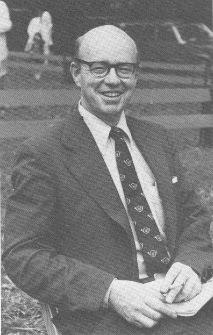
John B. Glass, who served as Clerk and Keeper of the Foxhound Kennel Stud Book for the Masters of Foxhounds Association (MFHA) from 1973 to 1995, died on Friday, April 10, 2015, in Concord, Massachusetts. He was eighty-six years old.
John was the second of only three men to supervise the MFHA office in the 107 years since the founding of the association; he succeeded the late Joe Jones upon the latter’s retirement. John began his twenty-two-year career in the old MFHA headquarters on Water Street in Boston, moving to Morven Park in Leesburg, Virginia, when the directors relocated the office. John was the first to recommend computerizing the Foxhound Kennel Stud Book, and he personally wrote the code and implemented the first computer program to do that. John’s “Fox Dog” program was used for years by the MFHA until commercial programs written in newer, higher-level language became available.
The son of a West Point army officer who served in two wars, John was born in Hawaii and spent his formative years in such far-flung locations as Virginia, Texas, Wyoming, Guatemala, and Germany. He majored in economics at Yale and earned a Ph.D. in archaeology at Harvard. He became an authority on Pre-Columbian hieroglyphic manuscripts, publishing numerous papers and books on the subject, most notably as a major contributor to the academic encyclopedia The Handbook of Middle American Indians.
Suspension
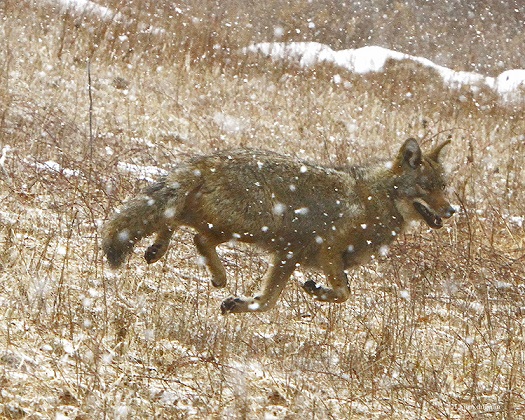
Snow on the ground or falling from the sky, no matter. The Golden’s Bridge Hounds (NY) and huntsman Codie Hayes are determined to keep coyotes on the move until the very last day in March. This coyote, writes photographer Jim Duggan, “kept circling as usual at this time of year with the mate and pups […]
Mark McManus: Huntsman and Mentor
Mark McManus is the new huntsman at the Chagrin Valley Hunt (OH).
When a huntsman retires after a long and successful career hunting hounds for a respected hunting establishment, that vacuum creates a ripple effect throughout the hunting community. So it was when Larry Pitts retired after thirty-five seasons hunting hounds at the Potomac Hunt (MD). Pitts’s vacancy was filled by huntsman Brian Kiely from the Myopia Hunt (MA); the void at Myopia was filled by huntsman Philip Headdon from the Chagrin Valley Hunt (OH); and the Chagrin Valley opening will be filled this season by huntsman Mark McManus from the Ottawa Valley Hunt (ON).
During his time at Ottawa Valley, McManus definitely left his mark (pun intended). OVH Master Anne McKibbin lets sixteen-year-old whipper-in Carmen Powell-Sadik tell us how.
Mark is an enjoyable person to be around, with many a good story to tell depicting various scenes of humor and horror taken from an exciting and sometimes perilous life of foxhunting in his native Ireland. He remembers times of his childhood riding with his baby brother “sat in me lap” as he (much to his father’s chagrin) jumped the hedges!
Captain Tom Morgan, MFH, Dies in Ireland at 94
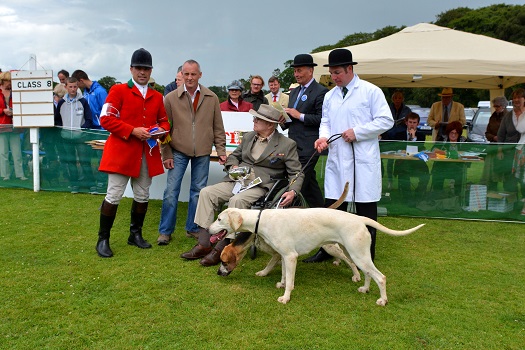
Captain Tom Morgan (in wheelchair) presents the Isaac Bell Perpetual Challenge Cup at the 2015 National Irish Masters of Foxhounds Show. / Noel Mullins photo
Captain Thomas Morgan, MFH, died peacefully at his home, Hunters Lodge, Bishopstown , Lismore, Ireland on Sunday, March 15, 2015 at age ninety-four.
Captain Morgan worked closely with Ikey Bell, father of the Modern English Foxhound, and with Ben Hardaway, MFH of the Midland Foxhounds (GA), to create the Hardaway Crossbred. The Captain was Joint-Master, with his wife Elsie, of the West Waterford Foxhounds (IRE) from 1953 to 1989. For more on this iconic triumvirate of hound breeders, read “The Hardaway-Morgan-Bell Connection.” Here is Noel Mullins’ tribute to this outstanding soldier/sportsman:
Captain Tom Morgan, MFH, was a gentleman, wise, widely read, passionate about horses and hounds, and a diplomat who had a wonderful relationship with neighbours and landowners across the hunting country. He welcomed visitors to his very traditional home with his lovely, gentle Welsh accent, and they seldom left without the customary cup of tea and talk of hunting and horse breeding.