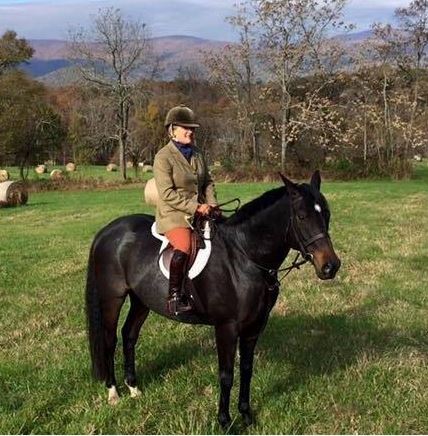
 Betsy Smith in Virginia’s Old Dominion Hunt country / Emma Rowe photoFoxhunting remained pure in much of rural Virginia even as the coyote population was increasing up and down the eastern coastal states. Why much of Virginia’s hunting country was ignored by coyotes is a question for another time, but there’s no doubt that canis latrans has discovered its earlier mistake and, for the last several years, has made substantial property acquisitions in the Old Dominion.
Virginia hunts are handling the situation in various ways—some considering coyote as riot, some adding the coyote to its list of bona fide quarry. For hunts in the latter category, with staff still relatively inexperienced in hunting the coyote, new questions arise for their hound breeding programs.
Betsy Smith asks whether a hound’s nose for coyote scenting should be any different than a hound’s nose for fox scenting. For a pack that hunts both coyote and fox, are there any breeding considerations when it comes to nose?
As a followup question, Betsy asks if there are other more important hound attributes than nose to consider and breed for.
We went to our Panel of Experts and asked two experienced huntsmen, C. Martin Wood, MFH, Live Oak Hounds (FL) and Marion Thorne, MFH, Genesee Valley Hunt (NY), to answer Betsy’s questions for the benefit of their less coyote-savvy friends in Virginia. Although Marty hunts in Florida, and Marion hunts in New York state, it’s uncanny how similarly they feel about what they need in their packs.
C. Martin Wood, III, MFH Marty Wood has been Master and huntsman of the Live Oak Hounds for forty-one years, and is one of the foremost international judges of foxhounds.
I do not think that any hound with a good enough nose to run a fox, either red fox or gray fox, will have any problem running a coyote. We hunt both fox and coyote at the Live Oak, sometimes both on the same day and have never had a problem with adequate scenting abilities for either one to provide sport.
In terms of other qualities necessary in a foxhound to be able to run a coyote, I do not think that there are any if all you want to do is chase it. If your goal as a huntsman is to account for your game, look carefully to your breeding program and the conformation of your pack as a whole. Coyotes (and foxes) are accounted for by the pressure put on them by a pack of foxhounds. You can spell PRESSURE in all capitals. Good conformation in the whole pack allows it to run farther and faster together as a pack.
It takes a pack to apply the pressure rather than a single hound or a spread-out line of hounds as the coyote will jink and turn and a single hound will also inevitably over-run the line and give the coyote the breathing space to get away. A pack of hounds running up with a good head will not over-run their quarry’s turns by much if at all, thereby putting the pressure on that will bring the hunt to a good conclusion. One of the most thrilling sights in all hunting is to see a pack of hounds in full cry flowing with the scent of its quarry and watching the hounds on either side of the pack hit the line away following a momentary loss when the coyote has turned sharply.
Having said all of that, I come back to the original question and my straight answer is that a coyote has a stronger scent than a fox or bobcat, and just about any pack of hounds should be able to run it if they are encouraged to do so.
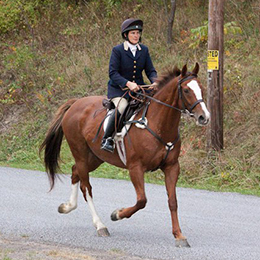 Marion Thorne, MFH is in her fifteenth season carrying the horn at the Genesee Valley Hunt. Before that, she whipped-in to her step-father Austin Wadsworth and his sister Martha Wadsworth.Marion Thorne, MFH
In breeding for a pack that runs both coyote and fox, or even mostly coyote, I don’t think you need to change anything as far as noses go. You do need to really pay attention to conformation and sheer physical ability as well as speed and drive to go forward on a line. A coyote will test your hounds’ endurance to the max. If there are hounds in your pack that don’t measure up, your pack will be strung out all over the country after a short time and no pressure will be on your game.
I think the coyote has a slightly stronger scent than the fox. It might be slightly easier for hounds to follow. It does seems somewhat more exciting to my pack. There is a higher intensity when they are on coyote. Their cry is higher and more of a scream. There is no time for boo-hooing up and down a log or creek. In a check they need to think forward and make wide swinging casts, wasting no time.
Though the scent may be stronger for a coyote, one still needs very good noses and drawing ability as they are harder to find. This is just math. In a well foxed country, there might be a fox or two in every covert. A good pack should be able to find a fox in no time at all. The coyote’s territory is much larger; they may cover fifteen miles in an average day. They will be less concentrated, so you can draw sometimes for quite awhile. No matter how good hounds’ noses are, there may not be any game. You do not want to miss one if it is there! So good noses and good, thorough, quick drawing is important.
We have had fox and coyote together here for over thirty-five years. Just this season the balance has tipped and the foxes are disappearing and moving closer to houses and towns. Now that our pack runs more coyote, they are not quite as good on the fox. They have to adjust each time. I am sure I am selecting for coyote in my breeding and culling program. That being said, nose would still be my first consideration when making breeding choices for my pack.
Posted December 18, 2015