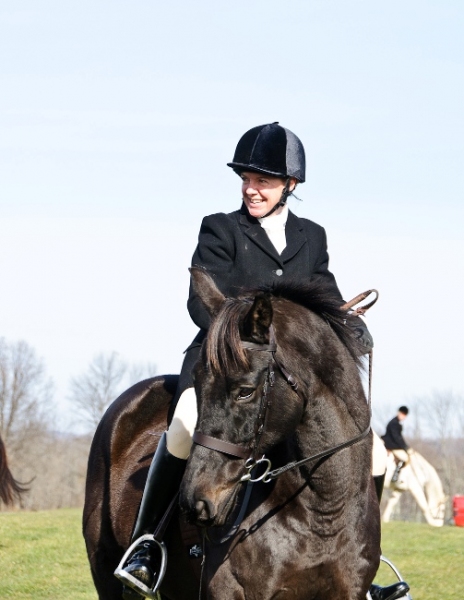
It’s no secret that standards of correct attire and appointments have been allowed to slip in many hunting fields in recent years. To some, it’s of no consequence. To others, standards are something they value. Why? Perhaps they simply wish to demonstrate their respect for history and tradition, or for being guests on the landowners’ property. Perhaps they want to maintain respect for the memory of those sportsmen/mentors of yesterday who taught them about foxhunting and have left us this special way of life. For whatever reason, it’s fun to listen to those who care about correct attire and appointments, wish to maintain the standards, have questions, and want to understand the finer points.
Aeron Mack is one who cares. She is starting to help her local hunt as an honorary whipper-in, and she has several questions that we have put to our Panel of Experts both here and abroad. Mack asks:
1. Regarding field boots during the cubhunting season: Wadsworth says no; the MFHA Guidelines say yes. I am inclined to follow Wadsworth whenever possible. Others are adamant that laces are acceptable. Can you give some direction one way or the other, and an explanation as to why?
2. Regarding flask or sandwich case: The rule is that staff does not carry a flask or sandwich case. I know technically, as a woman, I shouldn’t carry a flask, but I am learning the ropes of whipping-in, and I think “no flask, no sandwich case” borders on cruelty! I have seen my huntsman carry a flask. Surely in today’s day and age, it has become acceptable?
3. Regarding staff wearing scarlet: I understand that, in general, both professional and amateur whippers-in wear scarlet. Is this correct? I often whip-in (sort of in an honorary/apprentice capacity) on Wednesdays for a local hunt. I noticed yesterday that all of the other whippers-in were in scarlet coats, with the exception of yours truly, who was wearing my formal Middleburg-Orange County Beagle frock coat of dark green. (I am first whipper-in [honorary] for the beagles.) During the hunt, I noticed several deer hunters in stands around the woods in which we were hunting. I felt a little insecure, as my horse is, unfortunately, exactly deer colored! I am often alone in my duties, walking or trotting through the woods to the next point as instructed by our esteemed huntsman. I am thinking my green coat, as lovely as it is, may not protect me from getting shot accidentally by an eager deer hunter. So! Should I be wearing scarlet? And is this something I need to ask the Master permission for?
We consulted members of our Panel of Experts, and here’s what they had to say:
Field Boots
Although, according to Martin Scott, a professional should wear proper top boots even during cubhunting season, an amateur can wear whatever the Master approves of.
“Cubhunting attire is totally the Master’s prerogative, as it is first and foremost the time to train the young hounds and to re-educate the rest of the pack to hunt,” says Scott. “It is not a fashion show or a time to show sport. However, if hounds do have a good hunt, well, everyone out can enjoy it!
Further in regard to field boots, Jerry Miller points out that “brown field boots with laces at the ankle should be worn with ratcatcher during cubhunting and on non-formal days. Black field boots should never be worn and are a major faux pas.”
Flask and Sandwich Case
Our experts are in complete agreement on this question.
Martin Scott: “A simple NO to anyone who calls themselves a whipper-in or huntsman. They should not have the time nor the inclination to either have a drink or a bite to eat when out hunting. As I child I was sent out with a few ginger biscuits. There are plenty of hours of darkness when to enjoy either food or drink after hunting.
“I did not realise how many followers carried flasks until a cold February day about twenty-eight years ago when my horse and I came down in the river Thames, and I was soaked to the skin. Everyone came up to me afterwards offering me their flasks, all of which had something different in, and some of which I tried. I did not warm up till about four hours later when I suddenly became rather funny (well I thought I was)!
“If you are helping as a whipper-in you should be thinking about the hounds and what they might be doing next, anticipating every move and where the danger spots are, and not thinking of your stomach. Your job is to help the huntsman and be prepared for every eventuality. I still do not carry either a flask or sandwich case but may be tempted to a little food later in the day.”
Jerry Miller puts it this way: “Under no circumstances should a member of a hunt staff ever consume alcohol when hunting. Quite apart from giving a bad impression by having the smell of alcohol on your breath when talking to land owners, members of the public, etc., you need all your wits about you when taking charge of or directing hounds and crossing other people’s property. With regard to a sandwich case, a good breakfast should see you through until the end of the day. Most hunts don’t last more than four hours and you should be able to go without food for such a short period of time.”
On Staff Wearing Scarlet
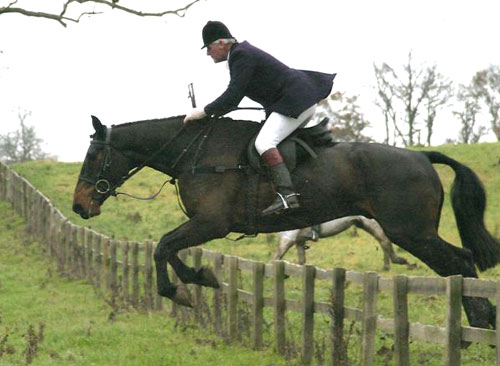
“Either you are a whipper-in or not a whipper-in,” says Martin Scott. “You know the hounds’ names and are continually counting them to ensure that they are all on.
“I think it is up to the Master what coat you wear, so he or she should tell you. When I went to whip-in as third whipper-in to Capt Wallace at the Heythrop in 1968 he gave me a green coat and said I better keep it clean, never disgrace it, never be late, and always do my best to help him, the huntsman. He would not tolerate any huntsman or whipper-in carrying a flask, and if he thought that you had food he would make quite certain you never had time to open your mouth, let alone put anything in it! One came back from hunting mentally as well as physically exhausted. On the point raised about walking or trotting through the woods, it is always important to get to where you are going in quick time and not to amble along. Get to where you have been sent quickly, then stand still and keep quiet. If someone does come along, quietly explain to them that they must keep quiet, too. After that shut up. Foxes can hear voices, and you will either head the fox or he will slip by unnoticed if you are chatting to anyone. As I said earlier there are plenty of hours of darkness in which to chat to people.”
While, as Scott said, it is always the Master’s prerogative, Jerry Miller doesn’t believe that any woman should wear scarlet, other than a Master or a huntsman.
“Amateur whippers-in do not qualify,” says Miller. “Deer hunting season doesn’t last long, and in the interests of safety it is perfectly acceptable to wear a fluorescent orange vest or sash when in wooded areas where there are deer hunters.”
Our Experts have weighed in, but reader comments are welcome. Let’s hear them!
January 7, 2011