The author explains how a huntsman deploys hounds when drawing covert for a fox, and the considerations that dictate his tactics. Drawing is what the huntsman does when seeking a fox, not to be confused with casting for the fox when hounds are at fault.
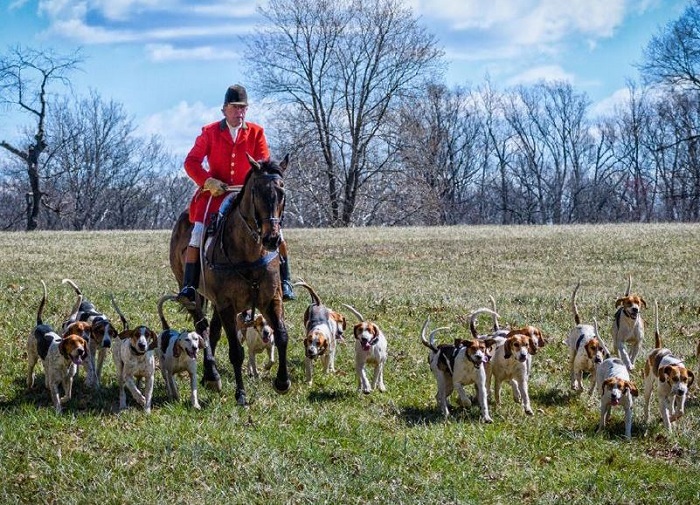 Hugh Robards and the foxhounds of the Middleburg Hunt / by Middleburg Photo
On leaving the meet, you might want to keep close to the Field Master so you are in a good position to observe what is going on at the first draw. The whippers-in and other helpers have gone to various point of the covert to view the fox away. Notice on approaching the covert, not one hound leaves the huntsman until he tells them to leu in, at which time hounds enter the covert and begin searching for the scent of a fox. The huntsman wants all hounds in covert when a fox is found so they will all be there to apply pressure, push it out, and be together on the line when it goes away.
If it is a large covert, the huntsman will draw it into the wind, thereby giving the pack every opportunity to wind and rouse their fox. He will also ride into the covert, cheering and encouraging his hounds: “Lieu try, try in there, leu wind ’im, push ’im up old dogs.” That may be what it looks like in print, but most huntsmen make guttural noises that few people can understand!
Most vocal terms used by huntsmen are corruptions of the hunting language brought to England by the Normans in 1066. “Leu in there” is a corruption of “loup-in-there,” which would translate to “wolf-in-there.”
If the covert is thick in the bottom with briars and such, the huntsman will give his hounds plenty of time to draw. The more open parts will be drawn quickly. In a large covert, the huntsman will occasionally touch his horn (i.e., blow a short note). This will not only let hounds that are drawing wide know where he is, but also his whippers-in and the Field Master.
If the covert to be drawn is small, then the huntsman will most probably draw it downwind. This will give the fox more warning and the chance to get up on his legs. The last thing a good huntsman wants to do with a big mounted field waiting for a gallop is to chop (kill) the fox in covert. Perhaps you noticed earlier in the season that the huntsman made quite a bit of noise while drawing for the fox. But as the season goes on, especially in a country that’s been well hunted, he will not be as noisy. By then, if he makes too much noise, foxes that have been well hunted in the past will be quickly up on their feet and gone.
Some huntsmen when drawing a small covert late in the season, will send their whippers-in and spotters well on in advance. On Approaching the covert, the huntsman will blow a couple of notes on his horn without letting hounds into covert. The fox, on hearing the horn, will be up and away. The whipper-in or spotter viewing the fox as it leaves covert, signals to the huntsman either with his whistle or halloa with his voice to let him know the fox has gone. The huntsman, still with all his hounds, gallops to the place where the fox exited the covert. The whipper-in or spotter watches for any hounds that might take the heel line the wrong way, and the pack is away as one, hard on their fox. Charlie Wilkin, when hunting Sir William Watt’s hounds, was an artist at this technique, producing some very sharp bursts for the mounted field. The method worked too well for me once in Limerick. I put the pack onto the line and that was the last we saw of them for an hour!
Foxes can be found in all kinds of strange places, such as willow trees and automobile junkyards. They love to lie up in the ivy on derelict buildings or high walls. If the weather is mild, they may well lie out in the open and even in the furrow of a ploughed field.
You will notice that when drawing an open area such as a ploughed field, the huntsman may keep one of his whippers-in close by to stop hounds from catching the fox before it gets on its feet. Foxes that lie in the open are inclined to wait until the last moment before they get to their feet. Foxes know that while they are lying tight they are not producing any scent and hounds may pass them by. This is characteristic of all wildlife.
Often a covert will be drawn blank when it has actually held a fox. I had drawn a covert in Limerick blank and was hacking up the road to the next draw, when a nice man caught me up on his bicycle and told me I had left the fox behind. He had just seen it go away! He kindly led me back to where he had seen the fox and a good hunt was enjoyed. Sometimes, better to be born lucky than smart!
An observant huntsman will watch his hounds while drawing, looking for signs of a fox being about. If you have remained close to the Field Master, you might do the same. You and the huntsman might see an old hound with his nose well down, searching every leaf and log. He is doing everything he can to say that a fox is or has been there. The huntsman will see that this hound is frustrated; it wants to throw its tongue but won’t in case it is wrong. This is where the huntsman can help. He has watched the hound work yet come up with nothing. Now the huntsman must work with this hound. He too must start searching for this fox. The hound has shown him a fox had been about. Now, with the rest of the pack, every nook and cranny of the covert must be investigated. It is detective work which should result in a find.
He has worked through the covert without finding and has not heard a halloa from the whipper-in. Yet he still believes a fox is there because hounds have, in their own way, told him. As this is the first covert drawn, the huntsman still has no idea of scenting conditions—whether good, bad, or indifferent. He doesn’t know if the scent is old—the drag (line) of a fox that passed through during the night. The huntsman has to use his instincts, developed through experience and woodcraft. He also has to know his hounds. And, right or wrong, he has to be decisive.
On reaching the end of the large covert which he initially drew into the wind, he once again touches his horn and calls “Elope, e’lou,” or “Try bike,” which are instructions for his hounds to turn with him, and once again draw back through the covert, aware that this time they do not have the advantage of the wind. The huntsman knows this and will try to get his hounds to quarter down the wind in the hope the hounds will wind the fox, much the same way as a shooter would have his pointer or setter work for him.
Posted December 26, 2017
–From Foxhunting: How to Watch and Listen, Hugh Robards, The Derrydale Press Foxhunters’ Library, 2006, available from Foxhunting Life and other booksellers.