
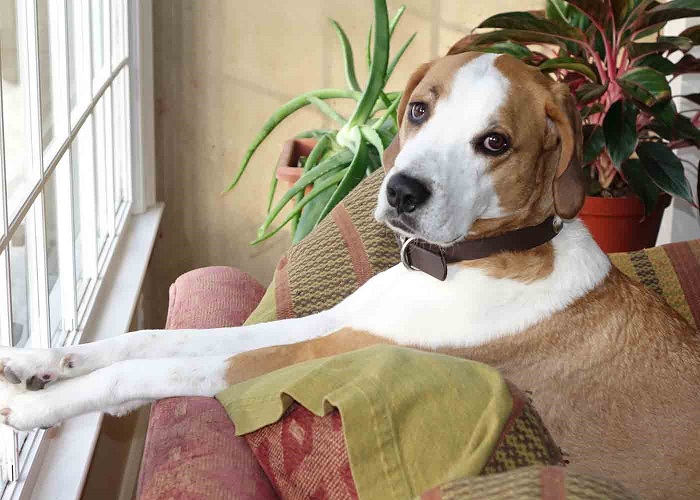
 Cathy’s seven-year-old pet “mostly-foxhound”
Five-and-a-half years ago, Cathy Eising asked our experts how she could steady her two-year-old pet “mostly-foxhound” on deer and other riot, so she could walk him in the woods off lead. She evidently achieved some success, since she has contacted us with another challenging question. The foxhound is now a seven-year-old.
Cathy asks, “How can I prevent his aggression towards other dogs who are invited into our house by me with their owners? I would like to be able to have friends bring their dogs when visiting and not have fights.”
Cathy notes that her foxhound has not drawn blood, but makes a convincing show of neck biting accompanied by bark, growl and head shakes that scare the other dog, her, and other owner. He likes people, but started his aggressive posturing at age three. At about that time, Cathy had acquired another house dog—a female. The pair get along very well.
The foxhound will catch and kill squirrels in the fenced-in yard at home and occasionally he will dig out a possum. Cathy wonders if, by allowing this behavior, she has contributed to his aggression against visiting dogs.
Cathy feels that our hound experts have an understanding that offers a unique perspective on hounds in particular and dogs in general. Once again, we asked Hugh Robards and Jerry Miller—both members of Foxhunting Life’s Panel of Experts—for their advice on Cathy’s seven-year-old foxhound.
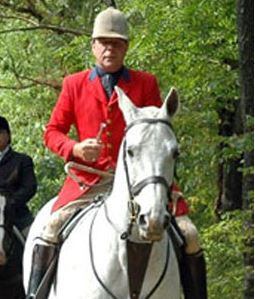 Hugh Robards recently retired as professional huntsman of the Middleburg Hunt (VA). Robards was, for twenty-seven seasons, huntsman of the famed County Limerick Foxhounds in Ireland. He came to the U.S. to serve as Master and huntsman of the Rolling Rock Hunt (PA).
“The aggressive nature of the hound does not stem from hunting squirrels and possums,” writes Robards. “It is purely a jealousy thing.”
“It gets on with the other house dog because it is female. It is very rare that a female and male dog do not get on together.
“I think that the hound wants to be shown as many strange dogs as possible, preferably on its own property. It should be put on a collar and lead when another dog visits, and then very quietly introduced to the visiting animal. This has to be done very slowly, making a fuss of him and letting him know that he is a good dog when he does not struggle to get at the visitor. It will all take time, there must be no hurry, and every effort must be made that they do not make direct contact too quickly. The more strange dogs that are introduced to him the better, but none of the visitors should be of an aggressive nature.
“I know this sounds easy; it is not. It is all to do with patience and time.”
 Jerry Miller starts his twenty-sixth season as Master of the Iroquois Hunt (KY). He served as huntsman for most of those years. Miller created the Hound Welfare Fund, a registered non-profit charity that cares for hounds through their days in retirement.
Miller agrees with Robards’ assessment that the hound’s aggression has nothing to do with the fact that the hound is allowed to hunt. “It is natural for any hound to catch and kill squirrels, and that is unrelated to him being territorial towards visiting dogs,” he writes.
“Not knowing dog or the owner, or being able to see the body language of their interactions when the aggression occurs, it is difficult to offer a solution. There isn’t necessarily a “one size fits all” method. My advice for Cathy is to hire a local dog trainer to come for a consultation and assess the situation. Both Cathy and her dog need the instruction of a dog trainer so they can learn together how to change this behavior that has been allowed to continue for some years. A session with a professional trainer at her home would not cost that much. If Cathy needs help finding a trainer, she may email Becka Rossi and ask her to look in her database of dog trainers to find one in her area.
“Best of luck to Cathy in solving what I think is a correctable issue.”
****
Cathy, we’re pleased to hear from you again. Your foxhound has obviously found a caring home with you, and I hope you will let us know how this most recent issue turns out.
Remember that the dog talks to you with its tail, its expression, the hair on its back, and its body language. An excellent trainer of field trial dogs that I know had a mantra: “Read your dog.” Sometimes, what might appear to be aggression might just be a desire to play. This may include chasing and latching onto the ruff of a neck in mock battle. Of course, what starts as play can sometimes end in anger, as well. In which case, if Robards’ advice doesn’t appear to make the progress you desire, Miller’s suggestion regarding an experienced trainer at your side to evaluate the situation might well be in order.
Triangles are scarcely ever good—two males and a female or vice versa—whether human or animal! Even with gelded horses, triangles in the paddock are potentially troublesome. At one level, you might decide it’s simply unfair to bring another male into his house or his yard and expect peace!
Posted August 16, 2018