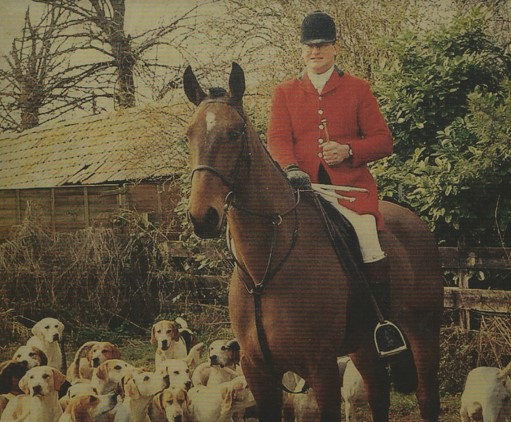
 James Barclay, MFH, hunting the Fitzwilliam hounds, 1993
We are deeply saddened to report the passing of Maurice James Barclay, ex-MFH, at age sixty-two. His death is attributed to heart failure.
After serving as Master of five British foxhound packs, his response to Britain’s Hunting Act of 2004 was to devote himself to educating and persuading everyone he could reach―whether pro-hunting or anti-hunting, adult or child, wealthy countryman or underprivileged child of the city―of foxhunting’s intrinsic value to England’s story-book countryside. To James, nothing was more important than saving the countryside.
Generations of his family were steeped in foxhunting and, more specifically, the Puckeridge Foxhounds in Hertfordshire, a hunt dating back to 1725. The Barclay Family was active in the Puckeridge Masterships starting in 1896. His sister served as Master, two brothers, his mother, father, grandfather, and great-grandfather. His father, Captain Charles Barclay, hunted the Puckeridge foxhounds from 1947 until 1970.
James’s first day of hunting was with the Puckeridge in the early 1960s. He was astride a donkey, and, by tradition, he wore a small version of the family scarlet coat which each family member going back at least three generations had worn on their first hunt!
In his teens, he kept a scratch pack, the Brent Pelham and Rickling Rabbits Hounds, with his neighbor Michael Payne as Joint- Master.
“We regularly had four and a half couple of dogs out from lurchers to terriers and would account for twelve brace of rabbits on a good day,” Payne recalled.
Barclay would think nothing of disappearing into a bramble patch to assist his hounds, once coming out covered in mud. On another occasion, he was spotted disappearing into an enormous fox’s earth until only his legs were sticking out.
James went on to serve as Master of the Essex and Suffolk (1983–1987), Fitzwilliam (1987–1999), Cottesmore (1999–2002), South Wold (2002–2003), and Grove and Rufford (2010–2012). At one time or another he has been personally involved with hunts situated in sixteen British hunting counties: Somerset, Dorset, Gloucestershire, Oxfordshire, Warwickshire, Northamptonshire, Hertfordshire, Essex, Suffolk, Norfolk, Cambridgeshire, Lincolnshire, Rutland, Leicestershire, Nottinghamshire, and South Yorkshire.
Scion of a privileged family associated with the multinational London bank of the same name, one might assume that James leapt easily into his positions of sporting leadership. Not so. He started on the bottom rung―in the kennels―toiling alongside the other lads. What follows is from his 2015 memoir, My Hunting England, reviewed in Foxhunting Life:
I was soon on my way to Ireland and the North Tipperary in a battered old farm van which, if I hadn’t snaffled it up from my father, would shortly have ended up on the scrap heap. It nearly did so anyway as not long into our journey to the boat at Fishguard the gearbox fell through the floor, conveniently in the middle of the Heythrop country so help was not too far away. Nevertheless, we eventually arrived at Dromineer on the banks of Loch Derg and the River Shannon and set up base in a rather damp flat above the stables at Kiltelagh, home of the Joint-Masters of the North Tipps, Colonel and Mrs. Dean. The next few months were certainly different and a considerable amount of knowledge was added to my Warwickshire experience. The country that surrounded us was some of the most beautiful anywhere in the world. It was all grass with wonderful patches of gorse on the hillsides that were full of foxes. The kennels, however, were another matter. I had been used to five yards, concrete beds, and, yes, running water. The North Tipps kennels were not quite on this scale—one muddy old yard and a Nissen hut for a lodge with an old wooden bed. Running water was easily available although sadly not from a tap, but from the River Shannon which flowed a hundred yards away from the kennels….Keeping fit was not a problem though, as hauling water two buckets at a time from the river up the hill to fill the kennel troughs ensured a degree of strength in my upper arms that I never knew I had….Twenty couple of hounds were resident and seemed remarkably happy. I had no choice but to get on with the job and make the most of it, no time for grumbling. Life here was unique and the few months I spent with the North Tipps were ones I shall never forget. They taught me just how spoilt I had been. Hunting is not all about large establishments with kennels full of staff undertaking every duty, it is the small two-day-a-week packs who make up the majority both in Britain and Ireland and at times struggle to survive.
He assumed his first mastership as huntsman of the Essex and Suffolk (1983-87). It was there, in 1984, that he met his future wife Lucy Taylor at the local point-to-point.
His then hunt chairman, George Paul, recalled him being sent on farm visits to clear the country. “We would give him six farms to visit in a day but, such was his enjoyment of their company and hospitality, he never managed more than two.”
On the invitation of Elizabeth-Anne, Lady Hastings, Barclay joined her in the Mastership of the Fitzwilliam foxhounds in Cambridgeshire, which he did for twelve happy and harmonious seasons.
He opened up new country in the Fens and hunted hounds one day a week, a duty he shared with the highly regarded and long-serving professional huntsman, George Adams. He also shared Field Mastering duties with Lady Hastings’s son, Sir Philip Naylor-Leyland, currently senior Fitzwilliam Joint-Master since 1987.
“He was steadfast in pursuit of a fox and, if hounds marked, would follow his quarry into the bushes,” Naylor-Leyland recalled of Barclay. “His favourite reading was the novels of Surtees and he could quote Mr. Jorrocks at length.” Highly organized, Barclay was immensely popular with hunting farmers and a not infrequent guest in their kitchens.
“I well remember one morning after an early cub-hunting start having breakfast in a farmer’s kitchen, and he was given a whole goose to go at on his own.”
Once in hospital, a friend visiting him was asked to bring food and arrived with an orange and a banana. “That’s not food!” Barclay firmly told him.
While at the Fitzwilliam, Barclay formed one of his many hunting friendships with Major Jonathon Seed, then Master and huntsman of the Royal Artillery in Wiltshire.
“We did week-long hunting exchanges, with all the soldiers joining in, often cub-hunting in the morning and afternoon each day. With the evening parties as well, it required a strong constitution, and James led from the front.”
But beyond such friendship and conviviality lay a deep love and understanding of the English countryside. In 2015 Barclay published his memoir, My Hunting England, writing about “Unsung Heroes” of the chase, and how hunting has influenced the English countryside for the good.
“He cared more deeply for the countryside and hunting than anyone I know,” said Jonathon Seed. “Although he was from the Establishment he was also never afraid to take on the Establishment.”
Feeling that not enough voice was being given to ordinary hunt followers, Barclay set up a website, This is Hunting UK, which is followed by thousands on the internet. It allows foot-followers to share their stories and passion for hunting and recount what they are doing in their local communities by way of charity and educational events. It is also used to encourage schools visits to the countryside, something in which Barclay took a particular interest and was heavily involved.
James was a man of warmth, quick to make and keep a friend, despite the passage of time and distance. He was a periodic contributor to Foxhunting Life, and, after voters passed the despised Hunting Act of 2004 in England―rather than gnash his teeth in frustration, accomplishing little of value―he tried his best to counter it with reason and education.
Through his book and website, he wanted to make foxhunting more available and approachable to readers in Britain. No one can predict the future of foxhunting there with certainty. At the moment it doesn’t appear bright. But James Barclay tried his best to play a responsible part in saving his sport and the countryside―not with lies or deceit, but honestly, passionately, and respectfully because that’s the sort of man he was.
Posted December 28, 2021