
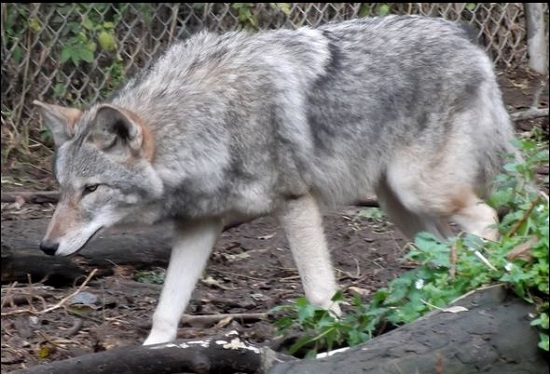
 The eastern Coyote or coywolf is larger and has a thicker body, shorter muzzle, and shorter ears than the western coyote.
Jonathan Way, a research scientist at Clark University in Massachusetts, makes a case for renaming the eastern coyote that populates the northeastern U.S. He sees it as a separate species of canid.
Way argues that the so-called eastern coyote looks unlike the western variety, exhibiting characteristics of coyotes, wolves, and dogs. There is a current debate among scientists as to what to call this creature.
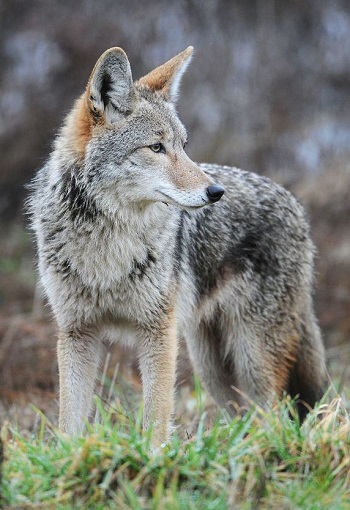 Western coyoteWay and his colleague William Lynn published a paper summarizing recent studies that confirm that the coyotes in northeastern states formed from the hybrid matings of coyotes and wolves in southern Ontario around the turn of the twentieth century. The authors suggest that coywolf is a more accurate term for the animal, and that it warrants a new species status, Canis oriens (Latin for eastern canid) to distinguish it from the two parental species—Canis latrans (coyote) and Canis lycaon (eastern wolf). The eastern coyote also has smaller amounts of Canis lupus (gray wolf ) and Canis familiaris (domestic dog) in its makeup.
The animal that the researchers wish to call coywolf established itself in northeastern North America fifty to seventy-five years ago. It has a larger home range than does the western coyote, but smaller than wolves. It travels distances of ten to fifteen miles a day and is social, living in family groups of three to five members. It hunts and eats a wide range of wild animals like mice, voles, rabbits, and woodchucks. Sometimes, however, it also teams up to hunts and eat white-tailed deer, which would be unusual for the western coyote.
Size- and weight-wise, the eastern coyote lies between the western coyote and the wolf, but closer to the coyote. Its makeup is about sixty percent coyote, thirty percent wolf, and ten percent dog. By this breakdown, close to forty percent of the animal is not coyote, and therefore, argues Way, should be classified as a new species. (One might flip that reasoning to argue that since it’s sixty percent coyote, why not leave the matter with the majority?)
Way admits that coyotes in the southeastern U.S. are more coyote-like than those in the Mid-Atlantic states, which in turn are more coyote-like than those in the northeastern region of the country. Mid-Atlantic coyotes have recently begun to make contact with eastern coyotes in the western part of their range, and he admits the possibility that with more crossbreeding with western coyotes in the south and west, what he wishes to call the coywolf might eventually evolve back to more closely resemble the western coyote from whence it partially originated.
If the tendency is to revert back to its coyote roots, does it really matter what we call this animal? Way believes it’s the biologist’s duty to “accurately describe natural systems,” and writes that “new species status, Canis oriens, is warranted for this cool creature.”
Click for Jonathan Way’s complete article.
Posted July 20, 2017