The late Erskine Bedford, Piedmont’s consummate Field Master for twenty seasons through the late twentieth century, explains how to lead and educate the field.
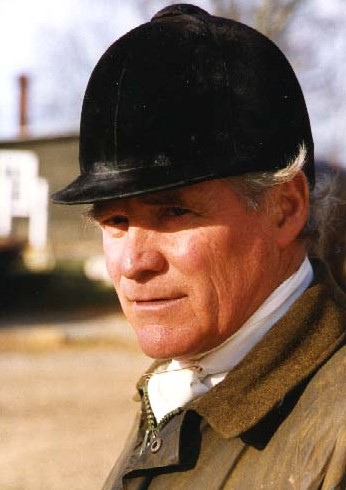 Erskine Bedford, MFH and Field Master, Piedmont Fox Hounds, 1979-1998
The Field Master’s job has five simple rules: first, have a great pack of hounds; second, have a great huntsman; third, have a great horse; fourth―getting serious now―know your country; and fifth, make it fun.
KNOW YOUR COUNTRY
When I say, know your country, how do I do it? I help clear it―year after year after year. And after you’ve hunted it for twenty-five years, you know where the holes are and where the rock is going to slide when you come down off a cliff face.
Stay Close to Your Huntsman
With a subscription pack, I am responsible to our subscribers to show them as much sport as possible and make it fun. How to handle that? You stay as close to your huntsman as you can, and that will vary from day to day, depending upon the scenting conditions and, if you will, the mood of the huntsman. If you do something wrong, that mood will change radically. When that happens, you’ll find yourself one hundred yards further back. But stay as close to staff as you can without interfering.
Stay Above the Huntsman
Stay above your huntsman so that your field members can see. If you think of yourself in a movie theater, you, as the Field Master, are in the front row. You should be down the hill enough so that the rest of the field can be above you to see hounds and staff and what is going on. It is fantastic when you can get them there, and hounds can open right in front of them and be gone.
Know your country. When you jump into any enclosure or field, know where you’re going, know your way out, know the probable line of the quarry. If the huntsman is going along the bottom, you can head up the hill and then turn parallel, so the field sees hounds and staff, knowing you will have to come down on a hard turn at the end of the enclosure to get out. Know your country so that if hounds turn or the quarry turns, you know which way to go to keep up.
Keep Moving by Learning Sightlines
In a hilly country, you will learn over the years where the panel is out of each enclosure. It is a sightline. How do you pick it up? It might be a treetop. It might be a different type of tree. There are a million ways. I have one sightline I use as an example to educate members of the field. It’s a line of white pine―a solid wall of green. The one way through is a tiny hole, and right next to the hole is a pin oak. Well, a pin oak doesn’t lose its leaves, so all you have to do is head for that little brown spot in that wall of green, and you can gallop there full-tilt and hit the right spot without pause.
By remembering sigh lines, you can cover a lot of ground in a short time, and this is what I mean by ‘know your country.’ By knowing your country, you can give your field good viewing and keep them as close as possible to hounds and staff.
Educate Your Field
When it comes to educating the field, I like positive methods best. In our country, we have a lot of cattle. As a result, we have a lot of Texas gates or wire gates, and they take unbelievable amounts of time to get undone and put back up again. I take the front end of my field, and I ask them to be the gatemen. And there’s a standing rule. Once you get a gate and close it back up, you return to the front of the field and report to the Master that the gate is shut. That does two things. It enables the gatemen to get back to the front legitimately, under orders if you will, to report that the gate is shut without having to fight their way back through the field. With our open country, most of the time, they can just gallop past the field. Secondly, it gives me the chance to thank them in front of the entire field, and that’s positive reinforcement for the help they have given to you, the field member.
That same individual may be on a different horse the next time out where he or she may not dare to get off to close a wire gate. If that person is unable to do it, I ask someone else at the front end of my field, “Can you help me today?” They will answer honestly, yea or nay.
How do you discipline the field in a positive way? When you get a lot of coffee-housing, you can turn around and tell somebody to shut up, but that’s negative. Turn around and yell, ‘Hark,’ and they’ll stop talking immediately.
If the field gets split up and there is a group in back, turn around and ask, ‘Would the field please try to keep up?’ You haven’t singled out an individual. They’ll all take the blame collectively, and they will do better and try to keep up.
We have three rules at Piedmont, and they go way back in history. There are no hill toppers, no green horses, and keep up or go home. [Piedmont does have a second field. –Ed.] That makes my life a lot easier, and it’s a lot easier on staff. If somebody has a problem―throws a shoe or gets in trouble―they know they are supposed to go to the nearest road to get out of any line of hunting in which they might find themselves.
In dealing with hounds, I have always tried to educate the field, especially if I’ve got tail hounds right or left, by turning around and yelling back at the field, ‘Hounds right,’ or ‘Hounds left.’ Hesitate enough to make sure that the field looks with you to see those tail hounds. Now, if the field is stretched out, you’re only getting the front end of it, but at least over the years, as they get educated, that passes down the line.
If tail hounds come up from behind, I expect my field to honor them the same way and yell forward to me, ‘Hounds right’ or ‘Hounds left.’ Once you’ve gotten that across to the field, they’re with you. They’re trying to avoid any problems of running over the top of hounds, and they feel it’s part of their duty to be a decent member of the field. Especially on a long day when hounds are tired, it makes it a lot easier to stay up close when your field is educated and with you.
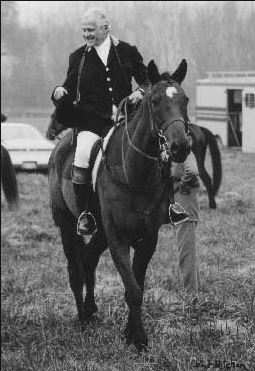
Hooking the Youngsters
A final word about the youngsters in your field: I was brought up in the Harford country where the front end of the field spent a great deal of their younger years running around a little thing called the Maryland Hunt Cup Course, so you didn’t have to worry about them too much and you had a lot of fun. Pat Nielson used to take the field many times in those days, and once the Grand Dames had gone home, he used to say to the kids, ‘Come on up. If you think you can run and jump, come on up.’ And as a kid, it was absolutely fantastic.
I would advise you, if you get the chance, to do the same thing with your youngsters. Once you can turn a child on to the speed―and I’m talking a two-minute lick or better―they may go many places in the horse world, but they’ll always come back to foxhunting because it’s the one place they can really enjoy speed. You have to pick your time and place but give the kids a chance to be up front.
Posted November 19, 2021
Erskine Bedford, MFH, was Field Master for the Piedmont Fox Hounds (VA) during the days of huntsmen Albert Poe, Jim Atkins, Charlie Kirk, and Randy Waterman. This article was first published twenty-five years ago, and I was reminded of it recently by Lisa Brown of the Millbrook Hunt (NY).