
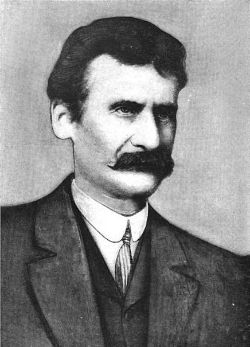
 Arturo Bandini“Mr. Arturo Bandini, of the Pasadena Hunt, owns the finest pack in the vicinity…. The meet is generally upon Orange Grove Avenue, or some spot contiguous to the Arroyo. And before the dew is off the grass, and while the scent is fresh, the musical notes of Mr. Bandini’s horn may be heard, followed by the fitful baying of the hounds; and then horsemen and women come from all directions—parties from the Raymond and other hotels, and from Los Angeles and San Gabriel, swelling the hunt….”
So writes Charles Frederick Holder, in his 1889 book, All About Pasadena and its Vicinity; It’s Climate, Missions, Trails and Canyons, Fruits, Flowers and Game. Holder tells us that the sport holding the most fascination to visitors is hunting the wild-cat with hounds—the cats in this area sometimes weighing in at fifty pounds. One can’t help but wonder if Mr. Bandini and his hounds were even known to those east-coast founding fathers that were pioneering our own sport of organized mounted foxhunting in the late 1800s.
“The horn brings the dogs in, and just as the sun is coming up from Arizona the hunt winds down into the Arroyo. The dew glistens on the leaves; the brook, reinforced by winter rains, rushes musically along; the trees—sycamores, oaks and others—are rich in new-born tints; wild flowers and vines spring from every crevice; and one feels that, if a wild-cat is not started, he is well repaid by seeing the green, leafy Arroyo at early morning.
“Down the Arroyo the hunt goes; some following the stream, others the road, passing beneath the bridge, and after a canter across the fields coming out above Sycamore Grove, where the cliff is high and precipitous. Here is a famous ground for cats; and, while the horses stand beneath the great trees and girths are tightened, the dogs are taken around, and soon their musical baying comes from far above. Now it breaks into a roar, and a moment later a small gray animal breaks cover and slides down the precipice….the dogs are on the scent, and finally they work down , and dash madly through the bush. The small animal is next seen climbing or scrambling up a sycamore, and the shout of ‘treed’ is passed down the line.”
Arturo Banini was a noted figure in old Pasadena with a distinguished family history tracing back in both maternal and paternal lines to the nobility of old Spain. His grandfather, Captain Jose Bandini, while a lieutenant in the Spanish Navy, participated in the famous battle against the British under Lord Nelson at Trafalgar. Later, as Captain and Acting Commander, Jose Bandini visited Spanish-owned California twice.
Arturo Bandini’s father Don Juan Bandini was born in Peru, emigrated to California, and acquired extensive land holdings. As Commissioner of Revenue in San Diego, he was a leader in 1832 of an uprising—sometimes called the Bandini Rebellion—against the tyranny of Governor Victoria, who was removed.
Dissatisfied with the Mexican administration of California, Don Juan gave early aid to Commodore Stockton when he came to take possession for the United States. He gave livestock and supplies to U.S. troops and turned over his San Diego house as headquarters for the Americans. In 1847, Don Juan Bandini was chosen as one of seven men to form laws for the new Territory and was a founder of Pasadena.
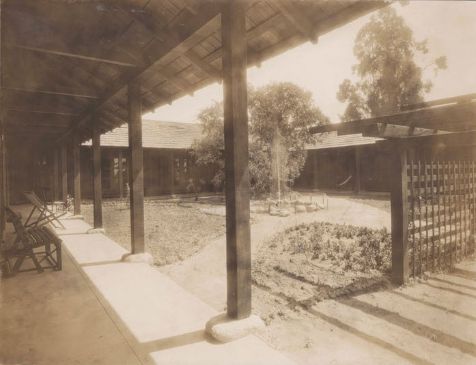 Arturo Bandini house, Greene and Greene, built 1903Arturo Bandini was at one time the largest wool grower in California. He was an avid and popular sportsman and spent lavishly for his hounds which he purchased from every corner of the globe. He hunted big game in the mountains and traveled into the recesses of Death Valley at a time when the place was relatively unexplored and unknown. A journey through Lower California, battling Indians, was one of his more notable experiences. He later turned to yachting and became Rear Commodore of the Southern Coast Yacht Club.
Bandini was equally fluent in the arts and active in civic affairs. He was one of the organizers of the Pasadena Rose Carnival. He wrote for magazines and papers, played the flute and piccolo, and organized the first band in Pasadena. A linguist, he spoke not only French, Italian, Spanish, and English, but several Indian dialects as well.
His lovely house, built in 1903 and designed around a U-shaped hacienda-styled courtyard was demolished in the 1960s for university expansion, but a portion of the house was rebuilt at the Huntington Library in this century.
Posted August 28, 2012