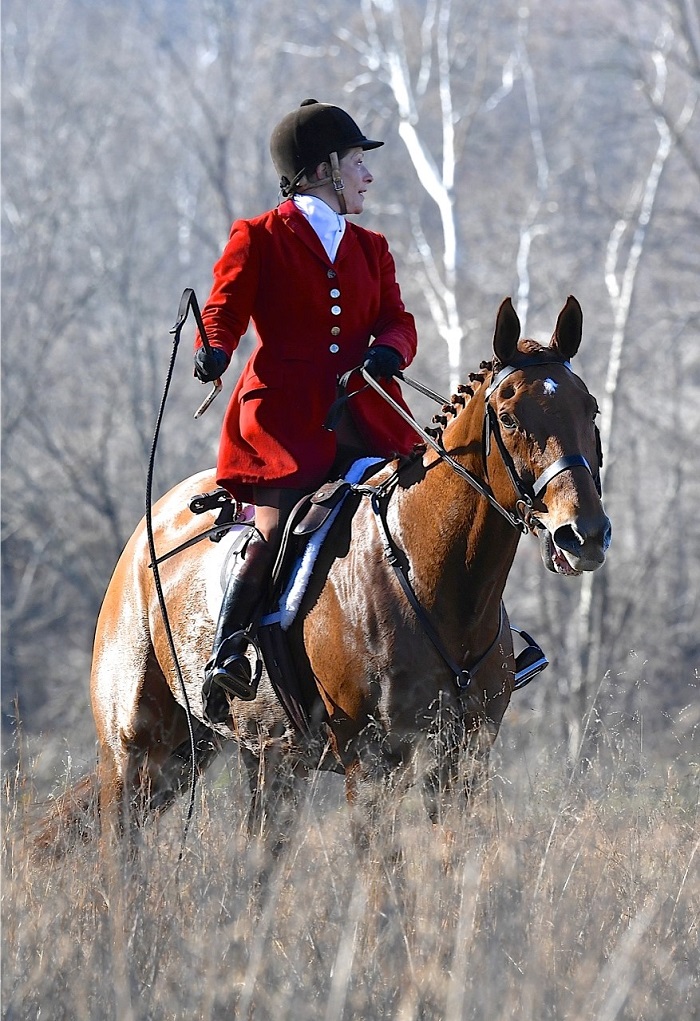
 Shannon MacKenzie’s professional life progressed from the confines of the office to the open spaces. / Douglas Lees photoThe horse industry is historic, even old-fashioned; the foxhunting world is more so. But follow Shannon MacKenzie’s journey from her native Canada to Virginia’s storied hunting country, and find a surprisingly modern twist to the tale. Facebook played a part.
MacKenzie first found out via a Facebook chat last year about an open slot for a professional first whipper-in at the Old Dominion Hounds (VA). It was a job she felt her skill set would serve, but it was a position she’d never held.
After a whirlwind trip late last spring, a working interview, and a nervous waiting period while ODH huntsman Jeff Woodall and the Joint Masters considered her application, MacKenzie was offered the job. Since May, she’s helped Woodall manage the club’s kennels in Orlean, worked with the staff horses, nearly a hundred hounds, thousands of acres of territory, and acquired new specialties: midwife and nursemaid to nineteen newborn foxhound pups currently wriggling around her kitchen.
“That’s a new one,” MacKenzie said with a laugh. “They’re so active, but the weather’s been too cold for them to be out in the kennels. They’re happy and snug (with their mothers) in here, but that’s a lot of animals in one space.”
It’s just the latest chapter in MacKenzie’s lifelong love story with horses and hounds, “a dream job” for the one who “used to beg my non-horsey parents to let me ride.”
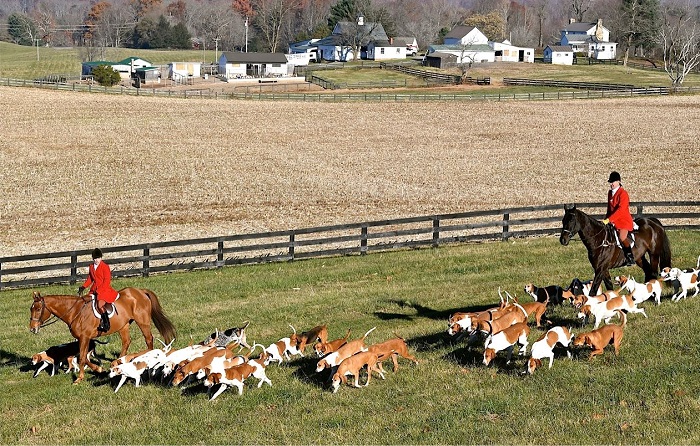 (l-r) First whipper-in MacKenzie, foxhounds of the Old Dominion Hounds, and huntsman Jeff Woodall / Douglas Lees photo
A Lifetime of training
Now 42, MacKenzie grew up in the Ottawa Valley’s farm country. “Corn and crops,” she said. “Herefords and dairy, a hundred acres, cows, chickens, the usual hobby farm.”
She didn’t start out with horses available to ride, even though her father did work for Canada’s famous Royal Mounted Police. “He wasn’t a mounted officer; he worked in accounting,” MacKenzie explained. Her mom worked in Canada’s National Archives. Still, their daughter morphed into “that typical horse-crazy kid” at an early age, basically driving her parents crazy asking to ride.
She started on a Shetland pony, then moved up to horses, showing hunter-jumper and later worked in a carriage stable. Her first hunting experience was following the local Ottawa Valley Hunt in a cart, driving a pair of Welsh ponies. “That was fun,” she recalled.
MacKenzie worked for show jumpers Sandy Patterson and Jill Henselwood before she “got tired from the grind. I took a break from horses,” she said, earned her college degree, and took a job with the Department of Foreign Affairs and International Trade.
It was a great job, working in the city and booking corporate travel for ministers and protocol officers. “The logistics were fun,” MacKenzie recalled,” even though sometimes I couldn’t pronounce where they were going.”
She worked there almost ten years, hunting occasionally, but eventually something snapped: “I was just tired of being stuck in an office all the time.”
She gravitated back to the horse world, working as Willaway Farm barn manager in 2014, hunting client horses and getting more deeply involved in the sport by laying the line for the local drag pack. The Master encouraged her interest in the English and Crossbred pack, and she helped in the kennels and learned about hound care. In 2015, Mackenzie moved to Ohio with her then-husband who’d been hired as huntsman for the Chagrin Valley Hunt. She helped him for a season but returned to Canada when they divorced. She took a job at Stevens Creek Farm, a local eventing barn, “but now I found that I missed the hunting most of all,” she recalled, and she began questioning her motivations. “I wanted something that combined everything, horses, hounds, hunting.”
One afternoon fiddling around on Facebook, she found the answer. MacKenzie was browsing friends’ photos when she saw a job posting for first whipper-in at Old Dominion. “I knew foxhunting in Virginia was a big deal,” she said. “There are more hunts in northern Virginia than there are in all of Canada. “I figured I had nothing to lose. I sent them my resume.”
Old Dominion Joint-Masters Gus Forbush and Scott Dove invited MacKenzie for a working interview. She recalls being unexpectedly anxious on the long drive south. She had decades of experience in the horse business, and had hunted for years, but had never worked as a hunt professional.
“I drove ten hours to a place I’d never been to meet people I’d never met,” she said. “I was nervous, but excited.” Old Dominion huntsman Jeff Woodall settled her nerves, saying he liked the unique skill set—a broad horse knowledge and an abiding interest—but a blank slate with foxhounds.
The Masters called her the next day. She got the job.
She recalls a mountain of paperwork and weeks of phone calls to get a working visa, but in a profession with few qualified applicants, MacKenzie was filling a crucial role.
“Shannon has done a great job from day one,” Forbush said.
MacKenzie arrived with her truck stuffed with luggage, borrowed some furniture, and set straight to work learning ninety hounds’ names, “figuring out who the troublemakers were,” and figuring out the similarities and differences between Canadian and American horse and hound care.
“There were some differences,” she said. Ottawa Valley fed flesh; ODH feeds kibble. Fauquier hunt country was hilly to Ottawa’s flat terrain. American hounds are a bit more sensitive than Ottawa’s English hounds, MacKenzie said, “but they’re friendlier and more personable, not so stubborn and hardheaded.
Still, MacKenzie felt right at home, finding “more familiar than foreign.”
There was a learning curve learning to hunt without a radio, but huntsman Woodall was a big help. Hunting without electronics “hones your senses,” MacKenzie said. “Jeff is a great teacher.”
“Shannon’s doing a really good job” with the horses and hounds, said ODH huntsman Jeff Woodall. “It’s a difficult job, to be first whip, and to be learning the country, hounds and horses all in your first season” as a professional. Woodall thinks Mackenzie “has a good understanding of what she’s doing,” something he believes she’d developed from years of seeing the sport from different angles—in the field, in the kennel, even from the back of a pony cart.
Former ODH huntsman Charlie Brown also helped in MacKenzie’s education. He invited her to “road whip” with Rappahannock Hunt sometimes on Wednesdays or Sundays, helping her develop intuition for the crafty native red fox. “Resident foxes almost always stick to a pattern,” she said.
One difference MacKenzie appreciates about Virginia is the climate. The recent cold snap notwithstanding, she said “a Virginian’s idea of cold isn’t the same as a Canadian’s idea of cold.
“As much as you all complain about freezing down here, the weather is much better in Virginia than it is in Canada,” she said. “Trust me.”
Posted February 1, 2018
Previously published in the Fauquier Times. Republished with permission.