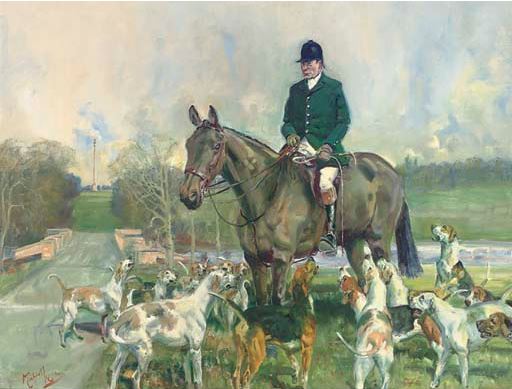
 Captain Ronnie Wallace with hounds while Master of the Heythrop / Oil portrait by Michael Lyne
Captain Ronnie Wallace, MFH, was the undisputed dean of British foxhunting for the entire latter half of the twentieth century. A Master of Foxhounds for more than fifty consecutive years, he was a genius in the art of venery, possessed a mystical connection with hounds, and was revered for his uncanny breeding sense. He was arguably the English breeder most influential in the development of today’s modern English foxhound.
It’s been sixteen years since Captain Wallace died in an automobile accident at age eighty-two. We have remembered the Captain in previous articles, but as we hear more personal and first-hand stories of his inexplicable feats with foxhounds, his legend merits revisiting.
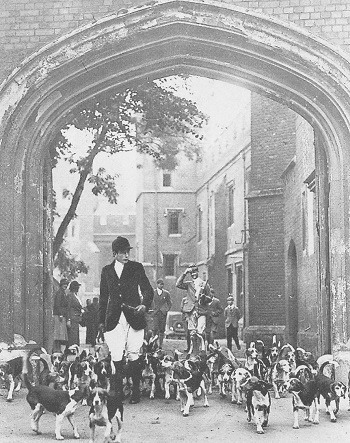 A youthful Ronnie Wallace, MB, setting records with the Eton College Beagles.Wallace was obsessed with hunting from the start. At age seven, he was hunting his own pack consisting of terriers, beagles, and a Labrador retriever. At age sixteen, he was the youngest ever to be appointed Master of the Eton College beagles. He proceeded to set beagling records at Eton that have never been matched. He was, for twenty-five years, Master and huntsman of the Heythrop, that period subsequently referred to in England as the “new golden age of hunting.” For the last twenty-five years of his life, he was Master and huntsman of the Exmoor. During a full life of hunting, he had also been Master of the Christ Church beagles, the Ludlow, the Teme Valley, the Cotswold foxhounds, and the Hawkstone Otter Hounds, which he particularly adored.
His goal was perfection—always—in breeding and in the field. Wallace was revered by his countrymen, whom he served for over twenty-two years as chairman of their Masters of Foxhounds Association, after which he was made president for life.
A youthful Hugh Robards, making his way up the highly structured ladder of British hunt service, served as second whipper-in to the Captain at the Heythrop for three years. At the Captain’s recommendation, Robards went on to hunt Lord Daresbury’s County Limerick Foxhounds (IR) for more than a quarter century, showing the best of Irish sport to throngs of international visitors and concluding an illustrious career as huntsman for the Middleburg Hunt (VA).
“A book has already been written about the Captain,” wrote Robards in his own warm and readable memoir,* “but I’m sure there is much more to be said. For me, there will never be another man like him. Certainly no man will ever match him in the hunting of the fox or in organising a country. He has done more good for foxhunting than any other man alive or dead. All those who have worked for him hold him in the highest regard; his loyalty to those people in return is phenomenal.
“He was not an easy man to whip-in to. Only once did he praise me, and that was when I got to a very busy road just in time to save hounds being killed, although two minutes later he sent me home. Fortunately, I was in good company, as he also despatched Mrs. Fleming. Naturally, we both carried on hunting and when the Captain had killed his fox and was standing amongst his hounds, he turned to the field with a big smile on his face and said, ‘I suppose Hugh and Mrs. Fleming have gone home?’ He knew I would not leave, as Bill [Lander, first whipper-in] was not out that day.’”
Between seasons, once the Captain had instructed staff how they were to exercise hounds, he left them to it and never walked out for the rest of the summer. Nor did he ever come to the kennels for feeding. Hounds saw him only when hunting, and the staff marveled at the magical connection he maintained with the pack. Robards continues.
“Hounds were unloaded from the lorry at the first cubhunting meet of the season and everyone, including the young entry, went straight to his horse; not one looked back at Bill or me or tried to break away from him. They followed him to the first draw as though he had been with them every day through the summer.”
If there was ever any question about the Captain’s sole focus while hunting, this vignette of Robard’s should put it to rest.
“Major Fleming was pulling the Captain’s leg about going home at five o’clock, which he thought was far too early for the end of the season. We were all laughing about this when I saw a fox move out of Marsh Mouth. Major Fleming was beside me and I told him what I had seen, but he did not believe me, saying, ‘Good try, Hugh,’ and laughing. For the second time that day, I decided to take the bull by the horns and rode up to tell the Captain. All he said was, ‘Show me where.’
“Hounds took the line straight away towards Stenson’s Osiers before turning right to go up the vale by Marsh Farm and Cold Park and on over the Fosse. I was riding with the Captain. As I opened a gate for him, I saw Major Fleming and Mrs. Wallace crossing the country like scalded cats and loving every minute as they approached a hedge with a good ditch and wire at the back or it. I shouted ‘ware wire’ but it was too late. They both got away with it and were galloping on when the Captain said, ‘Don’t ever shout again. Your job is to look after me, nobody else. If those silly buggers want to break their necks, that’s up to them.’ I just thought, Well, it’s your wife, and continued on with him through our line of gates.
“We were with them all the way over Elmbank farm, through Cold Aston Grove, into Coronation Covert, where the fox went to ground. It had been a lovely forty minutes and a four-and-a-half-mile point. The Captain was as happy as I have ever seen him at the end of a hunt, as were the small group who remained.”
In his book, Ronnie Wallace: The Authorized Version, Robin Roderick-Jones wrote, “Perhaps the most graphic description of Wallace’s unique skill comes from Michael Clayton, the editor of Horse and Hound who, having hunted with practically all the 196 packs of foxhounds in the United Kingdom, is better placed than most to make comparisons.
“It was toward the end of the day and there were not many of us left. Ronnie stood at the side of the wood and said, ‘Shut up all of you. Stand absolutely still and I want to hear no halloa-ing. Not a sound.’
“With that he disappeared into the covert with his hounds. Foxes came out in all directions but not a single hound. I was astonished; this was quite incredible. Eventually a fox emerged, presumably headed in the direction that Ronnie wished it to go and then came the pack; hunting as one they swept off like a carpet. I don’t remember seeing Wallace and we had a fast and brilliant twenty-five minutes round the Evenlode Vale, hounds catching and killing their fox just in front of us. I looked up and the Master of the Heythrop trotted through a gateway, dismounted, told the bitch pack that they’d been ‘rather good girls.’ It was an astounding performance and one that I have never seen matched….[N]obody else could do that.”
Antony Gaylard, huntsman for the Ottawa Valley Hounds (ON), worked at the Exmoor kennels during the Captain’s Mastership there. “He taught you more about hounds, hunting, and organizing country without you realizing, especially if he thought you were keen to learn,” recalled Gaylard. “Yes, I had the rough edge of his tongue a few times, but he always explained what I had done wrong at the end off the day, and I always made sure it didn’t happen again. He was simply great master to work for.”
Gaylard has his own recollection of the Captain’s magical connection with hounds. Through one entire season, the Exmoor foxhounds didn’t see the Captain at all from September to March. Both his hips had been replaced, and hounds were hunted by kennel huntsman Tony Wright, an excellent houndsman and huntsman in his own right. It was March, nearing the end of the season, when the Captain had his nurse drive him to a meet. He rolled down the window, said a few words in conversation, and the next moment the car was covered with hounds—on the hood, on the roof, jumping at the window. They had flown to him. He had to close the window and have the nurse drive away. Those that watched saw tears in his eyes as he left. Tony tried hunting the pack for a couple of hours, then gave up and took them in. Hounds were wild, and he could do nothing with them.
Your editor has his own special memory of Tony Wright. Joan and I were hunting at Exmoor with the Captain, and we had accepted Tony’s invitation to join him in walking out hounds the next morning. We arrived at kennels at the proper time and out we went with this brilliant pack of hounds looking forward to a long walk across the moors—just the three of us with the pack—and hopefully even learning something. We couldn’t have been walking for five minutes when a fox exploded out of a ditch not ten yards in front of the pack. The fox’s legs were whirling like the old Road-Runner cartoons. The pack was electrified and flew after the fox and were out of sight in seconds. Stunned by this sudden turn and speechless, Joan and I looked at Tony for emergency instructions, ready to do heaven knows what. Tony turned to us, smiled, and quietly asked, “How about a nice cup of tea?”
It may have been the next day’s hunting or another year’s visit, but Joan has a video in her head of the Captain’s connection with hounds that she can replay as clearly as if it were yesterday. “We were in the open, walking down a gentle hill which rose again in front of us. Ronnie was in front, and behind him hounds were scattered, noses down, just reading the country along the edge of a long covert to our right. Ronnie reached the bottom and started back up the rise. He didn’t break his stride, just turned in the saddle and looked behind him at hounds. He didn’t say a word, just caught their eyes, then turned back to the front and hounds flew to him—every one. I’ll never forget it.”
Captain Wallace was frequent and popular visitor to North America as a hound show judge. He shared his wealth of knowledge freely and was a valued mentor to breeders of the modern English foxhound here. C. Martin Wood III, MFH and huntsman of the Live Oak Hounds (FL) enjoyed an especially close relationship with Wallace, from whom he acquired much of his own breeding acumen. A stickler for tradition, the Captain still possessed the self-confidence to be always open to new ideas and new bloodlines. He is surely the Englishman most responsible for the introduction of American bloodlines into the English foxhound. Not many English Masters could have done that without censure!
Posted July 11, 2018
* Foxhunting in England, Ireland and North America, Hugh Robards, The Derrydale Press, 2000