
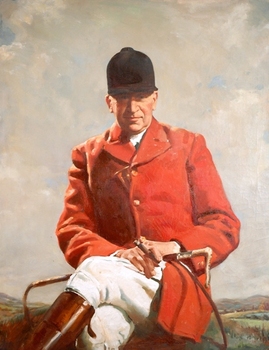
 Alexander Henry Higginson, MFHAn Old Sportsman’s Memories, the autobiography written by A. Henry Higginson and J. Stanley Reeve tells the story of a proper Bostonian, Harvard class of 1898, who turned his back on a life of commerce, finance, and philanthropy—the route traditionally followed by New England men such as he. Smitten by the sport of foxhunting to the exclusion of all else, and with the support of his indulgent father, A. Henry Higginson followed his dream: a life of foxhunting.
His father, Major Henry Lee Higginson, more than fulfilled the family’s responsibilities to his community by his own philanthropy. The elder Higginson had dreamt of being a musician in his younger years, but Puritan Boston expected other things from her sons, and so he became a businessman as was expected. In time, he founded the Boston Symphony Orchestra, however, and was its earliest administrator.
He organized the corporation that built Symphony Hall, the first auditorium designed in accordance with scientifically derived acoustical principles. It is, as a result, widely regarded as one of the top concert halls in the world. Interestingly, with all the architectural flourishes of the period that architects McKim, Mead & White could bring to their creation in the year 1900, the structure displays only one composer’s name upon a large shield mounted on a frieze centered above the stage—Beethoven. There are other smaller shields upon the frieze framing the stage, but they are still blank! Boston is a careful and thoughtful old city.
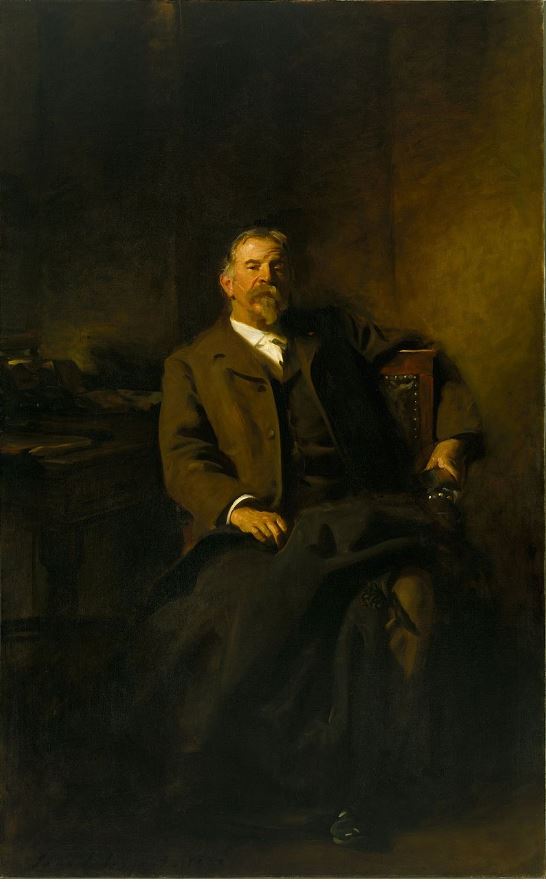 A. Henry’s father, Major Henry Lee Higginson (1834-1919) / Detail of oil potrait by John Singer SargentThe younger Henry was at the ceremony when his father, who served and was wounded in the Civil War, donated Soldier’s Field, located on the Boston side of the Charles River, to Harvard University in memory of six friends killed in that war. Hence its name. The university subsequently built Harvard Stadium on Soldiers Field. John Singer Sargent painted the elder Higginson’s portrait which hangs in the Harvard Art Museum, and a copy by Sargent’s students hangs in Symphony Hall.
As laudable as the elder Higginson’s philanthropy appears, he could be a martinet in other respects. He ruled the Boston Symphony Orchestra with an iron fist, and his musicians knew that anyone who joined a union would be replaced with a musician from Europe. Annoyed by drivers who sped past his summer home, he invented the first motor vehicle license plate and petitioned the Massachusetts legislature to register automobiles and make use of it.
As a teenager, A. Henry Higginson, the son, hunted black-tailed deer in the White River country of Colorado. Later, he explored the west—Montana and the Dakotas—where he collected ornithological specimens for the U.S. Biological Survey. He and other young men of his ilk raced their sailboats from one end of Massachusetts Bay to the other, forming the club that became the Manchester Yacht Club.
Quiet Sundays were spent at A. Henry’s father’s home in Boston’s exclusive Back Bay. The family home was a mecca to all the musicians and soloists who came to play with the BSO: Dame Nellie Melba, Paderewski, Serge Koussevitsky, and others. The visitors were guests at the dinner table, after which many would sit down at the piano and play.
While a freshman at Harvard, Higginson became captivated by a beautiful and talented stage actress. He wangled an introduction, and she consented to accompany him to the Symphony. That was the start of his long and enduring friendship with Ethel Barrymore. Even Buffalo Bill Cody ushered Higginson and his friends into the “Royal Box” for his show.
As a boy, Higginson had his own pack of beagles, but later, it was foxhounds he yearned for. The elder Higginson recognized that, though his son wasn’t following his peers down the traditional paths to commerce and finance, the boy had redeeming attributes; he wasn’t lazy, and he didn’t drink or gamble. And so his father allowed him the freedom to be the man he wanted to be. This dynamic and accomplished father, who also participated in the first transcontinental telephone call along with Thomas Watson, Alexander Graham Bell, Theodore Vail and Woodrow Wilson, allowed his son the means with which to build a stately home in Lincoln, Massachusetts, stables for horses, and kennels for his English foxhounds. And to pursue a life of foxhunting which took his sportsman son up and down the eastern seaboard and across the Atlantic to England on a regular basis.
At the turn of the twentieth century, the southern states had the country best suited for mounted foxhunting in the English style. And they had American-bred foxhounds that could hunt the country. What they did not have, after the Civil War, was money or—as descendants of English land-owning gentry—a heritage of commerce and business-like organizational skills. This is what foxhunting needed at the time, and this is what the northerners brought to the table. Their heritage, as descendants of the Puritans who emigrated from the east of England, was commerce. And the timing was such that this generation of New England Puritans was sufficiently distant from their forebears to decide that sporting pursuits were not necessarily the work of the devil. They raced sailboats, rowed skulls, formed polo clubs, and established the first country club. They founded foxhunting clubs, the Jockey Club, and the National Hunt and Steeplechase Association, one of the early efforts to organize sport with horses.
Higginson traveled with the hounds of his Middlesex Hunt wherever he could find sport, from upper New York State where William Wadsworth had established the Genesee Valley Hunt to Virginia’s Piedmont where Higginson had challenged Harry Worcester Smith, another Massachusetts sportsman/industrialist, to the Great English-American Hound Match. Reporters and journalists came from around the country to cover the competition, and it was prominently carries in the newspapers and sporting journals throughout the week.
Higginson and Smith rode every day, despite the fact that Higginson had fallen while participating in a steeplechase race just before arriving in Virginia for the match and had suffered broken ribs. Smith, known to be an aggressive and bold rider, had several hard falls during the match and was pretty banged up himself.
Though the sport was less than either man had hoped to show, the match did manage to bring the sleepy southern villages of Upperville and Middleburg to the notice of the outside world. Smith took over the Mastership of the Piedmont Fox Hounds, but the Orange County Hunt, established in Middleburg and The Plains by wealthy northerners from Orange County, New York, kept running their hounds into Smith’s Piedmont country. They ignored his complaints, and the National Hunt and Steeplechase Association also ignored his complaints and was unwilling to intervene. Smith quit the Mastership, sold the hounds to Orange County for the largest sum ever paid for a pack of hounds, and resolved to start an organization, the Masters of Foxhounds Association, that could and would maintain the integrity of member hunt boundaries.
William Wadsworth was elected to be the first president. He served for a year. Harry Worcester Smith was president from 1812 to 1915, and he was followed by the term of A. Henry Higginson who served from 1915 to 1931. Higginson resigned as MFHA president after he became Master of the Cattistock Foxhounds in England.
Generations of descendants of Higginson family lines continue to populate the foxhunting fields of North America, some by the name of Higginson, others by Mackay-Smith (Alexander’s first wife was Joan Higginson, breeder of the famed Farnley Ponies), Day (daughter of Dr. Matthew Mackay-Smith), and perhaps other branches unknown to the author. A fascinating and accomplished family!
Posted August 5, 2019