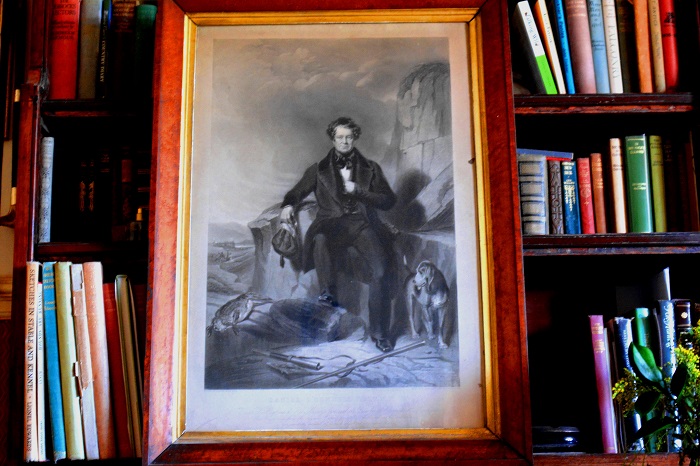
 Portrait of Daniel O’Connell and one of his Kerry Beagles / Noel Mullins photo
Researching the history of one’s sport can be very rewarding, as little did I know during my history classes in school that the Irish politician Daniel O’Connell (1775-1847), known as The Liberator, was a hunting man. Maybe I would have paid more attention had I known!
I explored Daniel O’Connell’s hunting life further when I was given a seventy-year-old unfinished manuscript on the Kerry Beagle written by the great Irish writer, poet, broadcaster, and hunting correspondent, Stanislaus Lynch (1907–1983). I since edited Lynch’s manuscript and published his book in 2017 titled, In Search of the Kerry Beagle.
Record of a Hunt in the Kerry Mountains with Daniel O’Connell’s Kerry Beagles
There is little written about Daniel O’Connell‘s Kerry Beagle pack hunting the hills of Kerry in the many books written about him. But I was fortunate to find some hunting passages in a publication I had in my library dated 1872. The passages were written some twenty-five years after O’Connell’s death by the MP, historian, and O’Connell supporter, William Joseph O’Neill Daunt (1807-1894).
“On the third or fourth morning after my arrival at Derrynane, I was summoned by Mr. O’Connell to accompany the hunting party. It was not quite six o’clock, the morning was clear and bright, and gave promise of a beautiful day. We followed a winding path called the Meadow Walk which crosses and re-crosses a merry mountain brook; we ascended the hill of Coomakista, crossed the line of the new road, and ere half an hour had elapsed, a hare was started. It was a glorious run; the view for half a mile or more; and as the dogs ran the scent they kept so close together that a sheet might have covered the pack. O’Connell, who enjoyed the hunt with infinite glee, walked and ran from rock to rock to keep the dogs in view. The mountain air had sharpened my appetite, and I inquired rather anxiously when we should have breakfast.
“‘We must earn our breakfast,’ replied O’Connell. He then engaged in busy speculation on the course of the hare— she had doubled and thrown out the dogs—the pack were at fault—they had scattered and were trying in different directions to recover the scent. Ah! Drummer hit the scent again, and now they were all once more in full pursuit. It was a glorious scene. Overhead was a cloudless sky; around us, on every side, was the most magnificent scenery, lighted up by brilliant sunshine. There was that finest of all music, the loud, full cry of the beagles returned by a thousand echoes; the shouts of men and boys ringing sharp and cheerily along the hills; and there was Daniel O’Connell himself, equalling in agility men not half his age, pouring forth an exhaustless stream of jest and anecdote, and entering with joyous zeal into the fullest spirit of the noble sport.
“We then sat down to breakfast in a small sheltered nook. It was a green hollow in the hill-side, about 900 feet above the level of the sea. Immediately over us projected a grey rock, which formed a sort of rude ceiling to the inner part of our mountain parlour. Breakfast in such a spot, and with such appetite, was truly a luxurious feast. A fragment of rock was our table; some of the party sat on stones, whilst others reclined in primitive fashion on the grass. The huntsmen, in their gay red jackets, and several of the peasantry formed an irregular line upon the outskirts. The noble dogs sat around with an air of quiet dignity, that seemed indicative of conscious merit. Far beneath us was the Atlantic, sparkling in the morning sun; to the right were the mountain isles of Scarriff and the bold rocks of Skellig.
“The post-boy arrived with a letter-bag while we were at breakfast. Mr. O’Connell read his letters on the mountain; the hunt was then resumed; and with such success, that, if I mistake not, we did not get home till sunset.
“On days when we did not hunt, the mode in which he usually disposed of his time at Derrynane was as follows; After breakfast the newspapers and letters occupied, in general, from one to two hours; he would then, if the day was fine, stroll out for a while to the beach, the garden, or to his turret in the shrubbery. Whenever I accompanied him on any of these walks, he invariably pointed out among the surrounding rocks the course of some hunt, and detailed with a minuteness that evinced the interest he took in the subject, the various turns of the hare, and the exploits of the dogs. He would then return to the house, and spent the rest of the day till dinner in his study.
“He always occupied the head of the table at dinner, and, with rare exceptions, was talkative and jocular during that meal. He generally sat about an hour after it, and then returned to his study, where he remained until bed-time.
“Daniel O’Connell died during the Irish Famine in 1847 in Genoa, Italy in his 72nd year when he was on what he termed as his pilgrimage to Rome. His last dispositions were, “My body to Ireland, my heart to Rome, my soul to Heaven.” His remains were interred in Glasnevin Cemetery in Dublin after a State funeral in August 1847 and the main street in Dublin, O’Connell Street, is named after him.
“The Kerry Beagles are still to be seen hunting in many parts of Ireland but especially in the hills of Daniel O’Connell home county Kerry, what a legacy!”
The O’Connell Family
The O’Connells were an old Irish family and were hereditary constables of Ballycarbery Castle. Daniel was born on the 6th of August 1775 to his parents Morgan and Catherine in Carhan House, Caherciveen, County Kerry. He was the eldest son of ten children. His grandfather and grandmother Donal Mor and Maire built up a successful sea trade between Kerry and France. Daniel later lived with his uncle Maurice ‘Hunting Cap’ O’Connell from whom he inherited the Derrynane Estate. His uncle also paid for Daniel’s legal education at King’s Inns in Dublin and college in Paris.
Daniel O’Connell MP was a giant in Irish politics in the nineteenth century, and he kept a pack of Kerry Beagles at his home in Kerry. O’Connell mobilised the Irish people, rich and poor, in mass in a democratic way in campaigns on Catholic Emancipation for both religious freedom and human rights, and a repeal of the draconian Penal Laws. He was a Member of Parliament for County Clare, and later Dublin City, Cork City and Dublin Lord Mayor, all while Ireland was still part of the British Empire. His four sons Maurice , Daniel, Morgan and, John were also elected MPs. A lawyer by profession, he was said to have been the finest orator of his day, and probably the most successful and articulate barrister in court in his presentation of legal cases. He was also an active campaigner against slavery in the colonies addressing the Cork Anti-Slavery Society in 1829 and hosting a visit to Dublin by the African American anti-slavery author Frederick Douglas who spoke on “The Evils of Human Trafficking & Bondage.” O’Connell also gave a rousing address at the World Anti-Slavery Convention in the Freemans Hall in London in 1840.
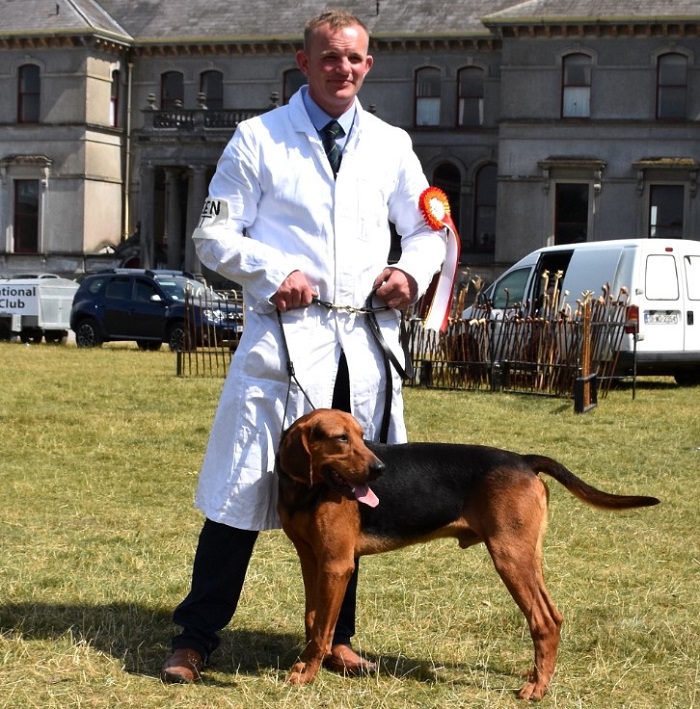 Huntsman Raymond O’Halloran showing Scarteen Kerry Beagles for the first time in 2018 at the Irish National Hound Show at Stradbally with winning hound, Scarteen Limerick. / Noel Mullins photo
The Ryan Family of Scarteen
The Ryans of Scarteen, and the O’Connells of Derrynane Abbey, two great hunting families were cousins. The historical records tell us that the Ryans have been Masters of the Scarteen Black and Tan Hounds certainly since 1735 when John Ryan who then lived in Ballyvistin kept a pack. He hunted the pack for over fifty years, and his son Thaddeus assumed the position on his retirement. But the Ryans are now more associated with their present home, Scarteen, near Knocklong in County Limerick, to which they moved in 1789. Their famous pack of Kerry Beagles are known all over the hunting world as the Scarteen Hounds. The pack has been hunted primarily by a member of the Ryan family with a few exceptions. In recent years Thady Ryan hunted the pack from 1946 for over forty seasons. His son Chris took over upon his father’s retirement in 1987 to become Master and huntsman, maintaining the family tradition with distinction. In recent years a professional huntsman hunts the pack.
Daniel O’Connell sourcing a hound for his cousin, Thaddeus Ryan
The following is a short extract from a letter from Daniel O’Connell to his cousin Thaddeus Ryan in 1812.
10th September 1812
My dear Ryan
I have found for you from my friend Mr. James Butler a sire dog of the old Irish breed. His name is Sharper and is more than seven years old. I am personally acquainted with his stock for the last ten years as a breeder of generations and pledge you my sacred word of honour that they were all the very best hounds. Breed from a light tanned bitch and you will have excellent hounds from him.
….
Mr. Butler begs me to say that his dog should reach you in better condition, but that he has been lately much hunted with young dogs on the mountains .”
….
My mother desires me to present her most affectionate compliments to her cousins under your roof. Let me add mine.
My Dear Ryan,
Yours Affectionately in Hunting,
Daniel O’Connell
He later advises Tha Ryan to take the owner to Limerick Assizes if the performance of the hound does not live up to its reputation!
Hunting references in O’Connell’s work as a barrister
It was not unusual for O’Connell to use hunting references in the course of his work.
He accused Sir Robert Peel of, “running with the pack.” In 1843 when the Crown Solicitor Mr. Kemmis was instituting proceedings against O’Connell for “conspiracy and other misdemeanours” having analysed speeches given by O’Connell at his Monster Meetings (often attracting up to 500,000 supporters), it is said that he returned to Dublin with a good-tempered growl at the Attorney General for taking him away from his hounds and his hunting.
When he reluctantly declined the position of Chief Baron, he commented, “I should be idle in the early part of April, just when the jack-hares leave the most splendid trails upon the mountains. In fact I should enjoy the office exceedingly on every account if I could, but except it consistently conflicts with the interests of Ireland; but I cannot.”
The London Examiner had compared O’Connell’s Repeal Movement to the cry of O’Connell’s Derrynane Beagles.
“Yes,” observed O’Connell, “but he made a better hit than he intended, for my beagles never cease their cry until they catch their game .”
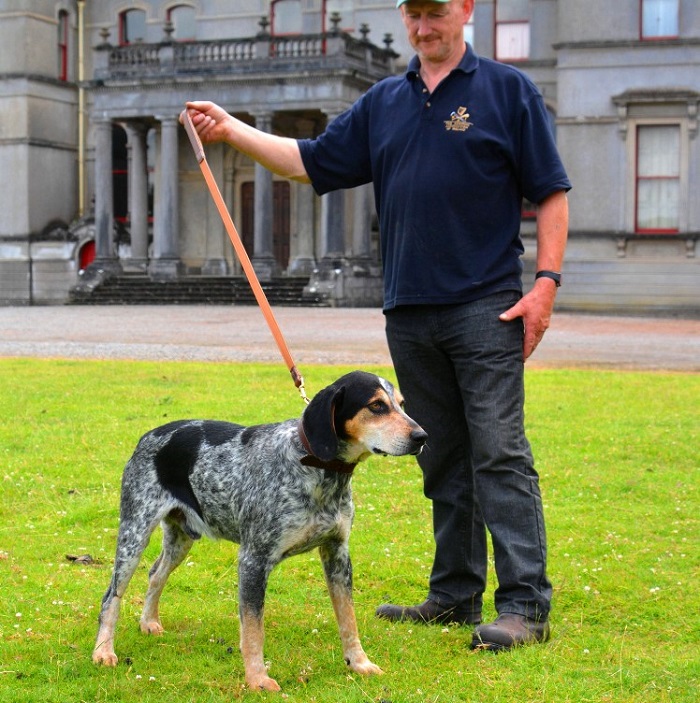 Noel Geary, Killeagh Harriers, with Twister, a blue mottled Kerry Beagle at Stradbally / Noel Mullins, photo
The Old Kerry Beagle Packs
Many of the best known of the old Kerry Beagle packs sadly are no longer in existence. They were Mr Chute of Chute Hall, Mr Butler of Waterville, Mr Wallis of Drishane Castle in Millstreet, and Mr Herbert of Muckross Abbey. But the best known packs were that of the O’Connells of Derrynane Abbey, Caherdaniel, County Kerry, and the Ryan Family of Scarteen, Knocklong, County Limerick.
In Britain the Woodland Pytchley had a pack of Kerry Beagles as had the Duke of Beaufort. The great writer Edith Somerville, who co-wrote over thirty books on hunting and country life, hunted a pack of Kerry Beagles on foot as well as her mounted West Carbury Foxhounds. Today there are a small number of mounted packs in Ireland that hunt the Kerry Beagle like the Scarteen: the Mullinavat in Kilkenny and the foot packs that hunt the hills of Kerry and show their Kerry Beagles at the Annual Kerry Beagle Hound Show. They also are the primary source of breeding stock that helps avoid inbreeding—foot packs like the Breahig, Glen, Foilmore, Caherciveen, Ballinskelligs, Waterville, Rockfield, Scarta Glin, Killoe and the Kenmare.
Posted September 22, 2020