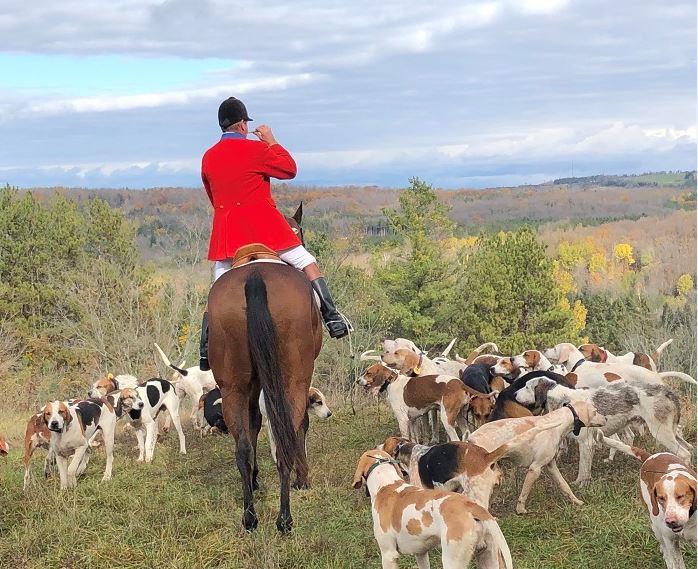
 Eglinton and Caledon Hounds with current huntsman, Mark McManus.The Eglinton and Caledon Hounds (ON) have long been noted for excellent live hunting. Drag hunting has been considered on occasions, but the decision has always been made to stay with pursuing the plentiful live coyotes in the hunt club’s southern countryside. It is not surprising then that the one attempt to incorporate some drag hunting with live hunting did not go according to plan.
The occasion was at one of the meets during the highly successful Ontario Festival of Hunting. The biennial Festival was spearheaded by the late Walter Pady, MFH of the Toronto and North York Hunt with the support of the five Ontario and and Quebec clubs during the 1990s and early 2000s.
Invitations were sent to all North American hunt clubs, and riders from as far away as Alabama made the long trek to Ontario. Some riders even came from overseas for the five days of hunting with foxhounds, beagles and basset hounds, interspersed with much partying and socializing.
The field sizes were inevitably large, as many as 120 riders, making the selection of meet sites limited to those locations that could handle this number of riders and the trailer parking. In the festival of October 2000, one of the selected fixtures when Eglinton and Caledon was hosting was Mono Centre, where there was adequate parking and Mono Cliffs Inn was nearby to provide a suitable watering hole for participants at the end of the day. The surrounding country from the meet area north to Blithe Hill and beyond has always been one of Eglinton and Caledon’s best hunt country locations.
The difficulty was how to get 120 horses and riders away from the pub parking lot in the middle of the village to more open country where the live hunting could begin. The prospect of taking this large group plus a combined pack of about thirty couple of foxhounds down the narrow and busy road to the start point presented a safety problem. This was especially true as horses and hounds were fresh and in high spirits, having just been unloaded from trailers and horse boxes.
At the time, I was living at Wyndham House about ten kilometres south of Mono and had previously undertaken to open up the country in Mono Township. This involved many hours visiting landowners and getting to know the lay of the land. Consequently, it was my job to determine the best way to get the horses and hounds away from the congested meet to the safety of open country. The solution seemed to be to lay a dragline through the complex area of small private properties to the east of the pub and away from the busy M20 road.
A few days ahead of the meet, huntsman Steve Clifton’s twenty-one-year-old son, Sam, a newly established whipper-in, and I worked out a route south of Mono Road 20 to come out on the Third Line. From there, we turned south for 300 metres before entering a driveway past a private home and into more open country to the east. The route then turned north up through a plantation of pine trees. At the top of this hill we built a rough cedar rail coop over a wire fence into a steep gully. This was where we found the skull of a cow so we named it Dead Cow Gulch. Northward, the route lay up and down a series of steep hills followed by sharp drops, an area which quickly causes horses to start blowing. Another coop or two brought us to Clarence’s farm.
I had made two or three visits with landowner Clarence, which involved sitting in the sun on a rough wooden bench outside his back door. We solved the problems of the world over a few drams of rye whiskey before licence was provided to ride over his strategically placed property. His land was somewhat hazardous as the large field beside his house was littered with rusted-out farm equipment and pieces of wire fencing laying on the ground. Circular loops of baling string lay around where the cattle had eaten the hay from dozens of large round bales from which the strings had never been cut or removed. Never mind, it was the access to Mono Road 20 which we needed. Once across the road, we were into wide open country toward Blithe Hill.
With the problem of the route solved, we arranged for a really fresh and juicy bag of drag scent to be available at the meet on the scheduled day. I don’t know where the drag juice came from or who provided it, but it proved to be the real McCoy—eighty-percent proof and with a long ‘best before’ date of thirty days or more. We decided it was advisable to not enquire about such matters and to leave it to the hounds to tell us how good it was by the volume of their music as their noses did the analysis.
About thirty minutes before moving off-time, Sam and I set out on the prescribed route. All went well for the first kilometre or two as we took turns dragging the succulent bag of whatever over the ground. We popped over the single rail onto the Third Line as planned. Turning south for three hundred metres, we turned east up the private driveway.
This is where our troubles started.
We had ridden the trial route on a Sunday. This was now a weekday. Previously, the owners had been there and happily waved us through their property. When they returned to their city home for the start of the work week, they had closed and padlocked the driveway gate.
The more nimble Sam jumped off his horse and started to find a way to open the gate. As he tried to release the chain which barred our entry, the clock was ticking and our lead time was dwindling. By lifting the wire frame gate off its hinges, he eventually was able to swing it open it in the wrong direction. As he did this, I stood by holding the string of the drag bag.
The sound of the horn and the cry of the hounds told us that the hunt had moved off and was moving fast in our direction, thanks to the fresh scent of the potent dragline. With each minute of delay the hound music was getting louder. Sam increased his efforts to swing open the gate.
With the gate finally open, Sam and I continued on at a much increased pace. Now at a fast canter, we continued through the rows of pine trees up the hill to Dead Cow Gulch. At an ever faster pace, we jumped the improvised coop down into the valley and up the steep hill to the north. This was a good viewing point on top of the hill, so we paused to assess the situation. We saw the flash of scarlet coats in the valley below to the west as the lead riders came out on to the Third Line. We didn’t see any hounds but we could tell by the volume of the cry that they were already coming up through the pines behind us.
This caused us to change our plan as our horses would be unable to outrun the hounds in this steep terrain. Sam came up with the answer. “You stay here, while I lift the drag and hightail it west over to the Fourth Line where I will bury it or get rid of it somehow.” Without wasting a second, he gathered up the string and, holding it at arms length off the ground, he kicked on his horse and quickly disappeared from view.
Later, I told everyone that we had always intended to have a check on top of this hill as we didn’t want the field to have blown their horses so early in the hunt. I waited the two minutes or so before the lead hounds appeared. Soon the whole pack of thirty couple arrived and I was surrounded. They were feathering the hilltop, wondering what had happened to the strong smelling coyote, and expecting an explanation. Some stood on their hind legs demanding answers.
“OK, what did you do with the coyote,” they seemed to be saying. “We did our job and you screwed it up. Now what do we do?”
I was hoping the huntsman would arrive soon and placate the sixty overly keen hounds milling around DaVinci, my horse, but the speed of the opening run was such that he was still struggling up through the pines.
Then the solution came to me.
Here I should explain that I was brought up in a foxhunting family. On hunting days my mother always sent my father, myself, and any of my brothers and sisters who could find a pony that wasn’t lame, off with oversized ham sandwiches in our pockets. The bread was what we called “doorstep-thick” slices, filled with generous carvings of ham and a hearty smear of mustard. Not that namby-pamby Dijon stuff but Coleman’s yellow powder variety, made with a drop or two of water and not olive oil or vinegar. We expected our ham sandwiches to shake us up with a hot burning sensation at the back of the throat—good puts hair on your chest stuff. This is a tradition that has stayed with me ever since those early days. Even today, my hunt coat always bulges with this same hearty lunch on hunting days.
That timeless tradition came to my rescue. I reached into my jacket pocket as sixty pairs of eyes looked on in anticipation. While I cannot claim any parallel to the parable of the loaves and fishes, I can claim to have provided sustenance to a large number of hungry mouths. As usual, the oversized sandwich had already turned to a mushy consistency but this made it easier to apportion it into tiny bite-size pieces. Trying to toss these minuscule treats to as many of the hounds as I could, I soon had their full attention.
Fortunately, the hunt staff arrived just as my food supply ran out. As Steve Clifton, the huntsman, took over his pack, I was able to toss him a cheeky quip: “Maybe you should take over now, Steve.”
Sam soon returned from disposing of the dragline and a good day’s live hunting began.
I believe that was the last time Eglinton and Caledon tried drag hunting. I continue to pack a ham sandwich on hunt days. After all, you never know when it might be needed for more than just lunch. If you follow this same tradition, be sure to use the hot variety of mustard!
Posted December 3, 2018
Derek French has been a member of Eglinton and Caledon since 1988. He served as Joint-Master from 2000 to 2007 and continued his support of the hunt as a road whip in the years that followed. His articles for the hunt’s Stirrup Cup magazine have always raised a chuckle.
Derek saw the war years of 1939 to 1945 through the eyes of a boy. Brought up on a farm in England near London, he recalls those tumultuous years with a light hearted touch in his memoir-cum-history book titled, Spirit: The Lighter Side of Life in Wartime Britain.