
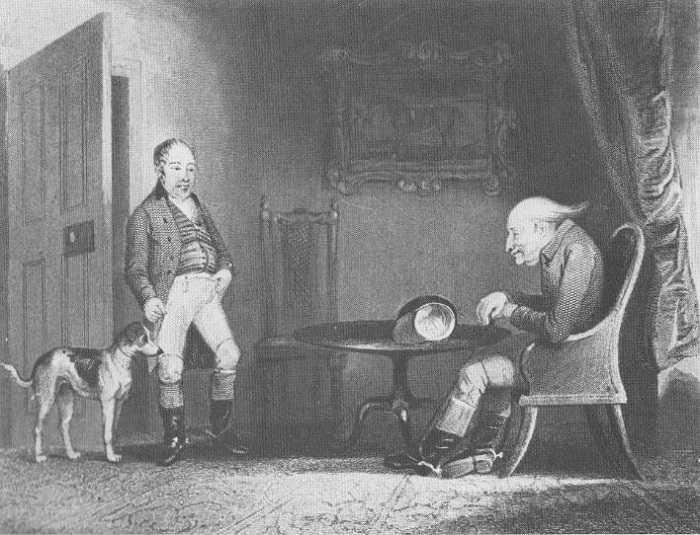
 Hugo Meynell (seated), in his later years, with his huntsman Jack Raven and a favorite hound Glider. / Engraving after a 1794 painting by Charles Loraine Smith
The father of English foxhunting was Hugo Meynell, founder of the Quorn, who began hunting hounds from his Leicestershire seat Quorn Hall in 1753. He developed the science of hunting the fox at speed in the open, made possible by the clearing of forests and the enclosure of land.
Meynell transformed hunting from just another method of vermin control into the premier country sport. He bred a pack capable of keeping up with a fast running fox at midday. With its fenced grassland and [holding] scent, Meynell’s Quorn became the heart of English hunting. In what became known as the ‘Meynellian Science,’ Meynell divided his pack into two, consisting of old and young hounds [plus applying more thoughtful methods to hound breeding and more organized ways of handling hounds in the field]. The big woods were hunted by the young pack two days a week, whilst the good country was kept for the experienced hounds. Meynell loved his hounds. On returning from hunting he would always see them fed first before sitting down to dinner himself.
Meynell owned little land and hunted by invitation. He was no great rider and saw his horse as just a method of conveying him to hounds. A friend described him as a “A regular little dumpling on horseback.’
In the 1790s Meynell hunted three days a week, killing up to ninety-two foxes a year. He hated hard riding and was known for his sarcastic putdowns. When someone rode over the scent and then insisted he was in the right, Meynell would reply, “You may be perfectly right, sir, and I quite wrong, but there is gross ignorance on one side or the other.”
Meynell was the first Master to establish order and discipline in the hunting field. He hated it if someone positioned himself at the covertside where the fox was expected to break and subsequently headed the fox. He had an unusual way of dealing with jealous riders. Instead of chastising the culprit, Meynell would scold his whipper-in instead in the hope that the offender would hear: “You damned fool! Come away instantly, spoiling the sport of the whole field!’
Much to Meynell’s dismay, by the end of his mastership the Quorn was being taken over by young bloods determined to ride as fast as they could and to hell with hounds. Meynell hated fast riding. After listening to some young Quorn men boasting of their exploits at the end of the day, he murmured, ‘I wonder where you find all these great places to leap—I never come across them.”
Posted October 11, 2018
From The Keen Foxhunter’s Miscellany, by Peter Holt, Quiller Publishing (UK), 2010