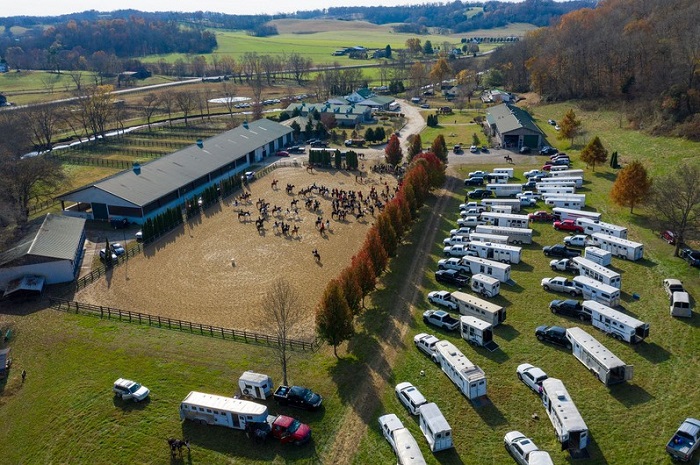
 Mells Opening Meet 2020 / Drone photography by Michael Gomez
The history of the Mells Fox Hounds (TN) goes back to a universally known nursery rhyme—“Little Jack Horner.”
Really. Stay with me. This innocent-sounding rhyming couplet is believed to be based upon a sixteenth-century real estate swindle at the highest levels of church and government in jolly old England.*
When “Little Jack Horner sat in a corner eating his Christmas pie, he stuck in his thumb and pulled out a plum.” Jack’s plum was metaphor for a far dearer prize.
The name, Jack, which appears often in nursery rhymes, is intended to suggest a knavish sort of ne’re-do-well. Historically, a fellow named Thomas Horner was entrusted by the Abbot of Glastonbury to carry a Christmas pie to King Henry VIII. Hidden in the pie were deeds to perhaps a dozen large estates across England, by which the Abbot hoped to dissuade the King from nationalizing Church properties. Horner, while on his mission, “stuck in his thumb,” but the plum he extracted was the deed to Mells Manor in Somerset. Knavish, indeed, Horner kept that deed for himself.
Actually, the entire rhyme is suspected to be a Catholic-inspired metaphor for what actually transpired as the King dissolved the monasteries and rewarded his Protestant supporters with estates at knock-down prices in expectations of their continued support. The Horner family lived in Mells Manor until the twentieth century.
Fast forward to 1964 when U.S. Army Colonel John L. Horner, Jr., a highly decorated World War II veteran, purchased a farm in Giles County, Tennessee. Colonel Horner named it Mells, after his ancestral manor in Somerset, England, which he had visited to meet his cousins while there in service. That same year Col. Horner established The Mells Foxhounds. The Mells was Registered by the MFHA in 1983 and Recognized in 1987.
Master Horner enlisted his nine-year-old daughter, Lou Horner (now Mahr), and, soon after, Lou’s best friend Karen Kressenberg, to whip-in to him. Karen Kressenberg has been a Master since 1999. Colonel Horner passed away in 1989 but his legacy endured.
In 2013 when Master Vannah Husband died, the hunt’s future appeared to be in serious jeopardy. That’s when Bill Haggard was contacted by Joint-Masters Karen Kressenberg and Stasia Bachrach. They invited him to join them in the Mells Mastership.
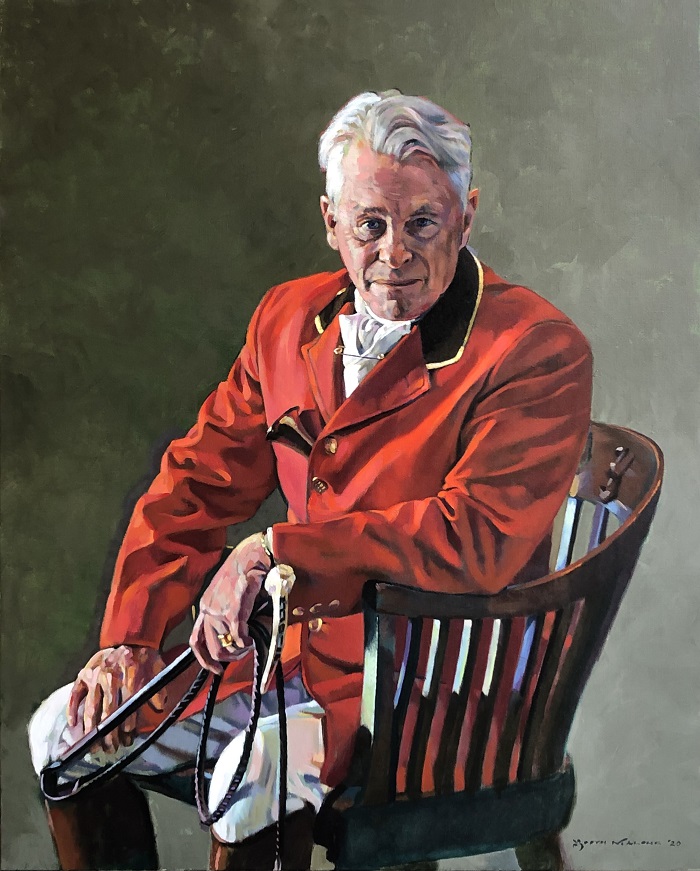 Bill Haggard, MFH, had a plan / Painting by Booth Malone
Bill Haggard was born and bred to foxhunting. His grandfather was among the original founders of the Hillsboro Hounds (TN). His grandmother, father, and mother all hunted with Hillsboro.
Bill’s father, Billy Haggard, a nationally known rider, had acquired a young dappled gray gelding named Bold Minstrel in a horse swap. Billy rode the horse foxhunting, international show jumping (the pair were inducted into the Carolinas Show Hunter Hall of Fame), and eventing as a member of the USET. Billy and Bold Minstrel competed in the 1959 and 1962 Pan Am Games for the USET, earning Team Silver and Gold Medals respectively.
Bill, the son, also hunted with Hillsboro in his younger years, later becoming heavily involved in angling. While living in Savannah, Georgia, he served as local then state president of Trout Unlimited and later sat on the national board.
From Savannah, Bill was able to hunt with the Aiken Hounds (SC). When he later returned to his home country in Tennessee, he resumed his foxhunting life with Hillsboro.
Bill served Hillsboro as secretary and treasurer for six years. He has served terms as Mid-South District Director for the MFHA and is the current Secretary-Treasurer of the MFHA.
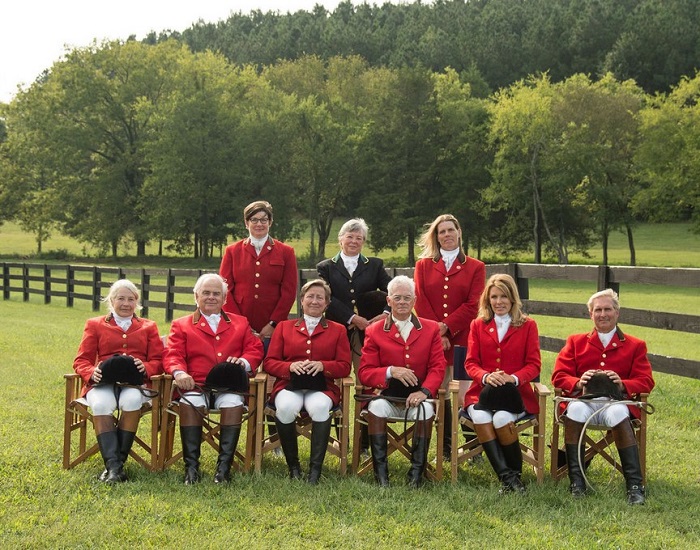 Masters and staff on Opening Day. Seated (l-r) are Masters Stasia Bachrach, Gerald Robeson, Karen Kressenberg, Bill Haggard, Terrissa Menefie, and Charles Montgomery. Standing are (prof) whipper-in Boo Montgomery, (hon) secretary Cheri Thomas, and (prof) whipper-in Claire Pinney. / David Dodson photo
When the call came from Mells Masters Kressenberg and Bachrach, Bill was intrigued. The Masters had a vision to revitalize their hunt on a sounder footing, and they recognized Bill had a knack for enterprise. He had already proven his expertise in building highly successful business organizations.
“I had only one reason to become a Joint-Master,” explained Bill Haggard, “and that was to have the opportunity to help rebuild Mells into the one of the premier hunts in the country.”
Bill was confident he possessed the wherewithal and the business experience to understand what it took to be a premier hunt: (1) more than one Master with resources, (2) a well-maintained country, (3) a premier huntsman and hounds, (4) an educated and invested field, and (5) a development program for youth to carry on.
Bill was appointed Master in 2014 and the Masters began implementing his plan. More Masters were appointed at Mells. There are now six.
The country hadn’t been well maintained, so it was cleaned up for hunting access. Landowner relations were revived. New coops were built. Twenty-five hundred acres of additional contiguous parcels of land were purchased by Masters and members, and more land acquisitions are in the works. Thirty-three acres near the hunt’s major fixture were acquired, and new state-of-the art kennels were built in 2015.
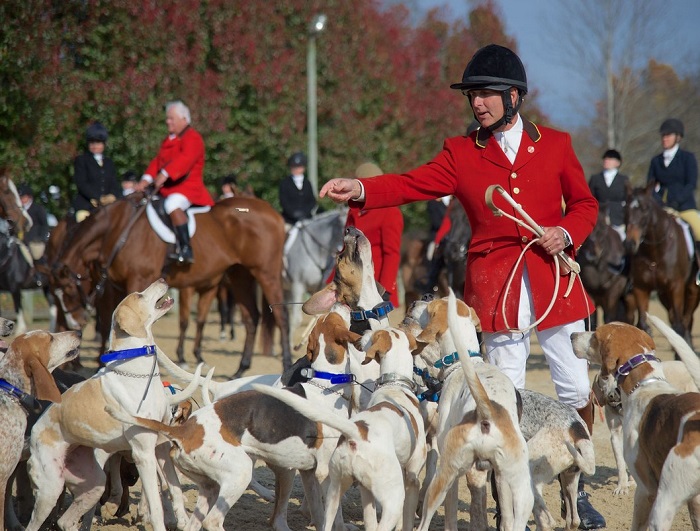 Huntsman Charles Montgomery, MFH with hounds / David Dodson photo
“When I learned that huntsman Charles Montgomery was available, I went after him!” said Bill, but Charles had other offers. “We offered a one-year trial agreement. If both sides were both happy at the end of the year and he wanted to stay, I promised we would appoint him Joint-Master.” Bill had known and hunted with Charles and considered him a superb huntsman and worthy of a Mastership. (And, as a bonus, Charles comes with his wife and most able first whipper-in Boo Montgomery.) Charles is now both MFH and huntsman at Mells.
At the conclusion of every meet a breakfast is laid during which Charles speaks to the field members and explains the hunt and hound work from his perspective. Which hound turned accurately on that first coyote when the front runners overran the line? When hounds were at fault at the road, which hound recovered the line? When hounds split, how and why did he choose which pack to follow? What worked and what didn’t work?
These talks are instructive, and as field members gain more knowledge and awareness they derive more pleasure from every hunting day. In just one year, Bill has seen the positive results of this program.
(Your editor has hunted behind Charles Montgomery a number of times in a number of hunting fields and still remembers stunning feats he pulled off with hounds as far back as twenty years ago—fresh in memory.)
Membership requirements at Mells are simple; the prospective member must love hunting and eschew drama! If personal finances are a problem for someone who otherwise loves hunting, Bill will help. Oh, and did I mention…no drama! All members are required to contribute to hunt projects and pitch in however best suit their talents. Total membership increased by more than forty percent this past year.
There are two Pony Clubs, and youth are pro-actively encouraged to hunt. When a junior views the quarry he or she receives a Mells pin to be proudly worn on their hunt coats or stock ties thereafter.
The Masters’ goal of rebuilding the Mells Foxhounds into one of the premier hunts in the country is not just words to Bill. He is passionately implementing his plan.
“If you’ve got passion, you can make it work,” he says with complete confidence. “Passion trumps everything.”
Posted November 27, 2020
* Heavy Words Lightly Thrown: The Reasons Behind The Rhymes by Chris Roberts