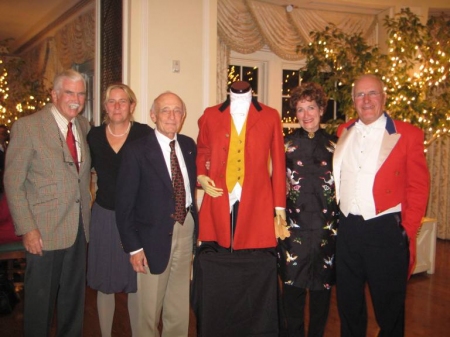
The Chevy Chase Club in Maryland, the surviving organization of the Chevy Chase Hunt Club, acquired a valuable historical artifact on Wednesday, November 17, when a scarlet hunt coat and canary vest belonging to Brigadier General Charles K. Nulsen was donated to the Club by Charles K. Nulsen III. The coat and vest bear the buttons of the Chevy Chase Hunt and have been hanging in a New Hampshire home belonging to the family for nearly a century.
The Chevy Chase Hunt was active from 1892 to 1916. It was a highly respected hunt of its time, but short-lived because the Master, Clarence Moore, perished on the Titanic in 1912.
The special evening ceremonies attracted a crowd of 110 members and guests who enjoyed a specially prepared hunt dinner including duck breast and venison loin, a speech and book signing by your editor, and the unveiling of the coat and vest on a properly attired manikin.
In his presentation speech, Charles Nulsen lauded the horsemanship of his grandfather, who rode with the U.S. Army team throughout Europe. Charles and his family hunt with the Blue Ridge Hunt in Virginia.
What follows is a transcript of the dinner speech I delivered to a largely non-foxhunting audience:
*******
Good evening. I’m honored to be speaking to you at this renowned and venerable club. Thank you for having me.
I see many foxhunting friends here tonight. I don’t know what I can tell you that you don’t already know, but for the non-foxhunters here…let me tell you a bit about what foxhunting is, a very short history—particularly Maryland’s place in that history—and a bit about the Chevy Chase Hunt Club.
Foxhunting can be defined as the pursuit of the quarry in its wild and natural state by a pack of hounds.
The hounds hunt the fox. There is a huntsman and a few members of his staff that help him direct and control the hounds, but for the rest of us—me and all the others in the field—our challenge is to establish a partnership with our horse so that we can keep up with the hounds no matter where the line of the fox leads them: through woods, across fields, over ditches and obstacles. We try to stay in touch with the hounds, be infected by their enthusiasm, their excitement, their cry, their music, and be with them until, hopefully, they put their fox to ground. It is a most exciting and exhilarating adventure.
Although we hunt in the English model, there are differences. One of the primary differences is that in England, foxes are considered vermin. There are way too many of them. They are a terrible nuisance to farmers because they kill lambs, chicken, and geese. Their population has to be controlled, and one way they have done this over the centuries is through foxhunting.
Here in North America we don’t have that problem. We don’t have an over-population of foxes, and most of us don’t make our living in any way that interests the fox. Our joy is in the chase, not the kill.
As I said, we hunt the fox in his wild and natural state. The fox knows every square foot of his country. He knows where every hole is, and when he is pressed, he will go to ground. At that point the huntsman will get off his horse and, while hounds are scratching and speaking at the earth, he will reward them with his praise and make much of them. For us that is a successful conclusion. I will tell you that ninety-nine percent of all foxhunters who go out hunting do not want to see a fox killed.
*******
There are about 170 organized and registered hunts across North America, and I don’t think that number has changed very much in the past twenty-five or thirty years. Each year one or two hunts disband through loss of country or as a result of the leaders having moved on to happy hunting grounds, but each year one or two new hunts are organized and registered to keep that number fairly constant. In all there are probably no more than ten thousand people actively foxhunting in North America.
A LITTLE HISTORY
Man has been hunting with dogs since ancient times. There are cave drawings, Grecian and Roman friezes, medieval tapestries—all depicting men and women hunting all manner of game with dogs and hounds.
In England, hunting was the favorite pursuit of the nobility and the land-owning gentry. Stag and hare were the favorite quarry. As I said, the fox was considered vermin: “The Thief of the World” as the Irish called him. But the king owned all the stag and deer in the country, so if you weren’t in royal company you weren’t hunting the stag. You could have been hunting hare, fox, otter….
It wasn’t until the 1700s and the introduction of the Inclosure Acts in England that the idea of hunting the fox exclusively became popular. As the countryside was being enclosed by hedges and fences, the fox turned out to be the perfect quarry to hunt across this type of country.
It appealed particularly to the young swells in London, who flocked out to the Shires to gallop and jump and either prove their manhood or break their necks.
And with the popularity of this new style of hunting, the breeding of the foxhound as a type of hound to hunt the fox exclusively began.
This was the 1700s, and Colonists were coming here through this period and bringing their hounds, so foxhunting has really been going on as long in North America as it has in England.
********
In 1650 Lord Baltimore appointed Robert Brooke to assist in the governing of the Province of Maryland. Brooke arrived from England with his wife, eight sons, two daughters, twenty-eight servants, and his hounds. This is the earliest recorded importation of hounds to the Colonies. Certainly they hunted all sorts of game—foxes, wolves, racoon, deer—but the bloodlines of Brooke’s hounds have survived in some of the American hound types we hunt today.
During the 1700s, the cultivation of tobacco in Maryland and Virginia ushered in an era of prosperity, and the prosperous planters imported horses, racehorses, hounds, and on the Eastern Shore of Maryland a few planters even imported some red foxes from England. They weren’t satisfied with hunting the native gray fox, who doesn’t run as fast or as far as the red fox that they were accustomed to hunting in their native England.
By the early 1800s, however, those red fox had multiplied, spread out, probably crossed with red fox migrating down from Canada, and foxhunting was in trouble again. Foxhunters found that their hounds—the old strains brought from England—were inadequate to hunt the red fox that were increasing in numbers. Their hounds lacked the speed and drive to chase and run down the red fox.
Then in 1814, Bolton Jackson, an Irish immigrant, brought two Irish hounds—Mountain and Muse—to Baltimore and presented them to Charles Sterrett Ridgeley of Oakland Manor near Ellicott City. It turned out that these two hounds could really hunt and run down the red fox. The problem was, however, that they ran down anything else that crossed their path as well: dogs, pets, probably even livestock.
Mr. Ridgeley was soon fed up with them and was about to put them down when Benjamin Ogle intervened. Mr. Ogle asked that they be spared and put into his keeping so that he could breed his hounds to them. From there they were passed to other hound breeders who bred to them. Those two hounds, Mountain and Muse, revolutionized the hunting of the red fox here, and they provided important foundation bloodlines for virtually every American hound type in the field today.
So while Virginia and Maryland may well be considered the birthplace of foxhunting in this country, Maryland must be considered the cradle of the American foxhound.
There are sketches of Mountain and Muse that Mr. Ogle did from life that have survived and are now in the Museum of Hounds and Hunting at Morven Park. So we know what they looked like. And there are hunts in Maryland, particularly the Howard County-Iron Bridge, that have preserved those bloodlines in their kennels and will have litters of pups, some of which when mature are the spitting image of Mr. Ogle’s sketches of Mountain and Muse. The Irish hounds were that prepotent.
One of the stories in my book speaks more about the Howard County-Iron Bridge and about Mountain and Muse and Doughregan Manor, the seat of the Carroll family, where hounds met that day.
What I have tried to do in most of my stories has been to tell a hunting tale within the context of place, or history, or some other unique aspect of the culture of the place. Hopefully that renders each story unique—not formulaic—which should be good news for anyone that actually intends to read the book.
CHEVY CHASE HUNT CLUB
The Chevy Chase Hunt Club was organized in 1892 and had a succession of Masters until Clarence Moore was elected Master in 1899, a post that he held until his death in 1912.
Samuel Henry, in his book about the Chevy Chase Hunt, The Old Days with Horse and Hound, that was published in 1960, described the period as “a lively, colorful era in the Club’s history, when horse was king and hunting and racing were the main topics of conversation over tea cups or highballs, just as golf and tennis are nowadays.”
Steeplechases, horse shows, and hunt balls were a highlight of every hunting year. And speaking of hunt balls, I have to tell you that the foxhunters of that time were a very hardy lot. We are wimps by comparison today. Their hunt ball would start with dinner that lasted until perhaps eleven o’clock. Then they would go to the ball and start dancing at midnight or at one a.m. They would dance all night and then—men still in their tails and women in their gowns—go off and have breakfast. We don’t do it like that today!
Clarence Moore had extensive hunting experience in England and Ireland and loved the English foxhound. He brought hounds over from England to the Chevy Chase Hunt, and he showed very good sport.
His establishment was impressive. Whereas most hunts today may keep an average of sixty to eighty hound in kennel, Mr. Moore had at times as many as 240 hounds in his kennels! Where hunts today may have a couple of horses for their huntsman and a couple more for one or two professional hunt staff members, Mr. Moore had as many as ninety hunt horses in his stables!
MFH Moore went abroad in the fall of 1911 for the winter hunting season in England, and while there he acquired a number of new English foxhounds for the Chevy Chase pack. A. Henry Higginson, in his popular book, Hunting in the United States and Canada, wrote that he saw Clarence Moore at the Grand National at Aintree just a few days before the Master sailed back on the ill-fated Titanic in April 1912.
Higginson also wrote, erroneously, that Moore’s new hounds perished on the Titanic as well. In reality, there hadn’t been space for the hounds, and they arrived on a later ship.
After Clarence Moores’ death, the hunt continued for only four more years under a newly-appointed Master, Charles Johnston. The Riding and Hunt Club came into existence after the Chevy Chase Hunt ended, and, according to Mr. Henry’s book, that club morphed into the Potomac Hunt which is very much alive and active today.
I would be happy to answer any questions you might have, and I thank you sincerely for inviting me here tonight.
*******
Posted November 22, 2010