
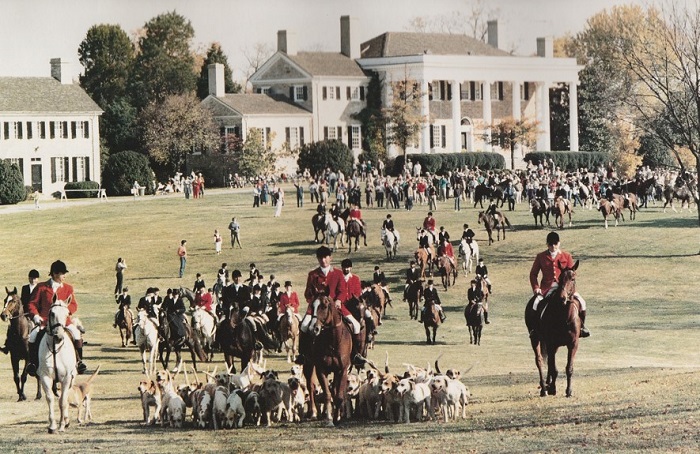
 1987 Blue Ridge Opening Meet at Carter Hall. Master and Staff: (l-r) Robert J. Pillion, honorary whipper-in, Mrs. George P. Greenhalgh, Jr, MFH, Christopher P. Howells, huntsman, and Clifford J. Hunt, honorary whipper-in. Fieldmembers: Mrs. Roy Batterton, Field Master, Mrs. Hobart Bauhan, Dr. Alfred Berz, Mrs, Jean-Claude Buffeault, Miss Leslie Bowery, Mrs. Robert Chandler, Cynthia Coates, Peter Cook, Georgia Crawford, Mr. and Mrs. Walter Donaghy, Mimi Donovan, Mrs. A.R. and Molly Dunning, Gray Farland, Mr. and Mrs. Norman Fine, Caj Haakenssen, Katie Henke, Mrs Clifford Hunt, Herbert Jonkers, Ann-Estelle Jung, Peter Levendis, Dr. and Mrs. Matthew Mackay-Smith, Philip T. McIntyre, Mr. and Mrs. Leander McMillen, Mrs. Walter Nalls, Sara Ohlidal, Allyn Patterson, Mrs. Robert and Sarah Pillion, Dr. and Mrs. Marc Read, Mrs. William Smythe, Mr. and Mrs. John Staelin, Mrs. Harry Stimson, III, Richard Sullivan, and Harold Van der Wilt.
History and tradition are synonymous with the Blue Ridge Hunt (VA). The hunt was established in 1888 and has been an enduring, influential, and visible institution in Clarke Country ever since.
On Saturday, October 30, 2021, the hunt’s Opening Meet will once again, after a hiatus of twenty-six years, take place at Carter Hall. Opening Meets had been held at Carter Hall since the mid-1930s.
“It’s wonderful that…the new owners want the tradition to continue,” said Anne McIntosh, MFH.
Speaking of history and tradition, the county of Clarke begins where the peak of the Blue Ridge Mountains slide downhill northwesterly into the upper Shenandoah Valley. It crosses the Shenandoah River, which twists its way northward along the western edge of the foothills. Clarke County continues northwesterly over the gently rolling verdant valley toward the eastern slopes of the Allegheny Mountain range in nearby West Virginia.
That land which became Clarke County in 1836 is where Thomas, Fifth Lord Fairfax, established his home base, Greenway Court, after moving to Colonial America from England in 1736. He came perhaps somewhat unwillingly to take control of his inheritance…the entire Northern Neck of Virginia…five million acres of land. Needing to survey its furthest reaches, Fairfax engaged the services of sixteen-year-old George Washington to help. Fairfax had sent foxhounds on ahead of his arrival, and he and young Washington hunted the native gray foxes regularly over the same countryside as has the Blue Ridge Hunt for the most recent 130 years.
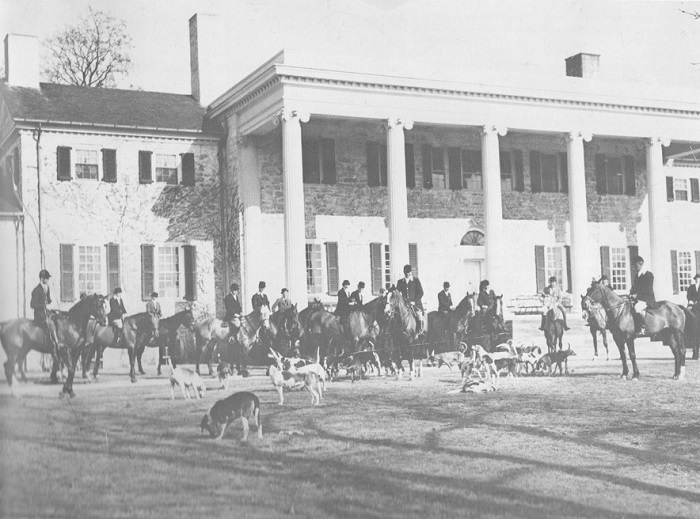 Blue Ridge Opening Meet at Carter Hall circa 1934. (l-r) Ben Randolph, Mary O’Fallon, Marie Pierce, Edward Jenkins, Alexander Mackay-Smith, Ted Jones, Mrs. Percy Randolph, Joseph Lewis, Bill Watkins, Edward B. Jacobs, ex-MFH, Capt. Ewart Johnston, ex-MFH, Kenneth N. Gilpin, ex-MFH, Mrs. Edward B. Jacobs, Graham Dougherty, Virginia Jacobs. / Courtesy of the Clarke County Historical Society
There’s still more history and tradition in this story. Carter Hall, perhaps a half-mile from the village of Millwood, was built by Lt. Colonel Nathaniel Burwell over the period 1792–1800 as the family plantation home. Burwell’s friend and neighbor, General Daniel Morgan, helped Burwell in the construction of Carter Hall. Morgan’s estate, Saratoga―named for the Battle of Saratoga, which he led and where he later accepted British General Burgoyne’s surrender―lies only about a mile distant from Carter Hall.
In addition to the Carter Hall project, Burwell and Morgan also developed the Burwell-Morgan Mill, a commercial enterprise in the center of the village. Today, the mill runs for tourists and visitors, grinding corn on massive old stone grinding wheels driven by the water in the millrace and turned by giant wooden gears, faithfully reproduced.
During the Civil War, Carter Hall served as Stonewall Jackson’s headquarters in the autumn of 1862 and was raided and sacked by Union troops. Carter Hall is listed on the National Register of Historic Places and the Virginia Landmarks Register.
In Burwell’s day, the Carter Hall property embraced five thousand acres. Today, the eighty-seven-acre property has been owned for the past forty years by Project Hope, a non-profit medical and humanitarian organization. During Project Hope’s ownership, Carter Hall’s local relevance, subsumed by matters of worldwide health, had little to do with local Clarke County affairs. About twenty years ago, Project Hope decided not to invite the hunt back for Opening Meet or any other meets.
Project Hope recently decided to consolidate all operations into a single facility and sell Carter Hall. The property was purchased by a limited liability company that plans to transform Carter Hall into a country inn and conference center and re-associate with Clarke County and its historical and natural attractions.
The limited liability company is owned by individuals, the two family names of which, Byrd and Greenhalgh, connect to history, Clarke County, and the Blue Ridge Hunt. Bradshaw Beverly Byrd, son of Senator Harry F. Byrd and descendent of the polar explorer, Admiral Richard Byrd, was Master from 1949 to 1950. Sybilla (Billie Jacobs) Greenhalgh, one of the storied Virginia horsewomen of the twentieth century, was Master from 1965 until her untimely death in 1971. Judith Hornby Greenhalgh, daughter of a British MFH in Ireland, was Master from 1971 to 2002.
In addition to contributing Masters, both families named have populated the Blue Ridge hunting fields for generations.
When asked by a local reporter why the families invited the Blue Ridge Hunt back to Carter Hall for their Opening Meet, spokesman Langdon Greenhalgh replied, “We value and respect the history of Clarke County and the unique role that the Blue Ridge Hunt has in that history.”
Posted October 12, 2021