 Hounds speak confidently in covert; the whipper-in on the far side lifts his cap to the sky; and hounds burst into the open in full cry.
Suddenly all of life is in motion. Your head fills with the sights and sounds of the chase—the cry of hounds, the huntsman’s horn, the thud of hooves, the wind in your ears. Bliss. Then it all goes quiet.
The pack fractures, hounds searching for the lost line. The huntsman gives them a chance to recover it on their own. He doesn’t want the line to go cold, nor does he wants hounds to lift their heads and look to him for help every time they are at fault. Hounds make their own swing. The huntsman weighs all the factors—wind, scenting conditions, time passing, landscape, how the foxes have run here in the past. He decides to make a cast.
Thomas Smith
It has been said of Thomas Smith, “Were I a fox, I would rather have a pack of hounds behind me than Tom Smith with a stick in his hand.”
Extracts from the Diary of a Huntsman by Thomas Smith is one of six classics that A. Henry Higginson lists in his Foxhunting, Theory and Practice as authoritative sources on the hunting of hounds. Lord Willoughby de Broke, in his introduction to a republished edition of Thomas Smith’s book wrote that if an aspiring huntsman were to read only one book, “no mistake would be made in choosing Mr. Smith’s work.”
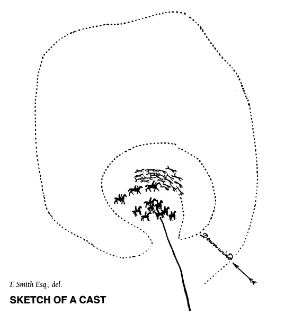
Smith was the first author to explain his cast in diagram form. Higginson wrote, “Many foxes have been killed either by the deliberate or accidental application of Mr. Smith’s patent cast, and many foxes have been lost through disregarding it. Every huntsman should have the idea of it in his mind.” Conceptually fascinating, here is Thomas Smith’s explanation of his famous cast:
“The following is a sketch of a general cast made by the writer for many years. Although the principle of it…is startling, yet few succeed better, namely that of first holding the way he does not think the fox has gone. Thus when at a check and the pack have made their own swing, he then holds them round to the right or left, whichever is most upwind, consequently this side would have been the most unlikely, for they probably would not have checked at first had it been right, owing to its being rather up wind; when, if it does happen to be right, they hit it off directly, so that it takes scarcely a minute to hold them round back, behind the spot where they checked, about a hundred yards or so. He then turns and takes a wider circle back, round in front all the way, to the left the same distance, til he reaches or nearly so, the line he came to behind the check at first. Now having ascertained for certain that his fox is not gone back, or short to the right or left, he can with confidence begin a wider cast than he would have ventured to make otherwise, owing to a fear that the fox had headed back, or to the right or left. The wide cast he commences on the left, progressing according to his judgement, and selecting the best scenting ground forward beyond any fallow or bad scenting ground. As he now knows that the fox must be gone on, this cast is continued all round in front, and to the right, til he again reaches the line behind. He then takes a wider cast either way, and is guided by circumstances; but 19 times out of 20 this last is not required, except the fox is headed some distance back, and the steam and stain of the horses prevents the hounds feeling the scent the first cast back. If there is no wind to guide him, there may be a cover to which the fox is gone, on the left; but still he holds them first the unlikely side.”
Basically, what Smith seems to be saying is to quickly make a short swing back upwind (the most unlikely direction for the fox to go). Then just before crossing the known line, reverse and take hounds in a short circle the other way. Now, just short of the known line, with little time having been wasted due to the short distance traveled, and with fair assurance that the fox has not doubled back, make a big circular cast forward (avoiding any poor scenting patches of ground).
Posted August 13, 2018