Whey: the watery part of milk that is separated from the coagulable part (curd) in the process of making cheese. Whey is rich in lactose, minerals, and vitamins and contains lactalbumin (proteins) and traces of fat. –Merriam-Webster Dictionary
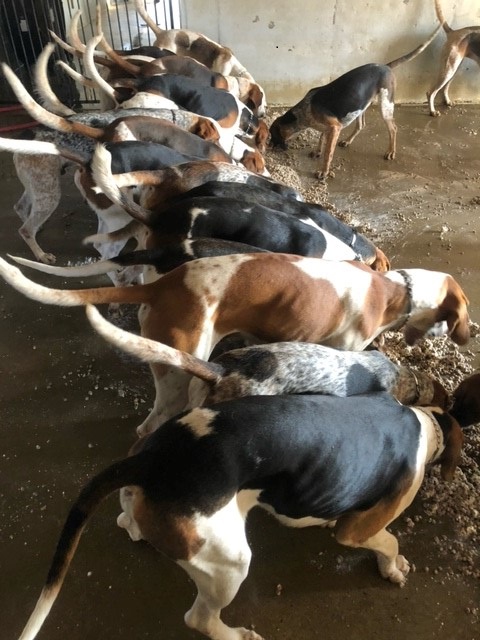 Foxhounds dig in to the palatable and nutritious mixture of kibble and whey. Note the healthy coats. / Graham Buston photo
The whey comes free. All huntsman Graham Buston has to do is drive a few miles from the Blue Ridge Hunt kennels to the cheesemaker’s farm in the village of White Post, Virginia and open the spigot on the fifty-gallon tank he placed there. He goes to collect the whey about once a week and has cut his feed bill in half.
All the cheesemaker has to do from time to time is pour the by-products of her cheese-making process into the tank and forget it. No longer is she concerned with how or where to dispose of it. Not her problem. There are eighty eager foxhounds in kennel waiting for meals they find have improved substantially!
For his part, Buston has discovered that the hounds have blossomed physically as a result of their new diet.
“I see a big difference in the hounds,” he said. “I see it in their coats, the stool is more solid, and they don’t eat as much. I’m anxious to see them when hunting begins!”
Buston has reduced his kibble purchases by half. He has gone from two bags a day to one bag a day, a savings of more than $800 a month.
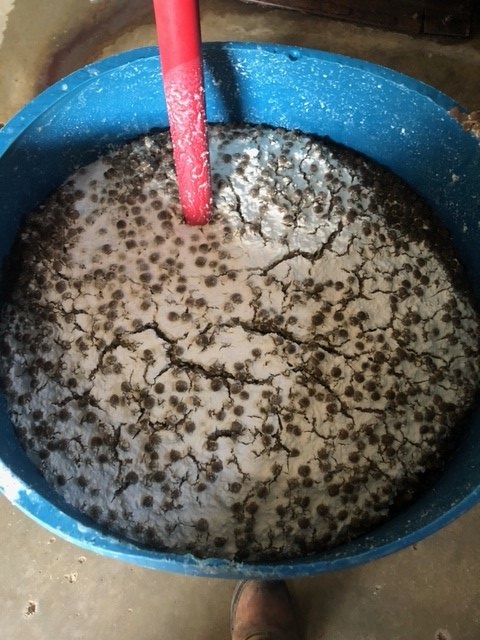 The kibble and whey mixture, ready to serve, after standing overnight in the fridge. / Graham Buston photo
Often, Buston finds that he is picking up whole goat’s milk in equal parts to the whey. The milk is just another leftover from the batch process. He mixes the whey and milk with the kibble and leaves it to stand overnight. Thus, the kibble is moist when fed and more palatable to hounds.
Before spreading this idea around the hunting community, I called a veterinarian who intimately knows foxhounds and serious foxhunting. Dr. Gary Wilkes, MFH of the Belle Meade Hunt (GA), is a small animal vet who has treated hounds at his hunt kennels for years. I asked Wilkes what he thought of this diet for working hounds.
“It’s rich, but if it were too rich, you’d see diarrhea,” he said. “Whey and goat’s milk would certainly make kibble more palatable. It makes a lot of sense to me.”
Buston learned about the cheesemaker’s disposal problem during one of his frequent visits with local farmers in the Blue Ridge hunting country. With small cheesemakers throughout the U.S., it occurred to your editor that other huntsmen and Masters might be equally interested in saving money and improving their hounds’ diet.
Buston feeds flesh to hounds as well and, with the new diet, finds he doesn’t need to feed as much flesh either. Hunts that feed kibble exclusively, as do most, might even reduce their feed purchases by more than fifty percent when supplementing with free dairy by-products from a local cheesemaker’s waste. A win-win-win for the hunt, the hounds, and the farmer.
Posted August 2, 2021