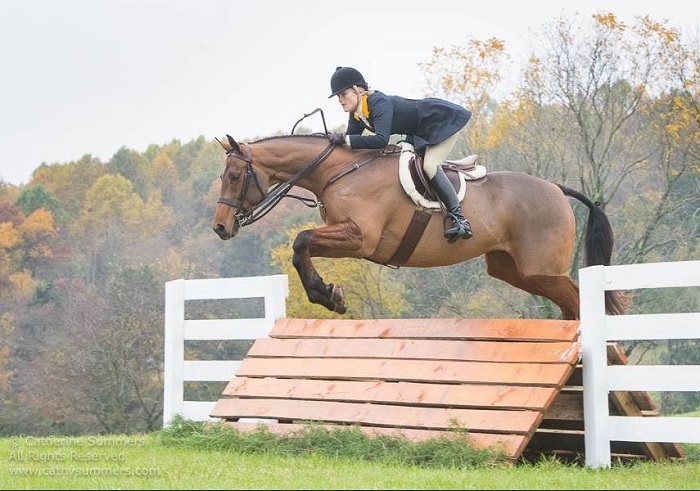
 Moe Baptiste and Fifty Grand representing the Piedmont Fox Hounds negotiate a seven-board coop during the individual test on their way to winning the Virginia Fied Hunter Championship. / Catherine Summers photo
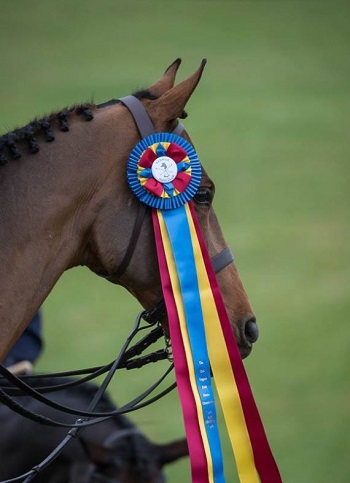
Mo Baptiste’s handsome bay Thoroughbred, Fifty Grand, has played the role of bridesmaid for years. He was Reserve Champion to Virginia Field Hunter Champions in 2012 and again in 2015. This year he was, finally, the bride. And the Champion.
Reserve Champion honors go to Marilyn Ware, Deep Run Hunt. The annual Virginia Field Hunter Championship is noted for the quality of the competing horses. The Masters of every Virginia hunt receive an annual invitation to nominate up to two horse and rider combinations which have been hunting regularly with that hunt. Chosen by the Masters, twenty-one riders from eleven hunts competed. They were:
Heather Heider and Donna Poe, Blue Ridge; Amy Savell and Jaime Temple, Bull Run; Emily Heyworth and Marilyn Ware, Deep Run; Stephanie Geurlain and Mark Thompson, Farmington; Chuck Meehan and Jennifer Nesbitt, Keswick; Larry Campbell and Amy McNeely, Loudoun Fairfax; Amy Brown and Teresa Croce, Middleburg; Sarah Crocker, Old Dominion; Emily Hannum and Sherre Nichole, Orange County; Robyn Harter and Mo Baptiste, Piedmont; Nicollet Merle-Smith, Thornton Hill; and Sophia Vella, Warrenton.
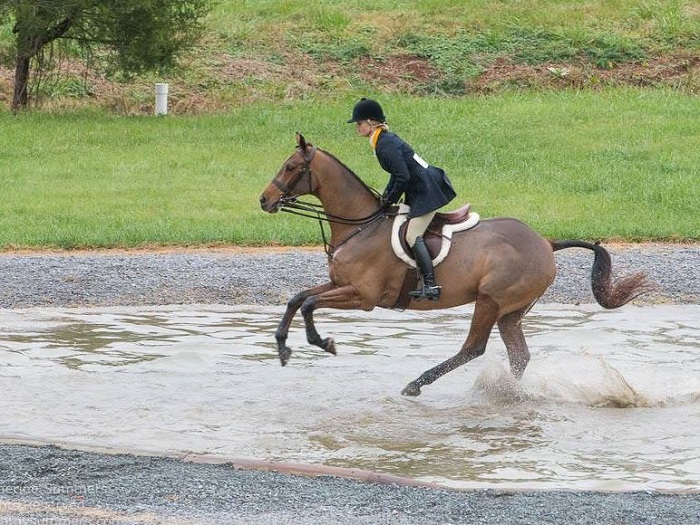 Baptiste and Fifty Grand through the water / Catherine Summers photo
This year’s Champion, Fifty Grand, is a ten-year-old gelding that Baptiste has had in her stable since he was three. The horse was bred by Bill Backer at Smitten Farm in The Plains, Virginia, and goes back in tail male (as well as in the dam’s side of the pedigree) through the Mr. Prospector–Raise a Native–Native Dancer line. A premature foal, he wasn’t expected to survive. He did, however, was placed in training, and even won races. Not a prospect for Stakes races, he wound up in Baptiste’s stable, where she trains field hunters and show horses.
 “I loved him from the start,” Baptiste said. “I hunted him as a three-year-old for the first time at Snickersville, and he’s my favorite field hunter. He’s done everything—the jumpers, evented.”
Fifty Grand is as handsome as they come, and he jumps in classic form (as the photo shows), but it is his mind that makes him special to Baptiste. “He has a confidence about him,” she says. “He’s intuitive, reads the situation, and is trusting…like a dog.”
Judges for this year’s Championship were Ellie Wood Baxter; Jane Bishop; Jeffrey Blue, MFH, Middleburg Hunt; Anne McIntosh, MFH, Blue Ridge Hunt; Ginny Perrin, MFH, Deep Run Hunt; and David Twiggs, Executive Director, MFHA.
The annual 2017 Virginia Field Hunter Championship is hosted traditionally by the hunt club that won the previous year’s competition. This year’s trial was hosted by the Keswick Hunt and held on November 5th at Tivoli Farm, home of 2016 winner Will Coleman. It was the sixty-third annual hunt competition for the title.
This year, each participating Hunt Club’s entry fee included the request for a voluntary $250 donation for each horse and rider combination to be applied to the renovation of the property that the MFHA Foundation has purchased in Middleburg. When refurbished for the purpose, it will become the new national headquarters of the Masters of Foxhounds Association (MFHA), the MFHA Foundation, and the Hunt Staff Benefit Foundation.
History and Conditions
In the early1950s, a group of Virginia foxhunters published a set of conditions. The first event was a huge success and immediately became a fiercely contested annual affair. The event attracted the best hunting horses in Virginia. Billy Greenhalgh, Paul Mellon, Cappy Smith, Alexander Rives, and Alexander Mackay-Smith rode in this event as often as they could from the 1950s through the 1970s. The current trophy presented to the winner each year is the Billy Greenhalgh Trophy, donated by her friends. Greenhalgh was MFH of the Blue Ridge Hunt from 1965–1071, a longtime Field Master, and a renowned horsewoman and show rider in Virginia.
What follows are the original conditions from 1954 suggested by Alexander Rives for the first Virginia Field Hunter Trials:
A. Entries will be received only from Hunts which are recognized by or registered
with the Masters of Foxhounds Association of America.
B. Masters of each Hunt may nominate two horses and riders.
C. Horses must be the property of a member or subscriber of the Hunt which they
represent or a member of his or her family.
D. Horses must have been hunted regularly during th e current season with the
Hunt which they represent. For the guidance of Masters, a horse which has
completed 20% of the hunts held during the regular season is considered to
have been regularly and fairly hunted.
E. Riders must be members of or subscribers to the Hunt which they represent.
F. Full hunting attire is required.
G. The actual course will not be designed in advance but will consist of conditions
and obstacles normally encountered in a regular day’s hunting. Horses are to
be ridden as a field under a Field Master. They may also be required to perform
individually. Distance will not exceed three miles.
H. Entries will be judged as independent working hunters on performance,
manners and way of going only. Hunting soundness required. Preference
will be given to horses in hard hunting condition.
I. The two top hunters, as selected by the judges, to be named Champion and
Reserve Champion Field Hunters of Virginia and to receive appropriate ribbons
and plate.
J. The Hunt represented by the winner of the Championship shall act as Host
to the event for the following year. If however a Hunt should win the
Championship for two years in succession the Host for the following year
will be the next highest place hunt.
K. Normally the rider and horse winning the Championship will lead the event
as Field Master the following year. If they are unavailable, however, the Master
of the Host Hunt shall appoint a Field Master.
L. The horse winning the Championship may not compete the following year, but
may compete subsequently.
M. The Committee in charge of the event each year shall consist of the Master of
the Host Hunt, the rider of the Host Hunt’s representative the previous
year and the Master of the Host Hunt the previous year.
N. No entry fees.
Posted December 7, 2017